

AMMAN — As population and service pressures increase on Jordan’s major cities, the government has announced the “Umrah City” project as a long-term urban model, part of an official direction to create planned cities from scratch.
The project, whose implementation will span decades, is presented as a strategic solution for managing population and economic growth. However, it simultaneously opens a public debate on the feasibility of new cities, development priorities, and the state’s ability to execute major projects amidst chronic economic challenges.
Here are the key questions and information regarding this new city:
The New Umrah City
It is a government project to create a pre-planned modern city, aiming to provide an integrated environment for living, working, investment, and services.
The government states that the project represents a shift in urban planning methodology, moving from the random expansion of existing cities to cities built according to a comprehensive vision from the outset.
Why is Jordan moving towards creating new cities?
According to official statements, the move towards new cities responds to several key requirements:
- Continuous increase in population density, especially in Amman and Zarqa.
- Growing pressure on infrastructure and public services.
- Limited capacity for expansion within existing cities.
The government sees new cities as an opportunity to redistribute population and investments. Conversely, skeptics argue that the core of the crisis lies not only in the absence of new cities but in challenges of urban management, public transportation, and developmental disparities between governorates.
Location of the New City
The city is located in a strategic area in the eastern region between the capital Amman and the city of Zarqa, on state-owned land, and near major road axes, making it close to existing population and economic centers.
Why is the city named Umrah?
The name “Umrah” was chosen for the new city because it is located near the historic “Qasr Amra” (Amra Palace); one of the heritage landmarks in the region.
The name reflects the geographical and historical connection to the place and helps preserve the cultural and historical dimension of the area, according to those overseeing the city’s urban plan.
Government Objectives for Creating the City
The project aims – according to official statements – to:
- Manage the increasing population growth in Amman and Zarqa.
- Alleviate congestion and pressure on infrastructure in current cities.
- Create new investment and economic opportunities, and encourage public-private partnerships.
- Present a modern, environmentally sustainable urban model with integrated facilities and services.
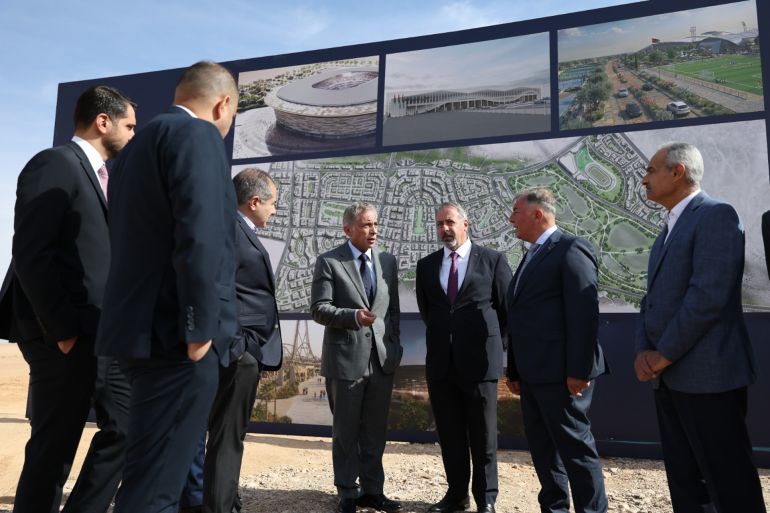
Jordanian Prime Minister Jaafar Hassan (center) at the Umrah city site.
Implementation Phases of the Plan
The city will be built in phases spanning approximately 25 years. The first phase will begin in an area of about 40,000 dunams out of roughly 500,000 dunams owned by the state. This phase includes service, sports, cultural, and commercial projects expected to be completed between 2027 and 2029.
The Entity Implementing the Project
The project will be implemented – according to the government – through a state-owned development company, relying on partnerships with the private sector, in a financing model aimed at reducing the direct burden on the public treasury.
Supporters believe this model may increase efficiency and attract quality investments, while others emphasize the necessity of transparency and governance in managing partnerships to avoid burdening the state with future financial risks.
Basic Components and Patterns of the City
Initial plans indicate the city will include:
- Residential neighborhoods with multiple patterns.
- Commercial, industrial, and investment zones.
- Educational and health facilities.
- Modern infrastructure considering sustainability.</li
Jordan
Jordan is a Middle Eastern country with a rich historical tapestry, home to the ancient city of Petra, a Nabatean capital carved into rose-red sandstone cliffs over 2,000 years ago. Its landscape also features significant biblical sites and the vast desert of Wadi Rum, with the nation’s modern history shaped by its role in the Arab world and the Hashemite monarchy established after World War I.Amman
Amman is the capital and largest city of Jordan, originally built on seven hills. Its history dates back to antiquity, when it was known as Philadelphia during the Greco-Roman period, and it contains ancient ruins such as the Roman Theatre and the Citadel. Today, it is a modern, bustling metropolis that serves as the country’s economic and political center.Zarqa
Zarqa is a major city in Jordan, located northeast of Amman, and is known as the country’s industrial center. It was historically a small settlement that expanded rapidly in the 20th century, particularly after the establishment of a military base and the influx of refugees following the 1948 Arab-Israeli war.Umrah City
Umrah City, also known as Mecca, is the holiest city in Islam and the birthplace of the Prophet Muhammad. It is the site of the Masjid al-Haram, which houses the Kaaba, and has been a central pilgrimage destination since the 7th century when Islam was established.Qasr Amra
Qasr Amra is an 8th-century desert castle in eastern Jordan, built during the Umayyad Caliphate as a royal retreat and bathhouse. It is a UNESCO World Heritage Site renowned for its well-preserved frescoes depicting secular scenes, including hunting, dancing, and astronomy, which provide a rare glimpse into early Islamic art and culture.Amra Palace
Amra Palace, also known as Qasr Amra, is an early 8th-century desert castle in eastern Jordan, built during the reign of the Umayyad caliph Walid I. It is a UNESCO World Heritage Site renowned for its well-preserved and vibrant frescoes depicting secular themes, including hunting scenes, musicians, and mythological figures. The site originally functioned as both a royal retreat and a bathhouse.
























































































































































































































































































































































































































































































































































































































































































































































