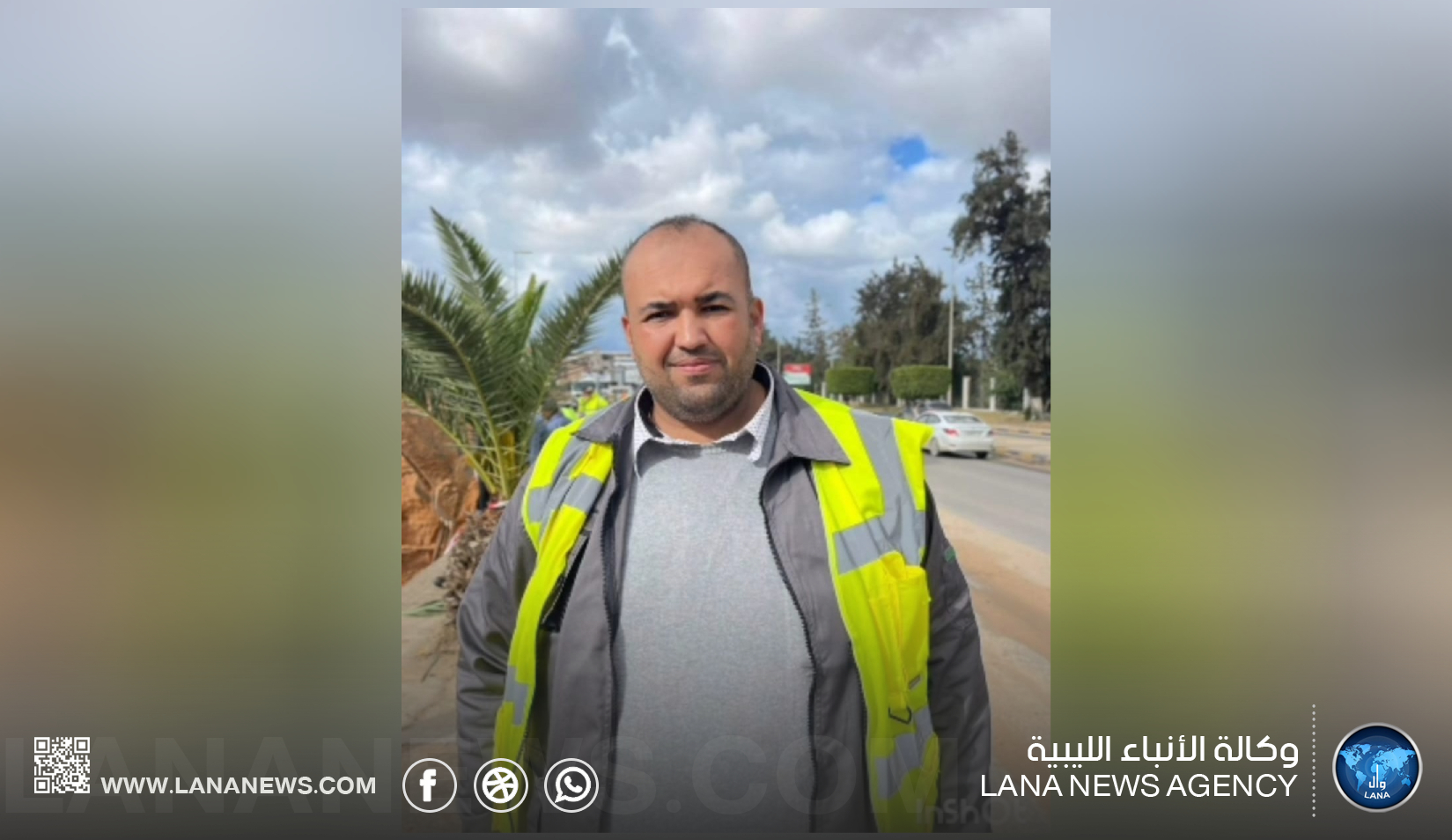
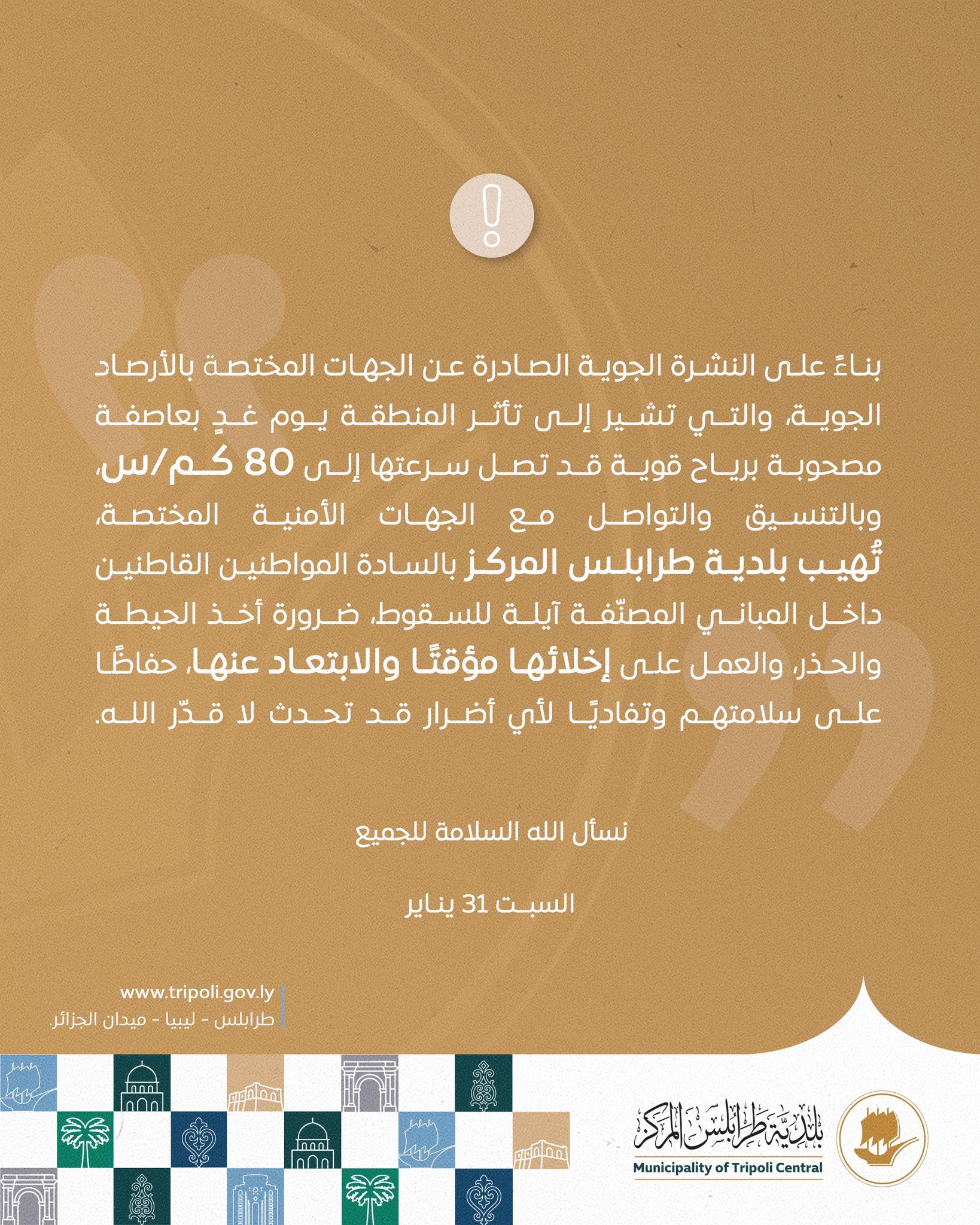
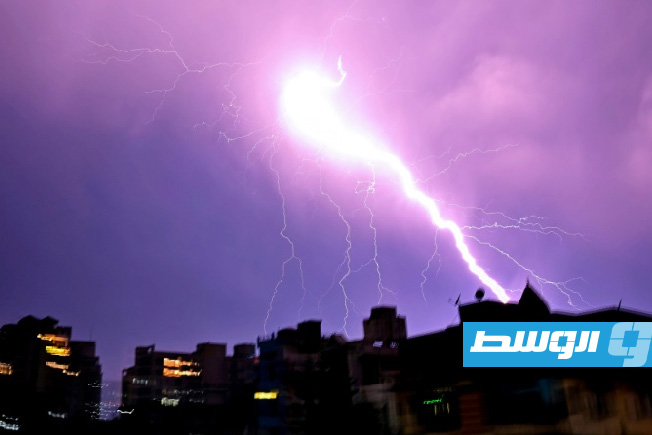
Tripoli, January 27, 2026 – The official spokesperson for the General Company for Water and Sewage confirmed that the company has raised its state of readiness to the highest level and deployed its technical teams to various regions across Libya in anticipation of recent weather fluctuations and potential water accumulations or pressure on the networks.
He explained in statements that field interventions resulted in clearing blockages within the city of Al Bayda by teams from the Al Bayda Services Office, affiliated with the Al Jabal Al Akhdar Operation and Maintenance Department. He noted that the situation in the cities of Al Marj and Al Abyar is stable, despite light rainfall that did not cause any significant issues.
He clarified that the capacity of sewage networks to handle water is directly linked to the amount of rainfall, pointing out that the overall situation is good and stable, despite variations in infrastructure readiness and operational capacity between regions.
He mentioned that any malfunction or emergency reported is addressed immediately and dealt with urgently. He explained that the technical situation so far is not a cause for concern, and that the state of emergency declared by the company involved distributing technical teams nationwide, with rapid interventions continuing as soon as reports are received. He cited the resolution of some blockages witnessed in Tripoli in recent days as an example.
He indicated ongoing coordination with service and security authorities, including security operations rooms, the capital’s call center (1415), and the ambulance and emergency service. He noted that the company’s main operations room operates around the clock to monitor all reports and field developments.
Regarding water quality, he explained that the company continues to conduct periodic analyses of water wells and pumping stations through the utility offices affiliated with regional administrations, in addition to the role of mobile laboratories in testing water and addressing any pollution indicators, especially in cases of random well drilling without official coordination.
He concluded by emphasizing that the company possesses advanced technical capabilities to address issues and implement network cleaning and unclogging campaigns. He noted that some older networks have limited capacity, requiring phased solutions and rapid interventions during periods of heavy rainfall.
Tripoli
Tripoli is the capital and largest city of Libya, with a history dating back to the 7th century BC when it was founded by the Phoenicians. It later became a significant part of the Roman Empire and the Ottoman Empire, which left a lasting architectural and cultural influence on its old city, the Medina. Today, it serves as the country’s major political, economic, and cultural center.
Libya
Libya is a North African country with a rich history that includes ancient Phoenician and Greek settlements, most notably at Cyrene, and later Roman rule. It was part of the Ottoman Empire before Italian colonization in the early 20th century, gaining independence as a kingdom in 1951 and later becoming a republic under Muammar Gaddafi from 1969 until the 2011 revolution. The country is home to five UNESCO World Heritage Sites, including the extensive Roman ruins of Leptis Magna.
Al Bayda
Al Bayda is a city in northeastern Libya, historically known as a center for the Senussi religious order and later as the site where King Idris I declared the country’s independence in 1951. It briefly served as the capital of the Kingdom of Libya from 1963 until the 1969 coup d’état.
Al Bayda Services Office
The Al Bayda Services Office is a government administrative center located in the city of Al Bayda, Libya. It was established to provide various public services and bureaucratic functions to residents of the region, reflecting the modern administrative structure of the country following its independence.
Al Jabal Al Akhdar Operation and Maintenance Department
The Al Jabal Al Akhdar Operation and Maintenance Department is a key administrative unit responsible for the upkeep and management of infrastructure and services in the Al Jabal Al Akhdar region. Its history is tied to the broader development of the area, which has seen significant modernization and investment in public works and facilities in recent decades.
Al Marj
Al Marj is a city in northeastern Libya, historically significant as the site of the ancient Greek colony of Barca, founded around 560 BCE. It later became an important Roman and Byzantine center before its modern development, and it remains a key agricultural hub in the region.
Al Abyar
Al Abyar is a town located in the Al Jabal al Akhdar district of northeastern Libya. Historically, it has been an important agricultural center and was notably the birthplace of Idris of Libya, the country’s first and only king, who ruled from 1951 until he was overthrown in 1969.