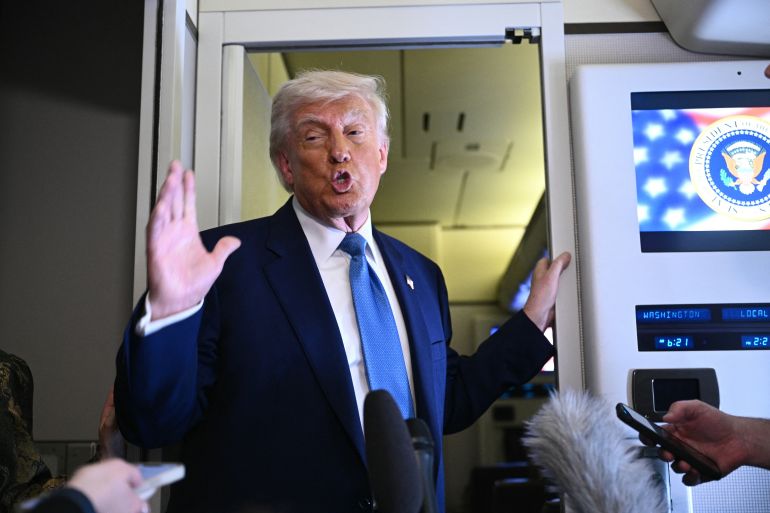
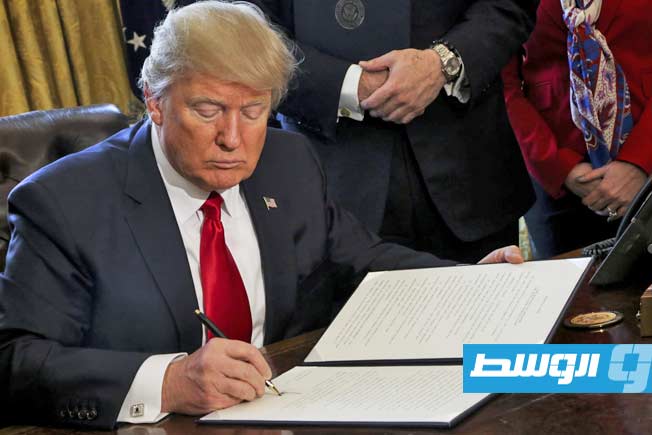
The US President stated that a massive fleet is heading towards the region “should the need arise,” and that he is closely monitoring the situation. He reminded that he had previously threatened to deliver a powerful strike if Iran carried out executions.
He added from aboard the presidential aircraft late Thursday evening that “Iran should have made a deal before being struck last year,” and emphasized that he would impose a 25% tariff on any party dealing with Iran, and that these measures would take effect very soon.
Mutual Threatening Rhetoric
Trump’s statements come after warnings issued by the commander of Iran’s Revolutionary Guard on Thursday to Washington, stating that “Tehran has its finger on the trigger.” This followed popular protests that erupted in late December last year and lasted for two weeks.
He added that they are “more prepared than ever and ready to execute the orders and measures issued by the Supreme Leader.”
The Iranian military official also warned Israel and the United States against the consequences of “miscalculations,” urging them to “learn from the lessons of history and what was learned during the past war that was imposed on us, to avoid a more painful fate.”
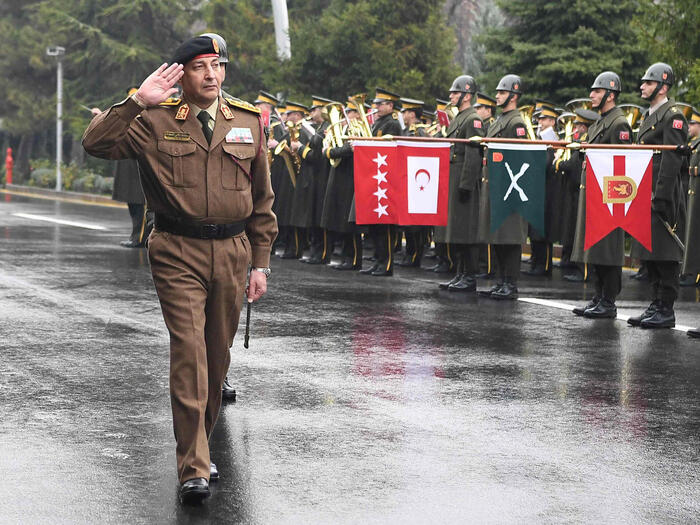
For his part, the Brigadier General, commander of the “Khatam al-Anbiya” headquarters, which represents Iran’s central operations room, warned that in the event of an American attack, “all American interests, bases, and centers of influence will be legitimate targets for the Iranian armed forces.”
Meanwhile, the Iranian President accused – in a speech on Thursday – the United States and Israel of fueling the protests, which he described as “cowardly revenge… for the defeat in the twelve-day war.”
Although the likelihood of an immediate US military move against Tehran diminished last week, following the cessation of the two-week-long protests, the option of new military action remains open, despite both sides speaking of giving diplomacy a chance.
Air Force One
Air Force One is the official air traffic control call sign for any United States Air Force aircraft carrying the President of the United States. The most recognizable planes are two highly customized Boeing 747-200B series aircraft, which entered service in 1990 and are equipped with advanced secure communications and defensive systems.
Abu Dhabi
Abu Dhabi is the capital and second-most populous city of the United Arab Emirates, historically centered around a freshwater well and a fort established in the 18th century. Its modern development and wealth are primarily derived from the discovery of oil in the late 20th century, transforming it into a global metropolis known for its striking architecture and cultural landmarks like the Sheikh Zayed Grand Mosque.
Middle East
The Middle East is a transcontinental region centered on Western Asia and Egypt, historically home to some of the world’s earliest civilizations, including Mesopotamia and Ancient Egypt. It is the birthplace of major Abrahamic religions—Judaism, Christianity, and Islam—and has been a central crossroads of trade, culture, and empires for millennia. Its modern history has been heavily shaped by the Ottoman Empire, European colonialism, the discovery of vast oil reserves, and ongoing geopolitical conflicts.
Iran
Iran, historically known as Persia, is home to one of the world’s oldest continuous civilizations, with a rich cultural history spanning thousands of years. It features numerous UNESCO World Heritage sites, including the ancient ruins of Persepolis, which was the ceremonial capital of the Achaemenid Empire founded in the 6th century BCE. The country’s culture is deeply influenced by its pre-Islamic Zoroastrian heritage and its later role as a center of Islamic art, architecture, and scholarship.
Tehran
Tehran is the capital and largest city of Iran, officially becoming the capital in 1786 under the Qajar dynasty. It serves as the country’s political, economic, and cultural center, home to significant historical sites like the Golestan Palace, a UNESCO World Heritage site from the 19th century.
Israel
Israel is a country in the Middle East, established as a modern state in 1948 following a United Nations partition plan. It is a historic homeland of the Jewish people, containing significant religious sites for Judaism, Christianity, and Islam, such as Jerusalem’s Western Wall and the Dome of the Rock.
United States
The United States is a federal republic founded in 1776 after declaring independence from Great Britain, with its modern government established by the Constitution in 1789. Its history encompasses westward expansion, the Civil War, industrialization, and its emergence as a global superpower in the 20th century. The nation is defined by its diverse population, democratic ideals, and significant cultural and economic influence worldwide.
Khatam al-Anbiya
Khatam al-Anbiya is a major Shia shrine in Tehran, Iran, believed to be the burial place of Imamzadeh Sayyid Ismail, a descendant of the Shia Imam Musa al-Kadhim. The site’s history dates back to the Safavid era, with significant construction and embellishment occurring during the Qajar period in the 19th century. It is renowned for its intricate mirror work and tile decorations, making it an important architectural and religious landmark.
Revolutionary Guard
The Islamic Revolutionary Guard Corps (IRGC) is a branch of Iran’s military, founded in 1979 following the Iranian Revolution to protect the country’s Islamic system. It has since grown into a major military, political, and economic force, with significant influence both within Iran and across the region.