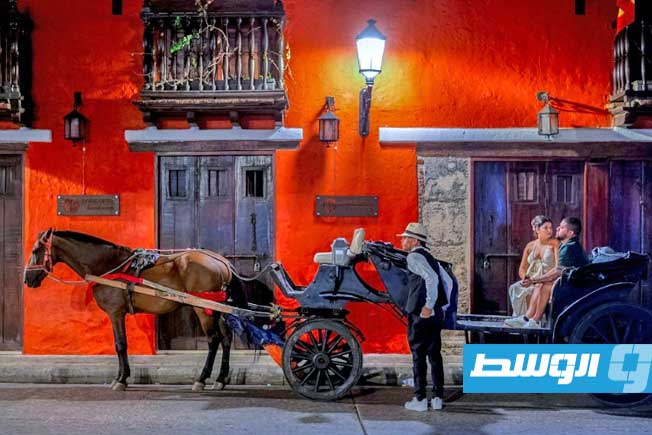
The mayor of Cartagena has announced a ban on the use of horse-drawn carriages in the Colombian tourist city, effective December 29, stating an intention to replace them with electric vehicles.
This city is famous for its fortified historic center and its architectural landmarks dating back to the colonial era. For decades, it has been associated with horse-drawn carriages transporting tourists along its cobblestone streets.
Commercial Exploitation of Animals
Animal welfare activists have condemned this practice, describing it as commercial exploitation that causes injuries, stress, and exhaustion for the animals.
The mayor stated on Friday, “We will not tolerate, under any circumstances, any form of animal abuse.”
A decree has been issued prohibiting the operation of horse-drawn carriages in the city center, which is home to about one million people and was visited by over five million tourists in 2025.
The approximately sixty traditional carriages will be replaced by a similar number of electric vehicles with a similar design.
Cartagena
Cartagena is a historic port city on Colombia’s Caribbean coast, founded in 1533 by Spanish conquistadors. It became a major hub for trade and colonial administration, renowned for its well-preserved Old Town surrounded by extensive stone fortifications built to defend against pirate attacks. Today, it is a UNESCO World Heritage Site celebrated for its colorful colonial architecture and vibrant culture.
Colombia
Colombia is a South American country with a rich pre-Columbian history, including civilizations like the Muisca and Tairona. It became a major center of Spanish colonial rule after the 16th century, gaining its independence in 1819. The nation is renowned for its diverse cultural heritage, which blends Indigenous, European, and African influences, and for its varied geography encompassing Andes mountains, Amazon rainforest, and Caribbean coastline.
Britain
Britain is a sovereign island nation in northwestern Europe with a long and influential history, including the Roman occupation, the formation of the United Kingdom, and the expansive British Empire. Its rich cultural heritage is reflected in institutions like the monarchy, Westminster Abbey, and Stonehenge, alongside its global impact on language, law, and parliamentary democracy.
Petra
Petra is an ancient archaeological city in southern Jordan, carved directly into vibrant red sandstone cliffs. It was established as the capital of the Nabataean Kingdom around the 4th century BCE and flourished as a major trading hub. The site is famously entered through the Siq, a narrow gorge leading to iconic structures like Al-Khazneh (The Treasury).