

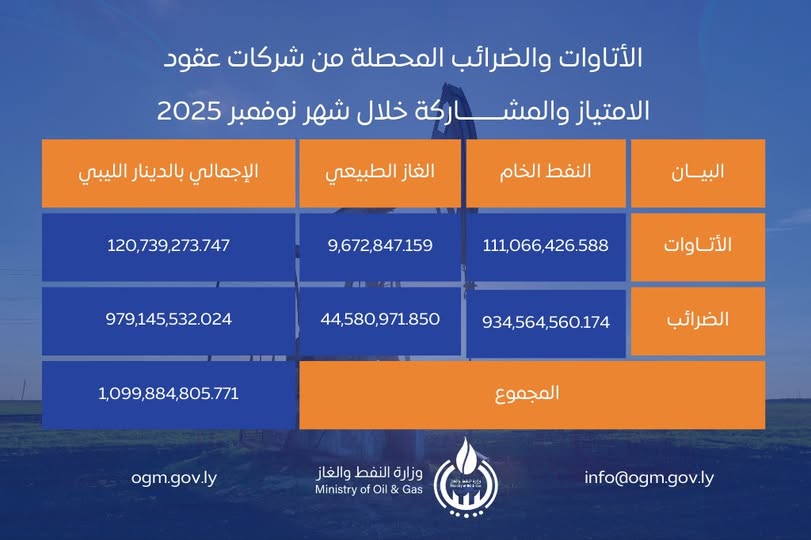
Tripoli, December 16, 2025 – The Ministry of Oil and Gas of the Government of National Unity revealed that the total royalties and taxes collected from concession and production-sharing agreement companies for crude oil and natural gas during last November reached 1 billion and 99 million dinars.
According to the table published by the ministry on Tuesday, royalties collected from crude oil amounted to 111 million and 66 thousand dinars, and from natural gas, 9 million and 672 thousand dinars, bringing the total to 120 million and 739 thousand dinars.
As for taxes collected, they amounted to 934 million and 564 thousand dinars from crude oil, and 44 million and 580 thousand dinars from natural gas, for a total of 979 million and 145 thousand dinars.
Tripoli
Here are a few key points about Tripoli, Libya:
– **Population**: Over 1 million people.
– **Language**: Arabic is the official language.
– **History**: Founded in the 7th century BCE, it has been influenced by Phoenician, Roman, Arab, Ottoman, and Italian rule.
– **Economy**: Major commercial and financial center in Libya.
– **Landmarks**: Includes the Red Castle (Assaraya al-Hamra), Arch of Marcus Aurelius, and the old medina.
There are also other places named Tripoli:
1. **Tripoli, Lebanon** – a major city in northern Lebanon.
2. **Tripoli, Greece** – the capital of Arcadia in the Peloponnese.
If you were referring to something else, please provide more context!
Ministry of Oil and Gas
### **Core Function**
A Ministry of Oil and Gas is a government department responsible for overseeing and regulating a nation’s petroleum (oil and natural gas) sector. Its primary role is to manage this critical natural resource in a way that maximizes economic benefits for the country, ensures energy security, and often aligns with broader national development plans.
### **Key Responsibilities**
The specific duties can vary by country but generally include:
1. **Policy Formulation & Regulation:** Creating the legal and regulatory framework for all upstream (exploration and production), midstream (transportation), and downstream (refining and distribution) activities.
2. **Licensing & Contracts:** Awarding exploration and production licenses to national and international oil companies (IOCs) through bidding rounds. Negotiating and managing complex contracts (like Production Sharing Agreements or PSAs).
3. **Resource Management & Data:** Monitoring the nation’s hydrocarbon reserves, estimating potential resources, and maintaining geological and production data.
4. **Oversight of National Oil Companies (NOCs):** In many resource-rich countries, the ministry sets the strategic direction for and oversees the state-owned national oil company (e.g., Saudi Aramco reports to the Saudi Ministry of Energy, PDVSA was overseen by Venezuela’s Ministry of Petroleum).
5. **Revenue Management & Monitoring:** Ensuring the state receives its fair share of revenues (royalties, taxes, profit oil) from production. This often involves close work with the Ministry of Finance.
6. **Promoting Investment:** Attracting foreign direct investment (FDI) and technology into the sector by promoting opportunities and maintaining a stable regulatory environment.
7. **Environmental & Safety Standards:** Setting and enforcing health, safety, and environmental (HSE) regulations for the industry.
8. **International Relations & OPEC Coordination:** Representing the country in international energy forums and, for member states, coordinating production policies with organizations like OPEC (Organization of the Petroleum Exporting Countries).
### **Examples by Country**
The structure and name of this ministry differ based on a country’s administrative system and energy focus.
* **Saudi Arabia:** **Ministry of Energy** (historically and still commonly associated with oil and gas, though its mandate has expanded to include broader energy mix).
* **United Arab Emirates:** **Ministry of Energy and Infrastructure**.
* **Nigeria:** **Ministry of Petroleum Resources**.
* **Norway:** **Ministry of Petroleum and Energy** (a notable example of a major producer with a strong focus on sovereign wealth management and energy transition).
* **Azerbaijan:** **Ministry of Energy**.
* **Iraq:** **Ministry of Oil**.
* **Russia:** **Ministry of Energy** (oversees oil, gas, coal, and power).
* **India:** **Ministry of Petroleum and Natural Gas**.
### **Evolution and Current Trends**
In recent years, the scope of many such ministries has evolved due to the global energy transition:
* **Broader Energy Mandate:** Many are being renamed or restructured to become “Ministries of Energy,” incorporating renewables, electricity, and sometimes even mining under one umbrella (e.g., Canada’s **Natural Resources Canada**).
* **Focus on Energy Transition:** Their role is expanding to include policies for reducing flaring, carbon capture, utilization and storage (CCUS), and integrating hydrogen production.
* **Economic Diversification:** In hydrocarbon-dependent economies, the ministry is often central to plans for using oil and gas revenues to fund diversification into other sectors.
### **In Summary:**
A **Ministry of Oil and Gas** is the central governmental authority that stewards a nation’s petroleum resources, balancing the goals of **economic maximization, resource sovereignty, and strategic development.** Its influence is immense in countries where oil and gas form the backbone of the economy.
Government of National Unity
### Key Characteristics of a GNU:
1. **Broad Coalition:** It goes beyond a simple majority or a two-party coalition. It aims to include all major parties, even those that are traditionally opposed.
2. **Crisis or Transition Context:** GNUs are often formed:
* After a civil war or conflict (e.g., South Africa post-apartheid).
* During a severe economic or national emergency.
* Following an inconclusive election with no clear winner.
* To oversee a major constitutional transition.
3. **Power-Sharing:** Key ministerial portfolios are divided among the participating parties, often based on a negotiated formula.
4. **Goal of Unity and Stability:** The primary objective is to unite the country, legitimize the government in the eyes of all factions, and prevent further conflict or paralysis.
### Famous Historical Examples:
* **South Africa (1994):** After the end of apartheid, Nelson Mandela’s African National Congress (ANC) formed a GNU with the National Party (the former ruling party) and the Inkatha Freedom Party. This was crucial for a peaceful transition.
* **Kenya (2008):** Following a violently disputed election, rivals Mwai Kibaki and Raila Odinga formed a GNU to stop the bloodshed and share power.
* **Lebanon:** Its political system often requires a “national unity” cabinet that includes representatives from all major religious and political groups.
* **United Kingdom (1940):** Winston Churchill formed a war-time coalition government during World War II, bringing together Conservatives, Labour, and Liberals.
### Potential Advantages:
* **Reduces Conflict:** Can dampen political or sectarian violence by giving all groups a stake.
* **Enhances Legitimacy:** Decisions have broader support, making them more acceptable to the populace.
* **Pools Expertise:** Draws talent from across the political spectrum.
### Potential Disadvantages:
* **Unwieldy and Slow:** Decision-making can be bogged down by the need for consensus among rivals.
* **Blurred Accountability:** Voters may find it hard to reward or punish specific parties in subsequent elections.
* **Can Entrench Divisions:** If power-sharing is strictly based on identity (e.g., ethnicity, religion), it may reinforce those divisions rather than transcend them.
### Current Context (2024):
The term is particularly relevant today in discussions about:
* **South Africa:** Following the 2024 general election where the ANC lost its majority, there is active talk and negotiation about forming a new GNU or a more conventional coalition to govern.
* **Conflict Zones:** It is often proposed as a solution in countries like Sudan or Yemen as a path out of civil war.
In essence, a **Government of National Unity** is a political tool for extraordinary times, sacrificing partisan clarity for the greater goals of national cohesion and survival. Its success depends heavily on the willingness of former adversaries to cooperate in good faith.
























































































































































































































































































































































































































































































































































































































































































































































