The North Magnetic Pole is no longer in the location maps have shown for decades. According to the latest international geophysical models, the pole has continued its accelerated drift towards Siberia, and in 2025 officially entered a geographical range never before recorded. This is an invisible shift but one with profound effects on a world reliant on precision.
This change, confirmed by the new version of the World Magnetic Model (WMM2025), does not signify a reversal of the Earth’s poles, but it necessitates immediate recalibration of aviation, maritime navigation, and satellite systems, as well as precise defense and technological infrastructure.
A Silent Drift at an Unprecedented Speed
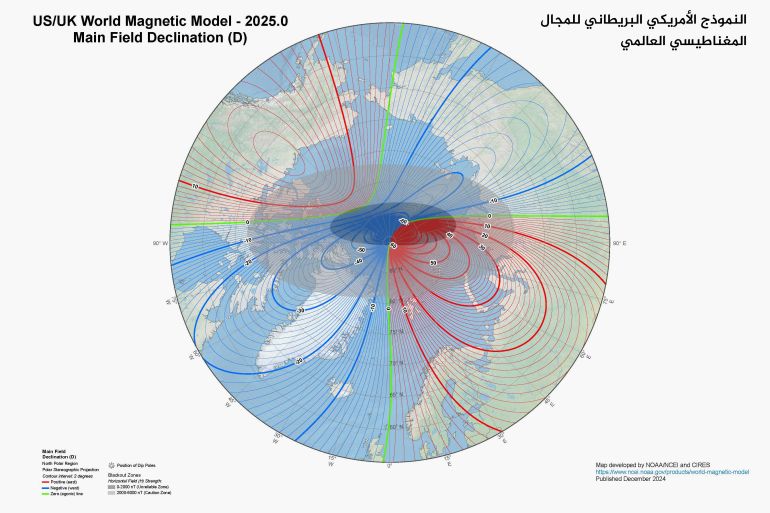
Data indicates that the North Magnetic Pole is now closer to Russia than to Canada, having traveled more than 2,200 kilometers since regular measurements began in the 19th century.
Between 1990 and 2020, its drift speed peaked at about 60 kilometers per year, before slowing to its current rate of about 35 kilometers per year—a speed still significantly higher than historical averages.
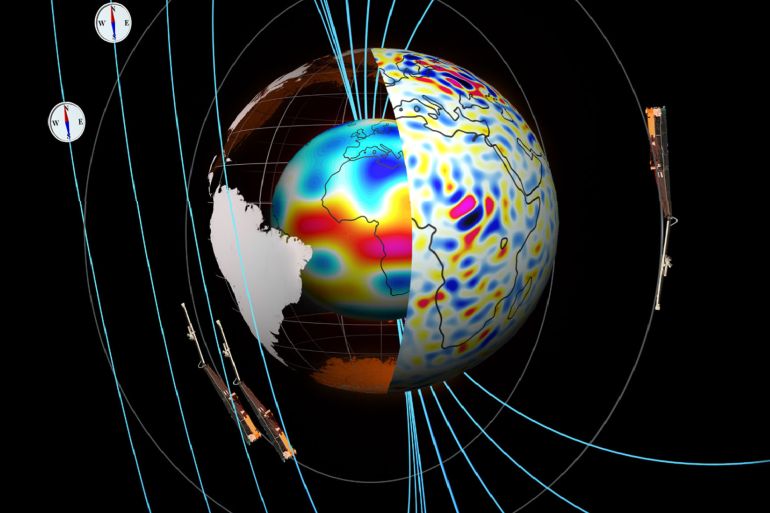
This drift is caused by deep changes in the flow of liquid iron within the Earth’s outer core, at a depth of approximately 2,900 kilometers from the surface. This is where the Earth’s magnetic field is generated, known as the “geodynamo,” where massive masses of molten iron and nickel move due to heat and the Earth’s rotation.
These movements generate enormous electric currents, which in turn create the magnetic field that protects the Earth and guides compasses.
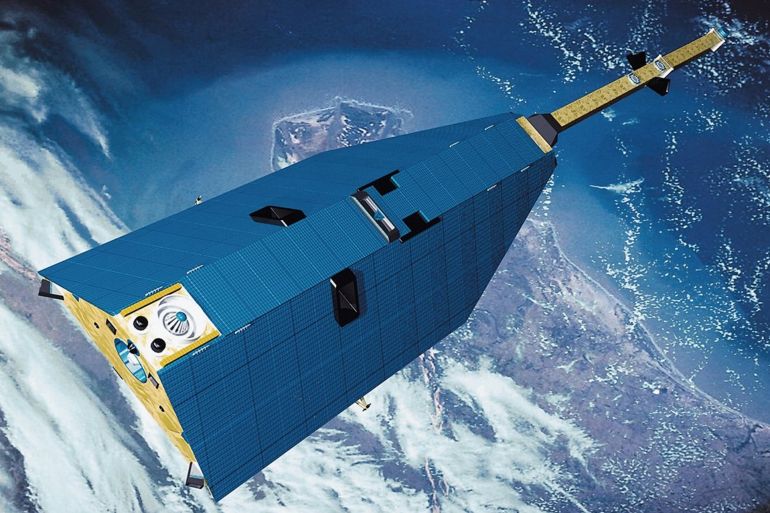
A model of the CHAMP satellite, whose boom carries Earth’s magnetic field sensors.
How Do Scientists Know? And Why Does It Matter?
Scientists rely on data from specialized satellites like Swarm and CHAMP, which measure the intensity and direction of the magnetic field with high precision. This data is then integrated into advanced mathematical models updated every five years. The unexpected acceleration in the pole’s movement necessitated an emergency, out-of-schedule correction in 2019, a precedent reflecting the sensitivity of modern systems to any magnetic deviation.
The direct practical impact shows that the angle of declination between “true geographic north” and “magnetic north” changes over time. In some areas of Alaska, the change exceeded 10 degrees in just two decades, which could cause serious navigation errors if systems are not constantly updated. Furthermore, areas of “magnetic blindness” near the poles are expanding, where compasses become useless.
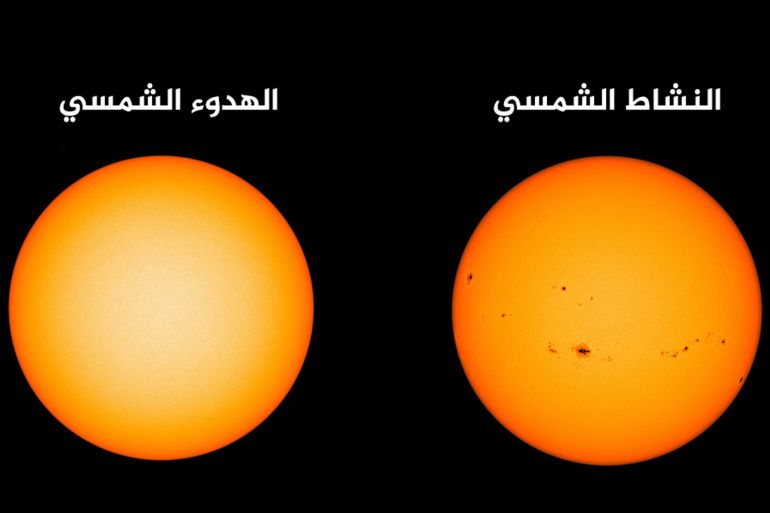
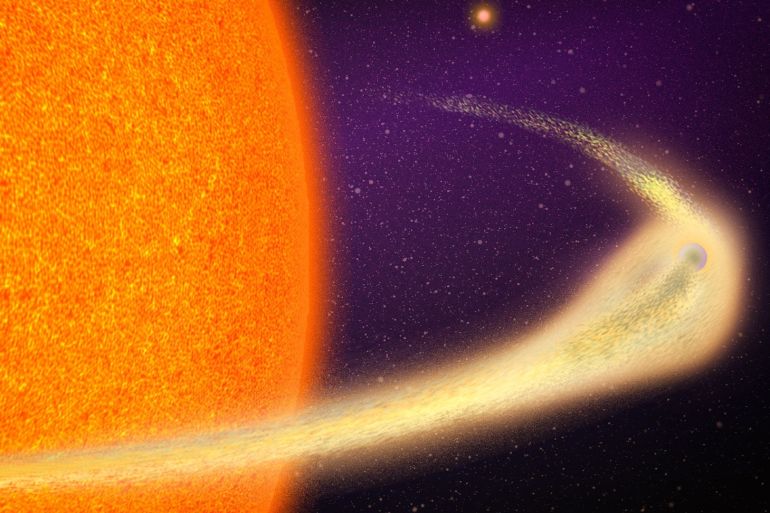
Activity and calm are part of the Sun’s 11-year solar activity cycle where sunspots appear or disappear.
Is Solar Cycle 25 Related to This?
The Sun goes through an 11-year solar activity cycle where sunspots appear and disappear, and the direction of the Sun’s magnetic field reverses. Although this news coincides with a relatively unexpected peak in Solar Cycle 25, scientists confirm that the magnetic pole drift is not caused by solar activity. The Sun primarily affects space weather and temporary magnetic storms, while the pole’s movement results from deep internal processes within the Earth’s core.
However, strong solar activity can temporarily complicate the situation by interfering with signals and
Earth
Earth is the third planet from the Sun and the only known astronomical object to harbor life. Its geological history spans over 4.5 billion years, with the development of complex life forms occurring over hundreds of millions of years. As humanity’s sole home, it encompasses all of human culture, history, and civilization.
North Magnetic Pole
The North Magnetic Pole is the point on Earth’s surface where the planet’s magnetic field points vertically downward, historically used for navigation. Unlike the fixed geographic North Pole, it shifts continuously due to fluid motions in Earth’s outer core; it has moved hundreds of miles from the Canadian Arctic toward Siberia over the past century.
Siberia
Siberia is a vast region in northern Asia, historically known as its harsh climate and use as a place of exile within the Russian Empire and later the Soviet Union. It is rich in natural resources and has been a focal point for exploration, industrialization, and settlement over centuries. Culturally, it is home to diverse indigenous peoples as well as communities shaped by waves of Russian expansion.
World Magnetic Model (WMM2025)
The World Magnetic Model (WMM2025) is a mathematical representation of Earth’s magnetic field, primarily used for navigation by organizations like NATO and the U.S. Department of Defense. It is updated every five years to account for the gradual drift and changes in the planet’s magnetic poles, which are caused by dynamic motion within Earth’s outer core. The 2025 version continues this scientific tradition of providing an accurate, large-scale chart of the geomagnetic field for precise orientation.
Russia
Russia is the world’s largest country by area, spanning Eastern Europe and Northern Asia. Its history is marked by the rule of the Tsars, the rise and fall of the Soviet Union in the 20th century, and its establishment as the modern Russian Federation in 1991. It is renowned for its vast landscapes, rich literary and artistic traditions, and globally influential cities like Moscow and Saint Petersburg.
Canada
Canada is a North American country formed in 1867 through Confederation, evolving from earlier British and French colonial territories. It is known for its vast landscapes, multicultural society, and a historical development deeply tied to Indigenous peoples, colonization, and immigration.
Swarm
“Swarm” is not a recognized place or cultural site, but rather a term often associated with collective behavior, such as in technology (e.g., drone swarms) or nature (e.g., insect swarms). It does not have a historical background as a physical location or traditional cultural monument.
CHAMP
CHAMP is an acronym for the Cultural Heritage, Art, and Music Project, a contemporary initiative often associated with community-driven cultural spaces or events that celebrate local arts and history. While not a single historic site, such projects typically aim to revitalize and highlight the cultural history of their surrounding urban or neighborhood areas.
Alaska
Alaska is the largest state in the United States, located in the extreme northwest of North America. It was purchased from the Russian Empire by the U.S. in 1867 and became the 49th state in 1959, with a history deeply shaped by its Indigenous peoples and later gold rushes.
Sun
The Sun is a star at the center of our Solar System, formed approximately 4.6 billion years ago from the gravitational collapse of a giant molecular cloud. It has been the central object of worship and study in numerous human cultures throughout history, profoundly influencing mythology, calendars, and scientific understanding.