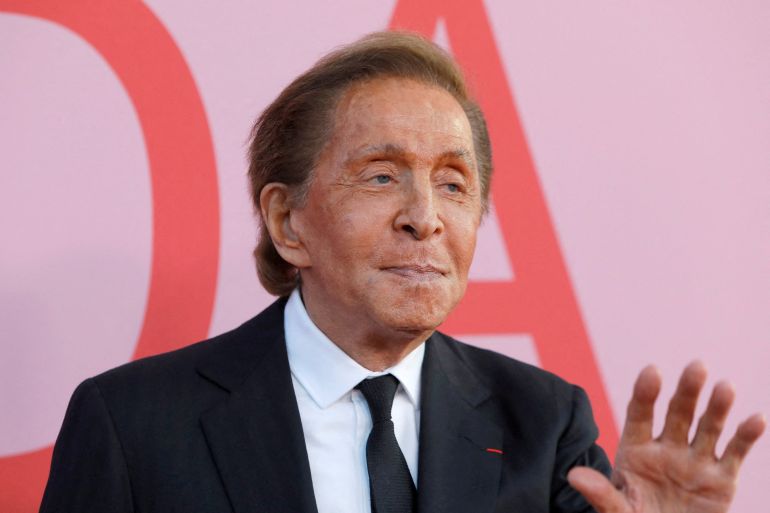
The world-renowned Italian fashion designer Valentino Garavani, one of the most prominent symbols of haute couture in the twentieth century, passed away on Monday at his home in Rome at the age of 93, according to a statement.
With Valentino’s departure, an exceptional chapter in the history of global fashion comes to a close. He was the designer who redefined the image of royalty in a republican era, and his name became synonymous with the elegance of princesses, Hollywood stars, and society women, both crowned and deposed alike. The news of his passing was announced in an official statement, confirming the end of a career that spanned more than six decades of influence, opulence, and aesthetic discipline.
Valentino was nicknamed “The Last Emperor” in the 2008 documentary of the same name. He founded the fashion house bearing his name in 1959. Over half a century, he not only designed clothes for the global elite but became one of them, surrounded by a traveling court, luxurious palaces, and an iconic red color that became a trademark registered in his name: “Valentino Red.”
With his striking presence, combining a permanent bronze tan and meticulously polished hair, Valentino Garavani embodied a complete image of quiet luxury. For decades, he contributed to shaping Italian taste and solidifying its features across successive generations. His creations were not merely garments but visual documents of pivotal historical moments, from Jacqueline Kennedy’s wedding dress for her marriage to Aristotle Onassis, to Farah Pahlavi’s look as she left Iran in 1979, and the iconic black dress worn by Julia Roberts at the 2000 Oscars ceremony.
Through the women who chose his designs, one can trace the narrative of the second half of the twentieth century. From Audrey Hepburn and Nancy Reagan to Princess Diana and Jennifer Lopez, Valentino was a byword for elegance among political, cultural, and artistic elites. Through his long partnership with Giancarlo Giammetti, he led the House of Valentino to the forefront of haute couture, becoming one of the most influential designers and paving the way for the rise of global Italian brands like Armani and Versace.
Valentino was known for his decisive stance on fashion shows as platforms for beauty, not for technical statements or fleeting trends. He said in his documentary: “I make dresses for women who actually wear them.”
Valentino Clemente Ludovico Garavani was born on May 11, 1932, in Voghera, northern Italy. His aesthetic inclinations appeared from an early age. He studied fashion in Milan, then moved to Paris to attend the “Chambre Syndicale de la Couture Parisienne” before working with prominent names in the design world like Jean Dessès and Guy Laroche.
In 1959, he returned to Rome to found his own house with his father’s support. One year later, he met Giancarlo Giammetti, beginning a partnership that formed the backbone of his professional and economic success. Despite initial financial turmoil, the duo succeeded in building a global fashion empire and amassing a fortune through licensing deals, making Valentino the first fashion designer to take his name to the Milan Stock Exchange.
Even after his official retirement in 2008, Valentino’s creative presence remained. He continued to design special wedding dresses, participated in opera set designs, and published a book reflecting his vision of lifestyle and luxury, leading those close to him to consider him “the one who set the standard for luxury” in the fashion world.
With his passing, Valentino disappears from the public scene, but his name remains present as a designer who made beauty a constant value and elegance a comprehensive vision that transcends fashion into a lifestyle.
Valentino Garavani
Valentino Garavani is the founder of the iconic Italian fashion house Valentino, established in Rome in 1960. The brand is renowned for its haute couture, elegant designs, and signature “Valentino red,” dressing celebrities and royalty for decades and becoming a cornerstone of luxury Italian fashion.
Rome
Rome is the capital city of Italy, founded according to legend in 753 BC. It grew from a small settlement to the heart of the vast Roman Empire, leaving an immense legacy of ancient architecture like the Colosseum and Roman Forum. The city later became the center of the Catholic Church and is today a major global cultural and historical destination.
Voghera
Voghera is a town in the Lombardy region of northern Italy, historically significant as a Roman settlement known as *Iria*. Its strategic location along trade routes led to the construction of a notable 14th-century castle, the Castello Visconteo, which remains a key landmark. The town later developed as an important railway and industrial hub in the 19th century.
Milan
Milan is a major city in northern Italy, historically founded by the Celts and later a key center of the Roman Empire. It is globally renowned as a fashion and design capital, and its cultural landmarks include the magnificent Gothic Milan Cathedral (Duomo) and Leonardo da Vinci’s famous fresco *The Last Supper*.
Paris
Paris is the capital of France, historically founded as a Gallo-Roman settlement in the 3rd century BC. It evolved into a major European center of art, philosophy, and politics, famously symbolized by landmarks like the Eiffel Tower and the Louvre Museum.
Chambre Syndicale de la Couture Parisienne
The Chambre Syndicale de la Couture Parisienne is the governing body of the French haute couture industry, founded in 1868 to protect and promote the standards of Parisian fashion houses. It establishes the strict criteria for the official “haute couture” designation and organizes the seasonal Paris Haute Couture Week.
Jean Dessès
Jean Dessès was a prominent 20th-century Greek-Egyptian fashion designer, celebrated for his elegant, draped evening gowns and his influence on haute couture from the 1930s through the 1960s. He opened his Paris salon in 1937 and became renowned for his use of luxurious fabrics and timeless, goddess-like silhouettes, dressing an international clientele of high society and royalty.
Guy Laroche
Guy Laroche is a French fashion house founded in 1957 by the designer of the same name, known for its elegant, wearable haute couture and ready-to-wear collections. The brand gained prominence for its sophisticated designs, fragrances, and for dressing numerous celebrities and public figures throughout the latter half of the 20th century.
Giancarlo Giammetti
Giancarlo Giammetti is an Italian businessman best known as the longtime professional partner and co-founder of the Valentino fashion house with designer Valentino Garavani. He played a crucial role in building the brand’s global business empire from its founding in Rome in 1960, managing the commercial and operational sides while Valentino focused on design.
Milan Stock Exchange
The Milan Stock Exchange, known as Borsa Italiana, was founded in 1808 by Eugène de Beauharnais, Napoleon’s viceroy of Italy. It is Italy’s primary stock exchange and has been a major financial hub in Europe, now operating as part of the London Stock Exchange Group.
Jacqueline Kennedy
Jacqueline Kennedy was the First Lady of the United States from 1961 to 1963, renowned for her restoration of the White House’s historic interiors and her promotion of the arts. Following President John F. Kennedy’s assassination, she was widely admired for her dignity and became a lasting international icon of style and culture.
Aristotle Onassis
Aristotle Onassis was a prominent 20th-century Greek shipping magnate who became one of the world’s richest and most famous businessmen. He is historically significant for revolutionizing the global shipping industry and for his high-profile personal life, including his marriage to Jacqueline Kennedy.
Farah Pahlavi
Farah Pahlavi is the widow of Mohammad Reza Pahlavi, the last Shah of Iran, and served as the Shahbanu (Empress) of Iran from 1959 until the 1979 Iranian Revolution. As empress, she was a prominent patron of the arts and culture, overseeing the establishment of numerous museums and cultural institutions aimed at modernizing Iran’s cultural landscape. Following the revolution, she went into exile and has since been a public figure advocating for Iranian cultural heritage.
Iran
Iran, historically known as Persia, is home to one of the world’s oldest continuous major civilizations, with a rich history dating back thousands of years. Its cultural landscape is marked by significant sites like the ancient ruins of Persepolis, the intricate architecture of Isfahan’s Naqsh-e Jahan Square, and numerous Islamic shrines and palaces. Modern Iran is an Islamic Republic established after the 1979 Revolution, blending its deep historical identity with contemporary political and religious structures.
Julia Roberts
Julia Roberts is an acclaimed American actress, not a place or cultural site. She rose to fame in the late 1980s and became a major Hollywood star in the 1990s with films like *Pretty Woman*, for which she earned an Academy Award nomination, later winning the Oscar for her role in *Erin Brockovich*.
Audrey Hepburn
Audrey Hepburn was a British actress and humanitarian, widely regarded as one of the greatest screen icons of Hollywood’s Golden Age. She rose to fame for her roles in classic films like “Roman Holiday” and “Breakfast at Tiffany’s,” and later dedicated much of her life to serving as a UNICEF Goodwill Ambassador.
Nancy Reagan
Nancy Reagan was the First Lady of the United States from 1981 to 1989, married to President Ronald Reagan. She is widely remembered for her “Just Say No” anti-drug campaign and her influential, though sometimes controversial, role in the White House.
Princess Diana
Princess Diana was a beloved member of the British royal family as the first wife of Charles, Prince of Wales. Her life and charitable work, particularly with landmine victims and those affected by HIV/AIDS, made her a global icon of compassion until her death in 1997. Her legacy continues through memorials like the Diana, Princess of Wales Memorial Fountain in London.
Jennifer Lopez
Jennifer Lopez is an American singer, actress, and dancer of Puerto Rican descent, born in the Bronx, New York City in 1969. She rose to fame in the 1990s, becoming a global pop culture icon known for her successful music and film careers, and is celebrated for breaking barriers for Latin representation in mainstream entertainment.
Armani
Armani refers to the Italian luxury fashion house founded by designer Giorgio Armani in 1975. It is renowned for revolutionizing modern fashion with its clean, tailored lines and understated elegance, particularly in menswear and womenswear. The brand has grown into a global empire encompassing clothing, accessories, fragrances, and home decor.
Versace
Versace is an Italian luxury fashion brand founded in 1978 by Gianni Versace, known for its bold, glamorous designs and iconic Medusa logo. The brand gained global prominence in the 1980s and 1990s, blending high fashion with celebrity culture, and continues to operate under the creative direction of Donatella Versace following Gianni’s death in 1997.
House of Valentino
The House of Valentino is an iconic Italian fashion house founded in 1960 by Valentino Garavani. It became renowned for its sophisticated designs, particularly the signature “Valentino Red,” and dressed numerous celebrities and royalty, solidifying its status as a symbol of high couture.