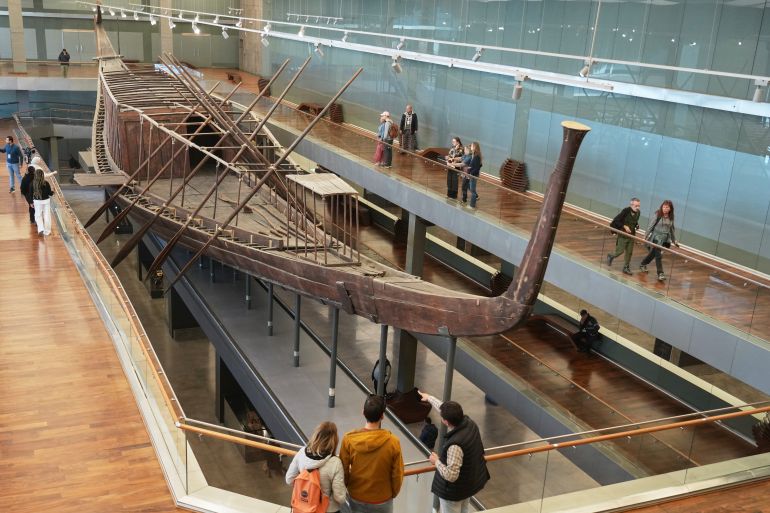

After more than four thousand years since its construction, parts of King Khufu’s boat were moved on Tuesday to their new location in the Grand Egyptian Museum, where visitors will be able to follow its restoration work live over the next four years.
In the hall of the King Khufu Boats Museum attached to the Grand Museum, restorers, assisted by a small archaeological crane, lifted a wooden plank showing signs of wear, thereby placing the first piece out of 1,650 wooden planks that collectively form King Khufu’s boat.
The museum, alongside the boat undergoing restoration, houses another solar boat from the same era, which was found in better archaeological condition and was previously displayed near the Giza Pyramids before being moved to the Grand Museum.
The two boats together are considered “the oldest known archaeological boats, and the largest organic artifact ever discovered in human history.”
The Minister of Tourism stated: “Today we are witnessing one of the most important restoration projects of the twenty-first century… It is an important project for the museum, for history, and for humanity.”
– The Grand Egyptian Museum adopts a full electronic reservation system starting December 1st.
– The golden collection of Tutankhamun is displayed for the first time at the Grand Egyptian Museum.
– The Grand Egyptian Museum welcomes its visitors today with ‘Generation Z’ technology.
The project is funded by a grant of 3.5 million dollars, with the participation of archaeological experts in the restoration work.
The boat, which is now about 4,650 years old, dates back to the reign of King Khufu, the builder of the Great Pyramid. It was discovered in 1954 inside a pit near the Giza Pyramids, but the extraction of its parts did not effectively begin until 2011.
It was explained that the wooden planks “had suffered thermal decomposition” and were in a highly fragile state, which led several archaeological missions to refrain from undertaking this project.
Treating the Planks with Organic Materials
It was noted that experts treated the boat’s planks and wooden oars using “internationally recognized organic materials,” including “nanocellulose and Klucel E” to reinforce, stabilize, and protect the decomposed wood.
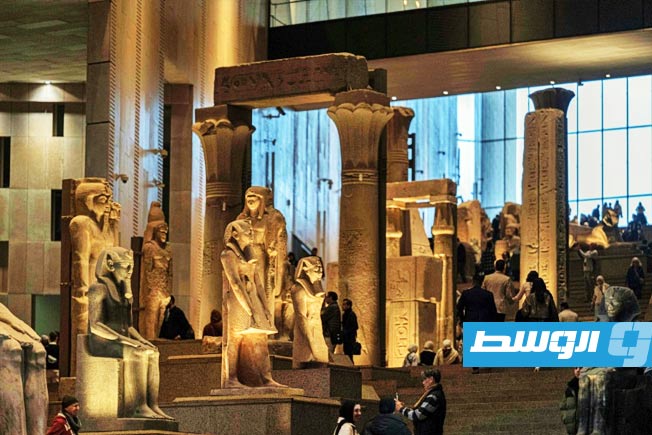
Since the beginning of November, the Grand Egyptian Museum has seen an increasing influx of visitors, following its official opening after two decades of construction and repeated delays.
It was stated that since its opening, “the museum receives an average of 15,000 visitors per day, but there have been days with larger numbers reaching up to 27,000 visitors per day.”
It is expected that the number of tourists arriving in Egypt will increase by 7% during 2026, compared to about 15 million tourists during the current year.
The government is counting on a recovery in the tourism sector, which contributes about 12% of the GDP and provides job opportunities for about two million people, after it was damaged over the past decade due to political unrest and the COVID-19 pandemic.