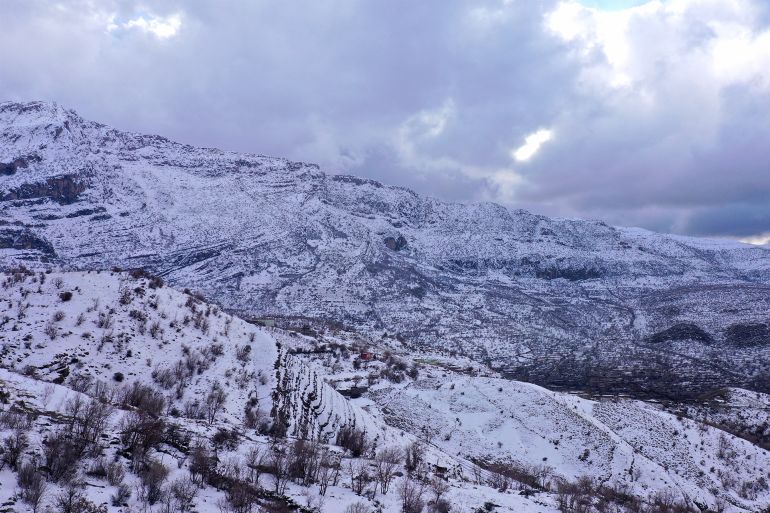
Discussion about Greenland often takes an economic turn, focusing on its mineral wealth. However, it seems this autonomous territory within the Kingdom of Denmark holds importance beyond that, as scientists view it as an open-air laboratory in many fields.
While former U.S. President Donald Trump’s threats to acquire the island were shaking the world last November, Greenland hosted an annual conference called “Greenland Science Week,” under the slogan “All Eyes on Greenland.” This signified that the island’s importance extends beyond economic dimensions, making it a focal point for researchers worldwide.
A Climate Warning Coming from Greenland
A report indicates that “the history of scientific research in Greenland encompasses knowledge derived from the traditional wisdom of the Inuit people, European polar explorations, and American military missions. By the 1990s, it had become a global center for climate change research after European and American-led teams drilled deep ice cores in the Greenland ice sheet to reveal past climate changes.”
Research conducted on the island has been extremely useful for warning about the consequences of climate change. Climate scientists from around the world measure, analyze, and predict changes in the Greenland ice sheet, issuing warnings about its potential complete melt. This melt could raise global sea levels by 7.4 meters. The latest such warning came last year when the ice sheet lost an estimated 129 billion tons of ice. It is responsible for about 20% of the current rise in sea level, equivalent to 0.8 millimeters per year.
Despite the island’s association with climate research, a document issued by the Greenland government in 2022 established its first research strategy, emphasizing that “Greenland is more than just ice and climate indicators.”
The document stated that Greenland is also important for geology and mineral research (such as lithium and other critical minerals). Furthermore, it is a unique location for genetic medicine and biology research because its indigenous Inuit population has lived in relative isolation from the rest of the world for thousands of years, leading to rare and unique genomic changes.
The document underscores the necessity for scientific research to be rooted in Greenland, responsive to social needs, open to international collaboration, and for its results to be accessible to all.
The Research Vessel “Taraajuk”
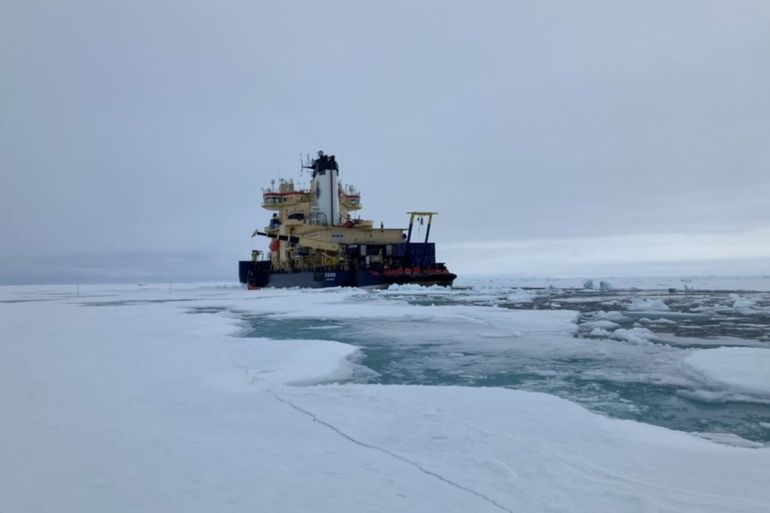
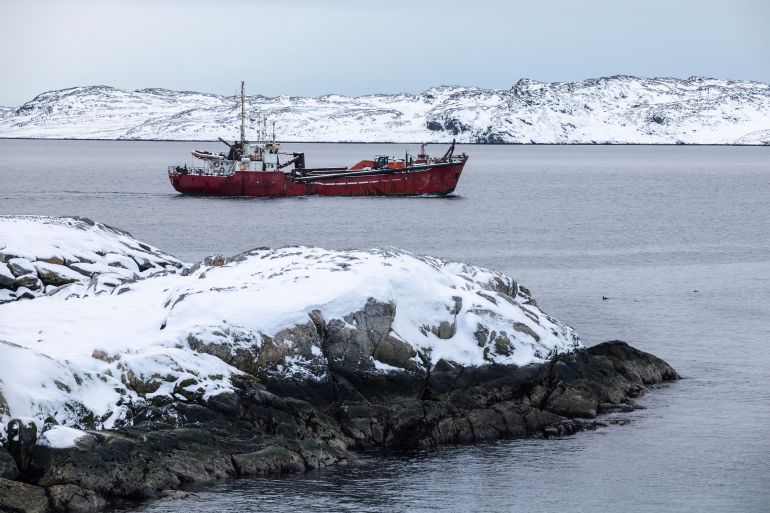
This strategy has led to the adoption of important initiatives, most notably the research vessel “Taraajuk.” It represents the largest research investment by the Greenland government to date, launched in 2022 at a cost of 235 million Danish kroner (approximately $37 million), funded by the government and private institutions.
Last August, during one of its many exploratory voyages, the “Taraajuk” and its crew carried a team to study the interaction of glacial meltwater with the rich ecosystem of a fjord in eastern Greenland. The vessel’s flexibility allowed the team to sail close to the ice edge and deploy scientific instruments to continue long-term monitoring of changes in this vital part of the Arctic.
Other new infrastructure includes Greenland’s AI-powered computing resources, installed last year at the Greenland Institute of Natural Resources in Nuuk. These resources help researchers conduct studies such as identifying and classifying marine species in underwater video and audio data.
Such tasks previously took weeks or months, but scientists can now conduct studies rapidly, such as modeling and predicting the locations of fish and other marine resources in the waters around Greenland.
International Cooperation at Risk
Scientific research in Greenland heavily relies on international cooperation between Europe and the United States. Scientists fear that the current political dispute over Greenland could impact this collaboration.
Although it was announced on January 21st that there was no intention to use military force to acquire the island, the desire for the United States to gain “full control” over it was reaffirmed following remarks made on the return journey from the World Economic Forum in Davos, Switzerland.
It is anticipated that these tensions will affect international scientific cooperation. One climate scientist expressed, “