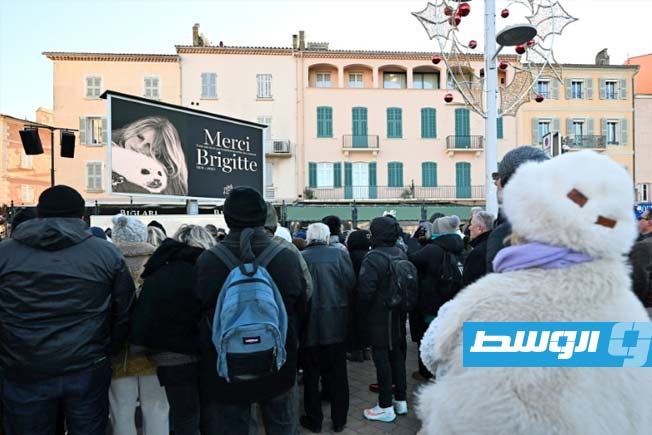
Mourners and fans wait to watch the live broadcast of the funeral of the late French actress Brigitte Bardot at the Notre-Dame de l’Assomption church in Saint-Tropez, southeastern France, on January 7, 2026.
Celebrities and fans are flocking to the city of Saint-Tropez on the French Riviera this Wednesday to attend the funeral of Brigitte Bardot, a pillar of French cinema and a fierce defender of animal rights whose statements often sparked widespread controversy.
The funeral mass for the famous actress, who died on December 28 at the age of 91, begins at 11:00 AM local time in France. The funeral is being held in this Mediterranean city, which Bardot, despite herself, helped turn into a favorite destination for the global elite.
The ceremony inside the church is limited to family guests and the Brigitte Bardot Foundation, who were transported by boat to an area closed to the public. Her husband, Bernard d’Ormale, had stated that the deceased passed away after a battle with cancer.
No precise information has been released about the guest list, but environmental activist Paul Watson was seen arriving from Paris. Questions remain about the attendance of her son, Nicolas Charrier, from Norway, whose relationship with his mother was strained for a long time following her famous statements about lacking maternal instinct.
– French President Mourns Bardot: A ‘Legend’ Who Embodied ‘a Life of Freedom’
– Death of French Cinema Icon Brigitte Bardot at 91
– French Far-Right Leader Marine Le Pen to Attend Brigitte Bardot’s Funeral
The French government is being represented by the Minister Delegate for Gender Equality, Aurore Bergé. Both Marine Le Pen and Nicolas Dupont-Aignan, right-wing figures, have announced their attendance as friends of the late star.
Tranquility and Simplicity at Notre-Dame
In the warm-walled church of Notre-Dame de l’Assomption (Our Lady of the Assumption), simple wreaths reflecting the deceased’s wishes have been placed. Among the most notable wreaths is a heart-shaped one from singer Mireille Mathieu and a bouquet of mimosa from media personality Michel Drucker.
The Brigitte Bardot Foundation announced that the memorial service would be simple, in keeping with the character of the star, who retired from acting at the height of her fame in 1973 to devote herself to animal welfare.
To ensure the privacy of the final resting place of the star, who was pursued by paparazzi for decades, authorities have implemented strict measures, including a ban on press photography inside the seaside cemetery. The prefect has also issued an order prohibiting aircraft and drones from flying over the area.
Live broadcast screens have been set up for local residents and fans at the port and town square, without granting the broadcast signal to television channels.
After the mass concludes, the funeral procession will pass near symbolic sites in the city, where the municipality has invited the public to pay their final respects, before the private burial in the seaside cemetery overlooking the Mediterranean, near the “La Madrague” estate where she lived and spent her final days.
Bardot will be buried in the tomb where her parents rest, and near her first husband, director Roger Vadim, who made her a global star with the 1956 film “And God Created Woman.”
French Riviera
The French Riviera, or Côte d’Azur, is a glamorous Mediterranean coastline in southeastern France, historically a winter retreat for British and Russian aristocracy in the 19th century. It later became a renowned summer destination for artists, celebrities, and tourists, celebrated for its resorts like Nice, Cannes, and Saint-Tropez.
Saint-Tropez
Saint-Tropez is a famous coastal town on the French Riviera, historically a fishing village that gained artistic renown in the late 19th century when painters like Paul Signac popularized it. Its modern fame as a glamorous jet-set destination was cemented in the mid-20th century, particularly after the 1956 film “And God Created Woman” starring Brigitte Bardot was filmed there.
France
France is a Western European nation with a rich history shaped by Celtic, Roman, and Frankish influences, evolving from a monarchy into a leading republic. It is globally renowned for its cultural landmarks like the Eiffel Tower and Louvre Museum, as well as its profound impact on art, philosophy, and cuisine.
Notre-Dame de l’Assomption church
Notre-Dame de l’Assomption is a Roman Catholic church located in the principality of Monaco. It was constructed between 1878 and 1903 from white stone from La Turbie, replacing an earlier parish church from the 13th century. The church serves as the final resting place for many former Princes of Monaco and members of the Grimaldi family.
Paris
Paris is the capital of France, historically founded as the Roman town of Lutetia in the 3rd century BC. It is globally renowned as a major center for art, fashion, and philosophy, and is home to iconic landmarks like the Eiffel Tower, the Louvre Museum, and Notre-Dame Cathedral.
Norway
Norway is a Nordic country in Northern Europe known for its dramatic fjords, Viking heritage, and modern prosperity. Its history includes the Viking Age (circa 800–1050 AD), a long union with Denmark and later Sweden, and full independence achieved in 1905. Today, it is a constitutional monarchy celebrated for its stunning natural landscapes and high standard of living.
Mediterranean
The Mediterranean is a sea bordered by Europe, Africa, and Asia, historically serving as a crucial crossroads for trade, cultural exchange, and the rise of major civilizations like the Ancient Egyptians, Greeks, Romans, and Phoenicians. Its shores have been central to the development of Western and Middle Eastern history, fostering interconnected societies through maritime networks for millennia.
seaside cemetery
The Seaside Cemetery, often associated with coastal burial grounds like the one in Sitges, Spain, is a historic graveyard located directly on the shoreline. Such cemeteries emerged in the 19th century, frequently serving as the final resting place for local fishermen and victims of shipwrecks, with the sea playing a central role in the community’s life and death.
port
A port is a maritime facility where ships dock to load and unload cargo and passengers. Historically, ports have been vital hubs for trade, cultural exchange, and economic development, often forming the foundation for major cities. Their evolution from simple harbors to complex logistical centers reflects advancements in global commerce and transportation.
town square
A town square is a central public space found in many cities and towns, historically serving as a focal point for community gatherings, markets, and civic events. Its origins often date to the medieval period or earlier, when it was established as the heart of commercial and social life, frequently adjacent to important buildings like a church or town hall.
La Madrague estate
La Madrague is a historic estate located near Saint-Tropez on the French Riviera, best known as the former summer residence of actress and singer Brigitte Bardot. Originally a fishing village property, it gained international fame after Bardot purchased it in the late 1950s, and it became synonymous with her private life and the relaxed, glamorous image of the Côte d’Azur.
Mediterranean
The Mediterranean is a sea bordered by Europe, Africa, and Asia, historically serving as a crucial crossroads for trade, cultural exchange, and the rise of major civilizations like the Egyptians, Greeks, Romans, and Phoenicians. Its shores have been central to the development of Western and Middle Eastern history, fostering the spread of ideas, religions, and goods for millennia.