Amsterdam- After a third of an hour of disjointed visual scenes of caves, tunnels, and water that did not reveal their immediate meaning, I was about to leave the screening room to catch another film in a neighboring hall at the international theater hosting the festival in the heart of the Dutch capital.
But just as the narrator began to shift to talking about how those underground shelters transformed into theaters for horrific human tragedies, I straightened in my seat and decided to continue, captivated by the power of the narrator’s story. He recounted how many people died collectively inside the caves of Okinawa, which witnessed some of the fiercest chapters of World War II in the final months of the war, when thousands of Japanese civilians took refuge in Okinawa’s natural caves (known locally in Japan as ‘gama’) to escape American soldiers.
Witnesses to Tragedy
By reviving the accounts of survivors and forgotten tragedies, the film contributes to the discussion of war in the Japanese consciousness. It barely begins exploring the submerged town before it documents stories of forced mass suicides that occurred in those caves during the final stages of the Pacific War in 1945.
The film represents a serious attempt to salvage submerged human experiences through cinematic art, affirming that the camera is an alternative memory that preserves the past from being lost.
For example, one cave—known as “Chibichiri Gama”—saw the death of more than 80 civilians at once in a tragic mass suicide incident. When I researched this phenomenon, I understood that this fate was not inevitable; many of these mass suicides resulted from psychological pressure exerted by authorities and society on civilians to convince them that surrendering to the enemy was worse than death.
The film’s narrative does not follow a traditional plot as much as it flows with a free current of events and images. It documents the subject of war by literally diving into the world of caves beneath Japan’s surface, including stories of forced mass suicides that occurred in those caves during the final stages of the Pacific War in 1945.
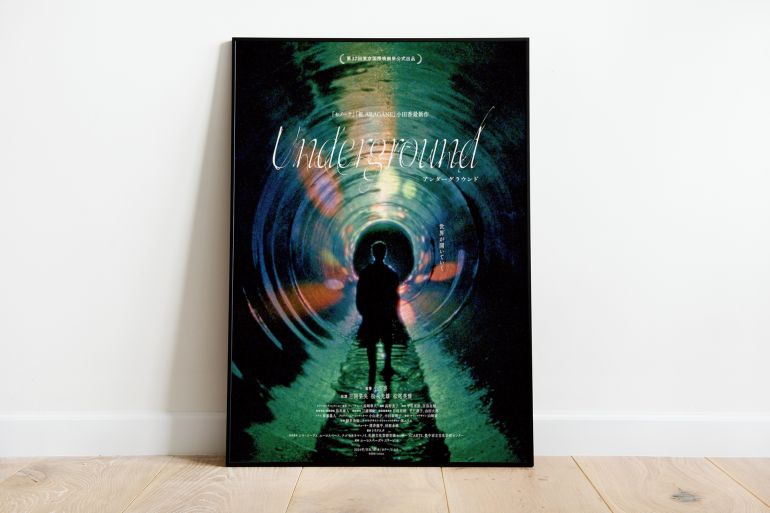
The film’s title appears as a quiet invitation to descend below the surface, into an underground world inhabited by the remnants of humanity’s traces, akin to an existential journey into the layers of the Japanese collective consciousness.
The story of “Underground” begins with a fleeting visual spark when a woman encounters old photographs or film clips in a screening room. Those scenes lead her to seek their truth.
The film’s protagonist—who does not speak throughout the film—discovers that those clips belong to a town that literally disappeared beneath the waters of a lake formed behind a towering dam. Driven by curiosity, and perhaps nostalgia for a past she never knew, she travels to that submerged place.
Thus begins the journey of search, a journey that leads her through time and the traces of the past. The main character here has no specific name and appears as a human shadow or ghost, wandering freely through scenes, sometimes via a hand extending from the side of the frame, content with her imprint and dreamlike presence. This woman becomes our guide through the underground labyrinths.
The film quickly moves beyond the literal task of finding the submerged town to engage in a broader exploration of hidden and suppressed places in collective memory, moving between multiple underground sites.
The Aesthetics of Darkness
The camera transitions from abandoned concrete tunnels beneath a modern city, to natural caves in Okinawa that witnessed the tragedies of a bloody war, and finally to the ruins of the submerged village itself at the bottom of the lake. The film does not directly reveal the names or details of these places; the transitions are intentionally hazy, as if part of a dream.
Time periods also interweave, as archival footage and old clips are projected over present scenes without a clear causal sequence. Yet they are connected by a set of symbols or sensations despite the absence of dialogue and direct explanation. From this angle, the film appears quintessentially “postmodern,” in terms of subverting the familiar narrative structure and documentary style for the viewer.
Despite these aesthetics, the film seemed confusing to me due to its bold experimental style. The fragmented narrative and sudden transitions between scenes confuse those who prefer a clear storyline, making watching the film akin to a journey requiring patience—something I nearly lost several times during the viewing.
Before the viewer is drawn into this meditative journey