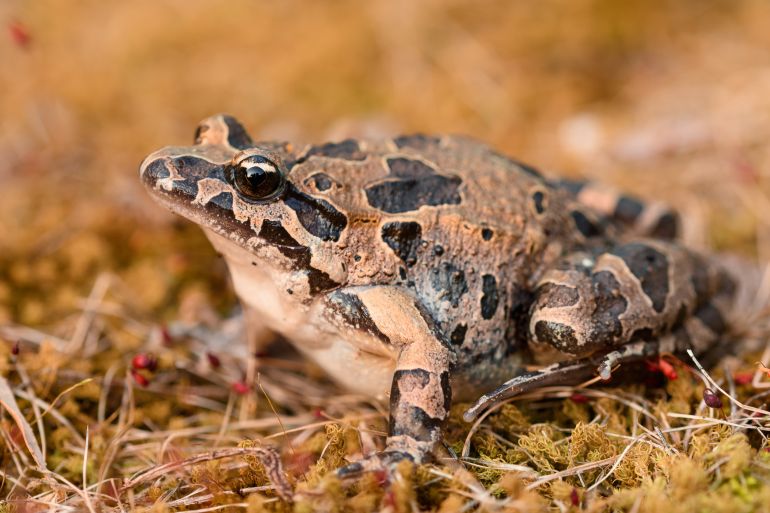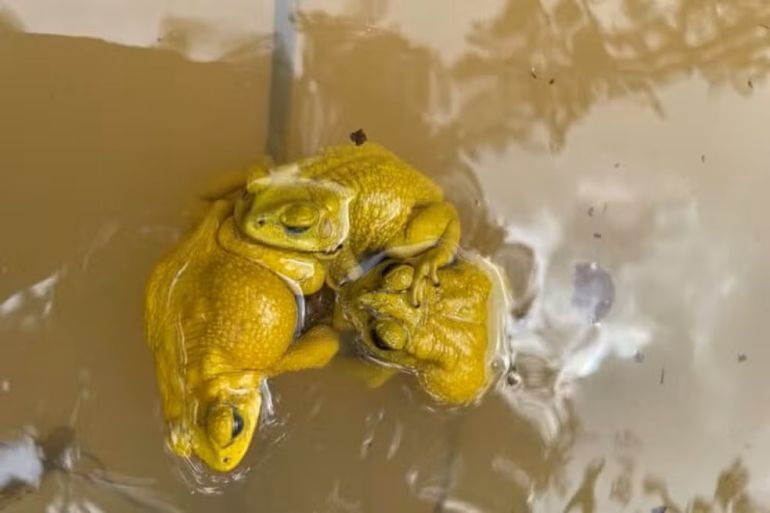
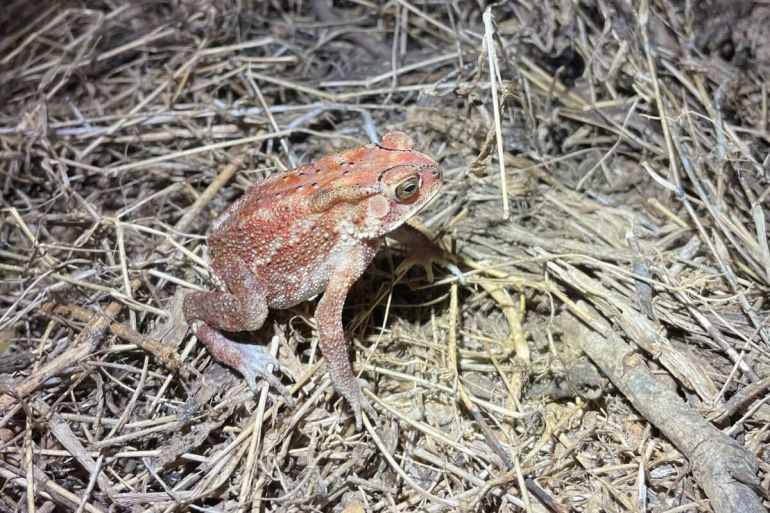
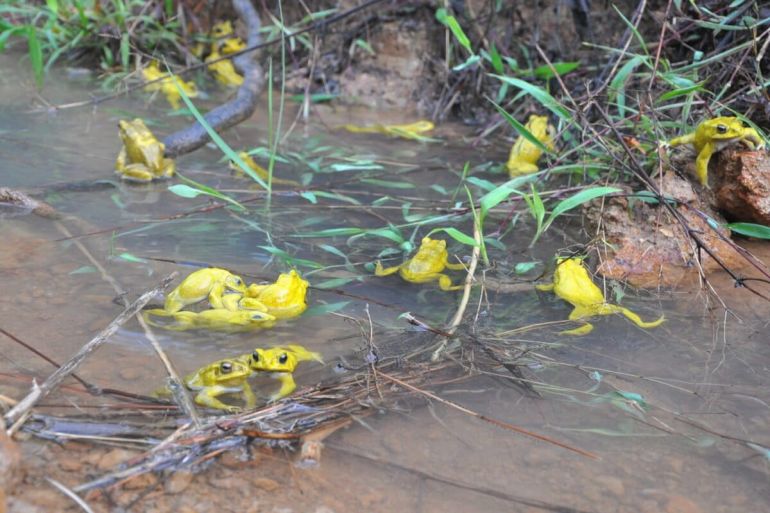
With the first monsoon showers each year in India and Southeast Asia, a type of frog appears in a strikingly colorful spectacle. Within minutes, the color of the male common Asian frog, scientifically known as “Duttaphrynus melanostictus,” changes from dark brown to bright yellow.
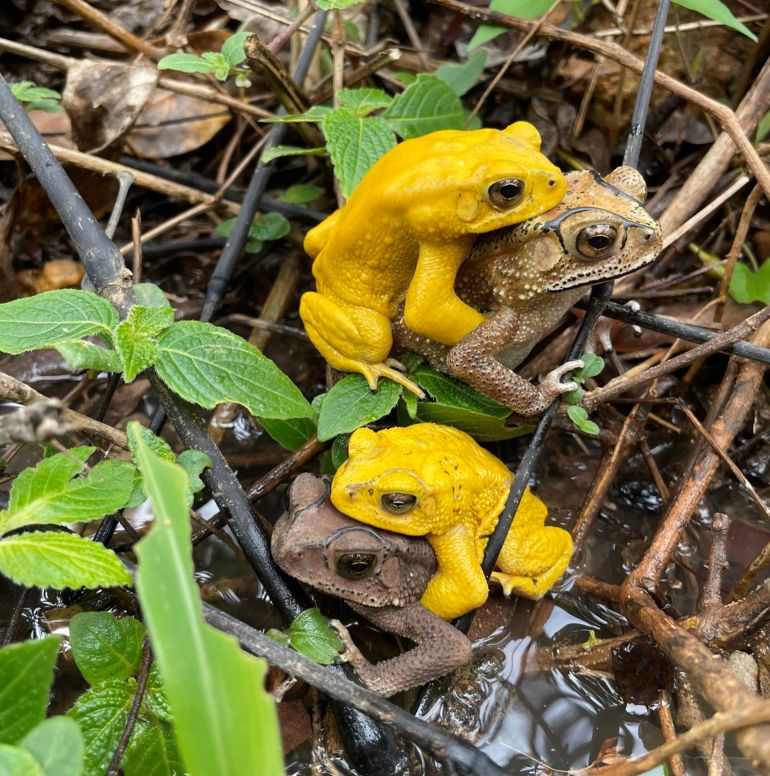
While the females remain their usual brown color, the males undergo a rapid “makeover” in preparation for a short, intense mating bout before their yellow skin returns to the dull, muddy brown it is for most of the year.
The Mystery of the Yellow Glow
Scientists have long known that the transformation of these dormant creatures into stunning yellow beacons coincides with the annual mating season, which lasts only two days. However, researchers have only recently discovered why the males abandon their natural color and the specific role of this dramatic costume change.
According to the researchers, the answer, while seemingly intuitive, needed scientific proof. The dynamic yellow color that appears on males for 48 hours each year is easily distinguishable from the females’ brown color from the frog’s own perspective.
For the first time, researchers led a study, published in the journal “Ichthyology & Herpetology,” to understand the true function of this change during explosive breeding events in the frog’s natural habitat.
This event refers to a large gathering of frogs for breeding, especially in spring when heavy rainfall and suitable environmental conditions attract huge numbers of males and females.
Testing the Function of the Color Change
To test the functionality of the dynamic color change, researchers attempted to see the world through the eyes of common Asian frogs in their natural habitat during the short mating period. They used computer models and data from spectrophotometers to develop a visual simulation showing how these amphibians perceive colors.
This test revealed that the dynamic sexual dichromatism in these frogs is an adaptation to serve as a visual signal, helping to clearly distinguish the males’ striking yellow color from the females’ brown in dense, time-limited breeding aggregations.
Subsequently, to verify the function of the bright color, the lead researcher stated: “We used highly realistic 3D models of frogs, based on a specimen preserved in a natural history museum, and colored them with the hues recorded by the spectrophotometer. Some were yellow to mimic males during the mating period, and others were brown to resemble females. We then placed them near a group of frogs gathered for mating during an explosive breeding event.”
She added: “We documented the interaction of real frogs with the designed models for later analysis. We observed that males largely ignored the yellow models, while showing clear interest in the brown models matching the female color, attempting to push and climb on them to assume the mating position.”
The results showed that males made physical contact with the brown models twice as often as with the yellow models and attempted amplexus (the mating embrace) with them at a rate over 40 times higher compared to the yellow models.
A Signal for Distinction, Not Display
Interestingly, the yellow color does not indicate a male’s strength, fitness, or attractiveness. When researchers tried changing other factors, such as the models’ weight, size, and color intensity, none