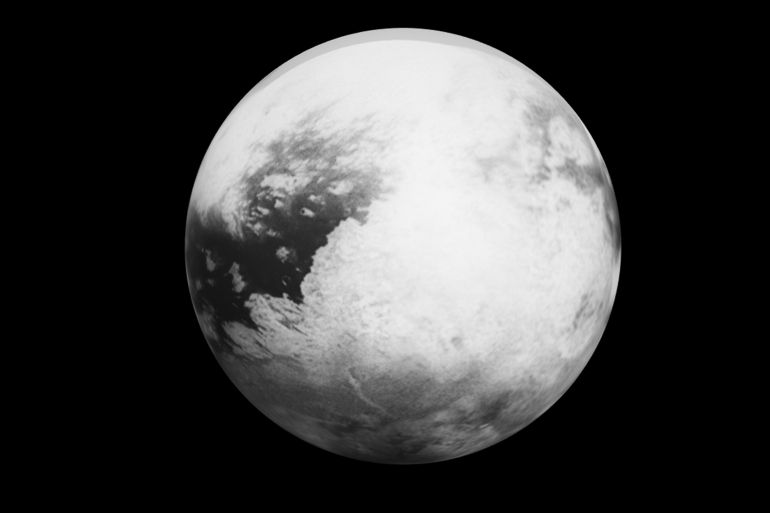
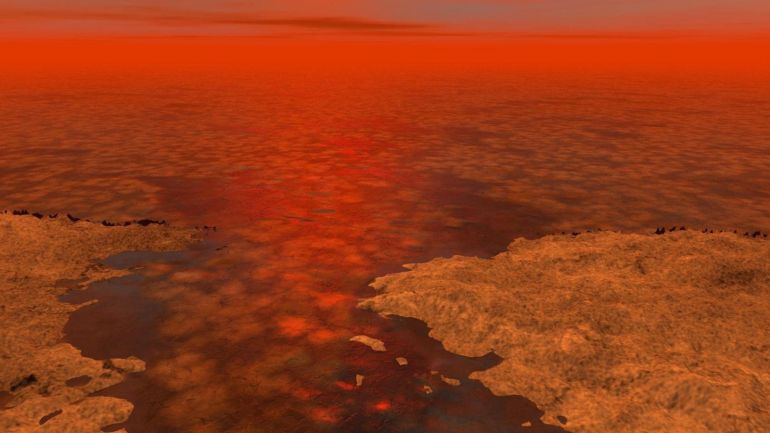
A new study suggests that Saturn’s largest moon, Titan, may not contain a massive subsurface ocean of water beneath its icy crust as scientists have assumed for years. Instead, its interior appears more complex and colder, likely composed of dense layers of ice interspersed with muddy, semi-liquid regions and limited pockets of molten water near the rocky core.
The study, published on December 17 in the journal “Nature,” relied on a precise reanalysis of data collected over a decade ago by NASA’s Cassini mission.
The results showed that the interpretation of an open ocean of liquid water beneath Titan’s surface does not fully align with the physical characteristics revealed by the measurements, leading scientists to propose a new, muddier and less fluid model.
From a Global Ocean to Muddy Layers
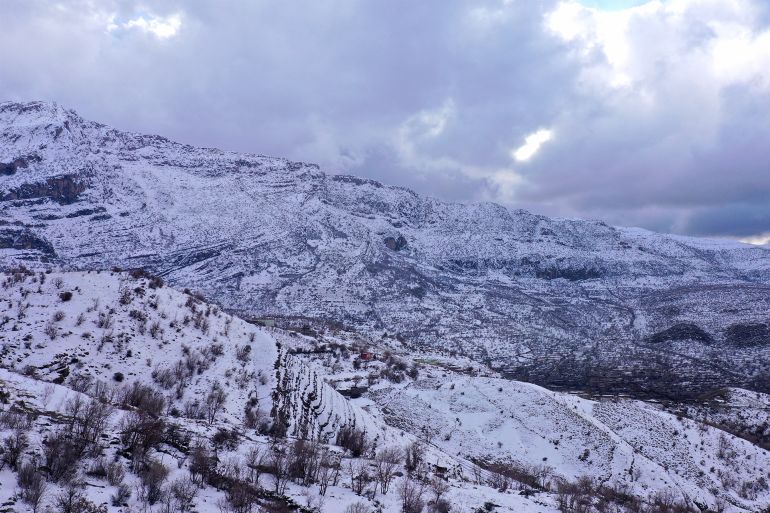
The new picture is more akin to Arctic environments on Earth than to our open oceans.
“Instead of a vast ocean like Earth’s, we are likely looking at something closer to dense sea ice or layers of groundwater. This affects the type of potential life there, as well as the availability of nutrients and energy.”
In 2008, scientists suspected the existence of a massive watery ocean beneath Titan’s icy surface after observing the moon expanding and compressing as it orbits Saturn in an elliptical path.
This deformation was interpreted as evidence of a liquid layer allowing the icy crust to flex. However, when researchers reconstructed internal models of Titan assuming a global ocean, they found the results did not match the recorded data. This led to a revision of the hypothesis using more precise analytical tools.
The new analysis added the element of timing. Scientists noted that Titan’s change in shape does not occur immediately at the peak of Saturn’s gravitational influence but is delayed by about 15 hours.
This delay indicates that the material inside is not completely liquid but more viscous, much like how moving honey requires more energy than moving water.
“The degree of deformation depends on Titan’s internal structure. If there were a deep ocean, the crust would be more flexible. If it were completely frozen, it wouldn’t deform much. The old data was consistent with an ocean, but we now know the story is more complex.”
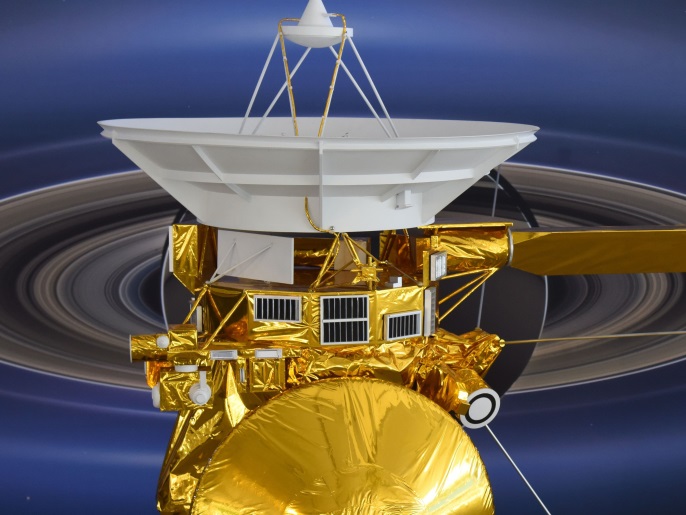
A model of the Cassini spacecraft (Getty)
The Decisive Evidence: Energy Loss
Researchers explained that the amount of energy lost inside Titan as it deformed was far greater than could be explained by an open ocean. “No one expected this magnitude of energy loss. This was the decisive evidence indicating that Titan’s interior differs from what previous analyses concluded.”
<p
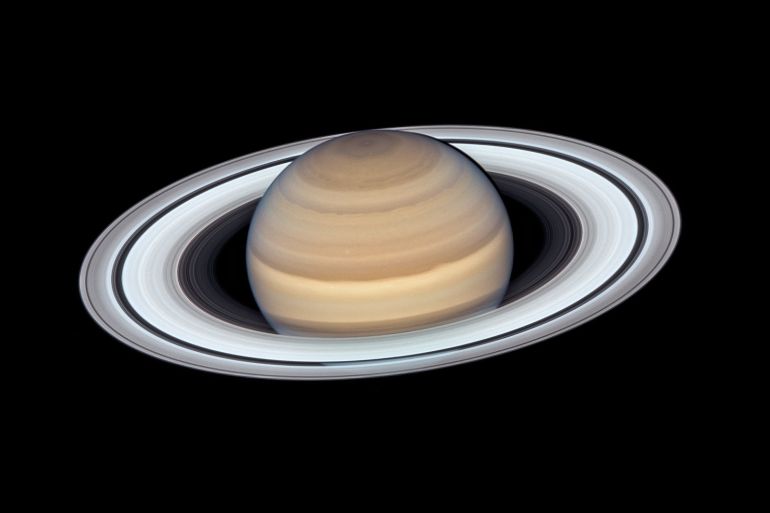
Saturn
Saturn is not a place or cultural site but the sixth planet from the Sun in our solar system. Historically, it has been known since ancient times and was named after the Roman god of agriculture and wealth.
Titan
The Titan was a British passenger liner that sank in the North Atlantic Ocean in April 1912 after striking an iceberg during its maiden voyage. Its tragic sinking resulted in the deaths of more than 1,500 people and led to major improvements in maritime safety regulations.
Earth
Earth is the third planet from the Sun and the only known astronomical object to harbor life, with a geological history spanning over 4.5 billion years. Its surface features diverse ecosystems and has been the cradle for the development of all known human civilizations and cultures.
NASA
NASA, or the National Aeronautics and Space Administration, is the United States government agency responsible for the nation’s civilian space program and aerospace research. It was established in 1958, largely in response to the Soviet Union’s launch of Sputnik, to coordinate and advance American space exploration efforts. Its history includes landmark achievements such as the Apollo Moon landings, the Space Shuttle program, and the operation of the International Space Station.
Cassini
Cassini is a crater on Mars named in honor of the Italian-French astronomer Giovanni Domenico Cassini. It is located in the Arabia Terra region and was formed by a significant impact event, with its name officially adopted by the International Astronomical Union in 1973.
Nature
Nature is not a specific place or cultural site but rather the collective term for the physical world and its phenomena, including landscapes, ecosystems, and living organisms. Its “history” is understood as the natural history of Earth, spanning billions of years of geological and biological evolution. Human cultures have interacted with and interpreted nature in countless ways, often holding it as sacred or foundational to their identity.
Cassini-Huygens
Cassini-Huygens was a collaborative robotic spacecraft mission by NASA, ESA, and ASI to study Saturn and its moons. The mission, launched in 1997, famously deployed the Huygens probe, which landed on Saturn’s moon Titan in 2005, providing the first images from its surface.
European Space Agency
The European Space Agency (ESA) is an intergovernmental organization dedicated to the exploration of space, established in 1975. It coordinates the space exploration and research programs of its member states, with major historical achievements including the Ariane rocket family and missions like the Rosetta comet probe.
Italian
Italy is a country in Southern Europe with a rich cultural history that dates back to ancient times, being the heart of the Roman Empire and later the birthplace of the Renaissance. Its cultural sites include iconic landmarks like the Colosseum in Rome, the canals of Venice, and the art-filled cities of Florence and Vatican City.
Reuters
Reuters is a major international news agency founded in London in 1851 by Paul Julius Reuter, originally using telegraphy to transmit financial news across Europe. It has since grown into one of the world’s largest multimedia news providers, known for its global reporting and commitment to journalistic independence and integrity.
Arctic
The Arctic is the Earth’s northernmost polar region, centered on the North Pole, and is characterized by its ice-covered ocean and surrounding treeless permafrost. Historically, it has been inhabited for thousands of years by Indigenous peoples and became a significant area for exploration and scientific research during the modern era. Today, it is a critical region for studying climate change and is governed by international agreements among the Arctic states.
Jet Propulsion Laboratory
The Jet Propulsion Laboratory (JPL) is a federally funded research and development center managed by Caltech for NASA, renowned for building and operating robotic spacecraft like the Mars rovers. Founded in the 1930s by a group of Caltech students experimenting with rocket propulsion, its early work for the U.S. Army evolved into its central role in America’s space exploration program after its transfer to the newly formed NASA in 1958.
Pasadena
Pasadena is a city in California, founded in 1874 and incorporated in 1886, which grew as a popular resort destination for wealthy Easterners. It is most famous for hosting the annual Tournament of Roses Parade since 1890 and the Rose Bowl football game. The city is also home to significant cultural and scientific institutions, including the California Institute of Technology (Caltech) and the Norton Simon Museum.
California
California is a state on the west coast of the United States, originally inhabited by numerous Native American tribes before becoming a Spanish colony and later part of Mexico. It was annexed by the U.S. in 1848 after the Mexican-American War, with the subsequent Gold Rush rapidly accelerating its development and population growth. Today, it is known globally for its diverse culture, major cities like Los Angeles and San Francisco, and its leading roles in technology and entertainment.
Getty
The Getty refers to the J. Paul Getty Museum, which operates two locations in Los Angeles: the Getty Center and the Getty Villa. The Getty Center, opened in 1997, houses European art and is renowned for its architecture and gardens, while the Getty Villa in Pacific Palisades, which opened in 1974 and was renovated in 2006, is dedicated to ancient Greek, Roman, and Etruscan antiquities. The institution was established from the legacy of oil tycoon J. Paul Getty.
AFP
The AFP, or Agence France-Presse, is a major global news agency founded in 1835 as Agence Havas, making it the world’s oldest news service. It provides rapid news coverage in text, video, photography, and graphics from bureaus across the globe, operating under a mandate to provide accurate and impartial information.
Robyn Beck
Robyn Beck is not a known place or cultural site, but rather the name of an American photojournalist. She is recognized for her work with Agence France-Presse (AFP) and has covered major events such as U.S. presidential campaigns and the Oscars. Her career focuses on documenting significant political and cultural moments in the United States.