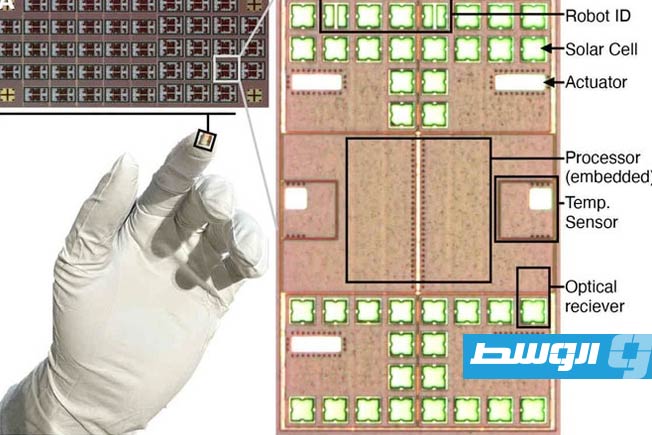
Universities have unveiled the development of the world’s smallest fully programmable and self-driving robots, a step described as a new scientific breakthrough.
These microscopic robots are distinguished by their ability to receive sensory information and process it to perform complex tasks, paving the way for a real revolution in the fields of manufacturing and medicine.
The size of a single robot is approximately (0.2 × 0.3 × 0.05) millimeters, a size that is almost invisible to the naked eye and comparable to the scale of microscopic organisms.
While one university developed the locomotion system, another provided the brains for these machines via its microscopic computer ‘M3’.
These robots rely on an innovative propulsion system without moving parts, generating an electric field that pushes ions in the surrounding liquid, creating a force that propels the robot forward. Thanks to this design, the robots possess exceptional durability, enabling them to ‘swim’ for several months.
Artificial Intelligence on Nano Power
It was explained that the biggest challenge was powering the robot’s computer with a very small amount of energy not exceeding 75 nanowatts, which is 100,000 times less than what a smartwatch consumes.
– Nobel Prize in Chemistry awarded to three scientists, one of Tunisian origin, for research on nanoparticles
– Manufacturing of a ‘microprocessor’ with a thickness of 7 nanometers
– ‘Nano-bodies’ derived from camels and llamas open a new era for treating intractable brain diseases
This necessitated reinventing the program instructions to reduce their size to match the robot’s extremely limited memory.
This technology, supported by the National Science Foundation (NSF), opens unprecedented medical horizons, including monitoring the health of individual cells from within.
These robots can also work in coordinated groups resembling schools of fish to build precise devices, with a production cost that could be less than one dollar per robot.