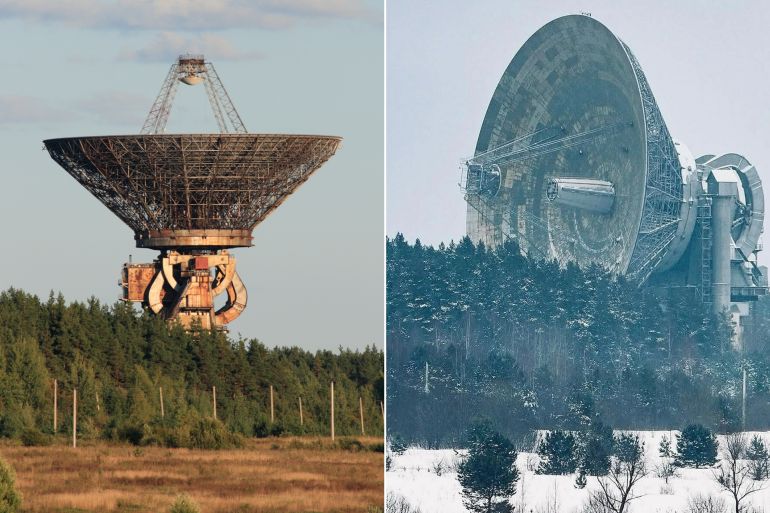
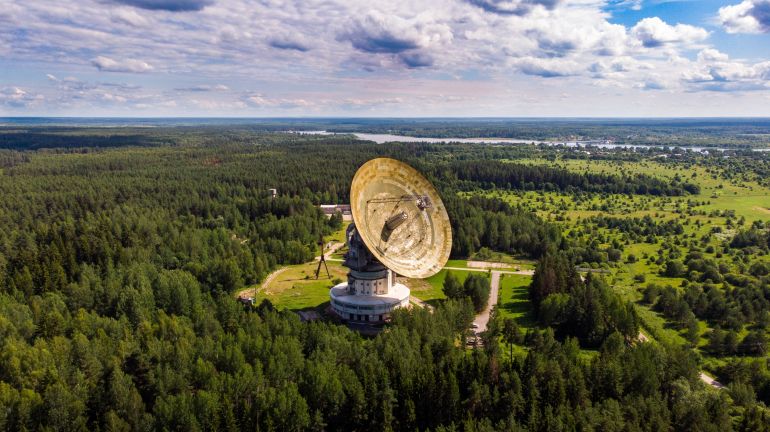
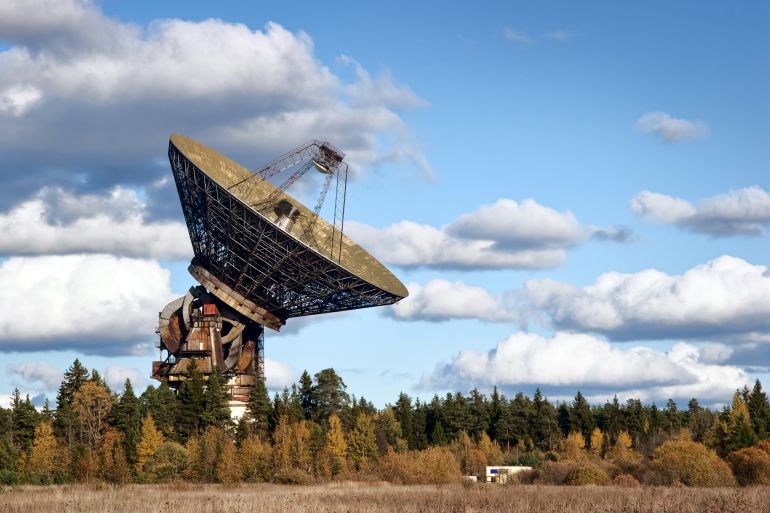
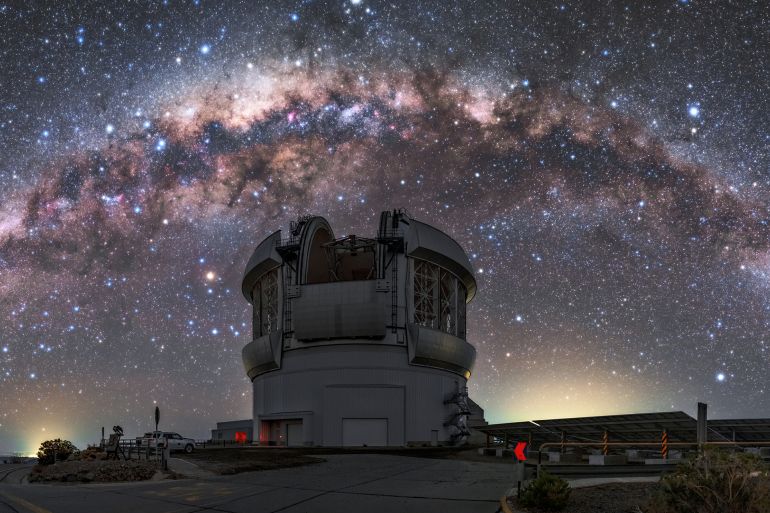
The “RT-64” telescope at the Kalyazin Radio Astronomy Observatory in northern Russia is one of the country’s most prominent scientific facilities, representing a legacy from the Soviet era in space exploration and astronomical observation.
This telescope features a dish with a diameter of 64 meters, making it one of the largest radio telescopes in the world and granting it a high capacity to receive weak signals from deep space.
The “RT-64” telescope was built in the late 1980s as part of the country’s efforts to develop scientific and technical capabilities for deep space exploration.
It was initially planned to fulfill space communication missions, including communications with spacecraft heading to Mars or other planets, before the program’s priorities changed with the collapse of the Soviet Union in 1991.
Despite the subsequent political and economic transformations, the telescope successfully remained active and effective, integrated into the Russian radio astronomy network, which contributes to multiple research areas including the study of distant celestial objects and their radiative activity.
Technical Specifications and Scientific Capabilities
The “RT-64” telescope possesses a massive 64-meter dish, weighing thousands of tons, which gives it a high capacity to capture weak radio signals from deep space. It can rotate 360 degrees horizontally and more than 90 degrees vertically, allowing it to track celestial objects.
This large size and suite of sensitive instruments make it suitable for research including:
Studying the radio spectrum of celestial objects.
The physics of pulsars and precise astrometry.
Studying objects within our galaxy and beyond.
Participation in Very Long Baseline Interferometry (VLBI) network experiments, which link signals from multiple telescopes to increase observation precision across continents and galaxies.
Role in International Scientific Projects
The “RT-64” is used for advanced radio astronomy research and participates in international networks that employ Very Long Baseline Interferometry to combine data from multiple telescopes, obtaining ultra-high-resolution images of distant celestial objects.
The “RT-64” telescope can receive weak signals from space.
Its original design also allowed it to support missions such as the “ExoMars” program, a joint project between European and Russian space agencies, contributing to communications and astronomical observation during parts of this program.
Maintaining a facility of this size is not easy, especially given aging equipment and the constant need to update sensitive systems. However, scientific efforts in Russia have ensured the telescope’s continued operation, and it is still used today for important scientific research.
The “RT-64” telescope is an example of scientific infrastructure that has managed to transcend the limits of time and political changes, remaining an active part of the global astronomical research system.
With its ability to receive weak signals from space, it contributes to expanding our understanding of radio waves emitted by stars and galaxies, remaining a technical symbol of an advanced era in scientific observation and vision.
RT-64 telescope
The RT-64 telescope, also known as the Kalyazin Radio Telescope, is a large, fully steerable radio telescope located in Russia, completed in 1992. It was constructed as part of the Soviet Union’s deep space communication network for interplanetary missions and remains a significant instrument for radio astronomy observations.
Kalyazin Radio Astronomy Observatory
The Kalyazin Radio Astronomy Observatory, located in Russia’s Tver region, is a major radio astronomy facility operated by the Russian Academy of Sciences. It was established in the 1950s and is best known for its 64-meter radio telescope, RT-64, which was originally built for deep space communication and later repurposed for astronomical research.
Russia
Russia is the world’s largest country by area, spanning Eastern Europe and Northern Asia. Its history is marked by the rule of the Tsars, the rise and fall of the Soviet Union in the 20th century, and its establishment as the modern Russian Federation in 1991. It is renowned for its vast landscapes, rich literary and artistic traditions, and globally influential cities like Moscow and Saint Petersburg.
Soviet Union
The Soviet Union was a socialist state that existed from 1922 to 1991, formed after the Russian Revolution and encompassing much of the former Russian Empire. It was a one-party state governed by the Communist Party, playing a central role as a superpower during the Cold War before dissolving into multiple independent nations.
Mars
Mars is the fourth planet from the Sun and is often called the “Red Planet” due to its iron oxide-rich surface. It has been a subject of human fascination and scientific study for centuries, with early telescopic observations by astronomers like Galileo and modern exploration by robotic rovers seeking evidence of past water and potential for ancient life.
Volga
The Volga is Europe’s longest river, flowing through central Russia to the Caspian Sea. Historically, it has served as a vital trade route and cultural heartland, shaping the development of major cities and playing a central role in Russian folklore and identity.
Kalyazin
Kalyazin is a historic town in Russia’s Tver Oblast, best known for the Kalyazin Bell Tower, which rises from the waters of the Uglich Reservoir. The bell tower is the sole remnant of the 15th-century St. Nicholas Monastery, which was flooded during the creation of the reservoir in the 1930s as part of Soviet industrialization projects.
Very Long Baseline Interferometry (VLBI)
Very Long Baseline Interferometry (VLBI) is an astronomical technique that combines signals from radio telescopes spread across the globe to create a single, Earth-sized virtual telescope. Developed in the 1960s, it allows for extremely high-resolution observations of cosmic objects like quasars and black holes, and it is also used for precise geodetic measurements, such as tracking tectonic plate motion.
ExoMars program
The ExoMars program is a joint mission between the European Space Agency (ESA) and Roscosmos, Russia’s space agency, aimed at investigating the Martian environment and searching for signs of past life. Its history includes the launch of the Trace Gas Orbiter in 2016 and the planned, but subsequently suspended, launch of the Rosalind Franklin rover following Russia’s invasion of Ukraine.
European and Russian space agencies
The European Space Agency (ESA) was founded in 1975 as an intergovernmental organization dedicated to space exploration, while the Russian space agency, Roscosmos, traces its origins to the Soviet space program established in the 1950s. They have a long history of collaboration, most notably on programs like the Soyuz launches from French Guiana and the ExoMars mission to search for life on Mars.