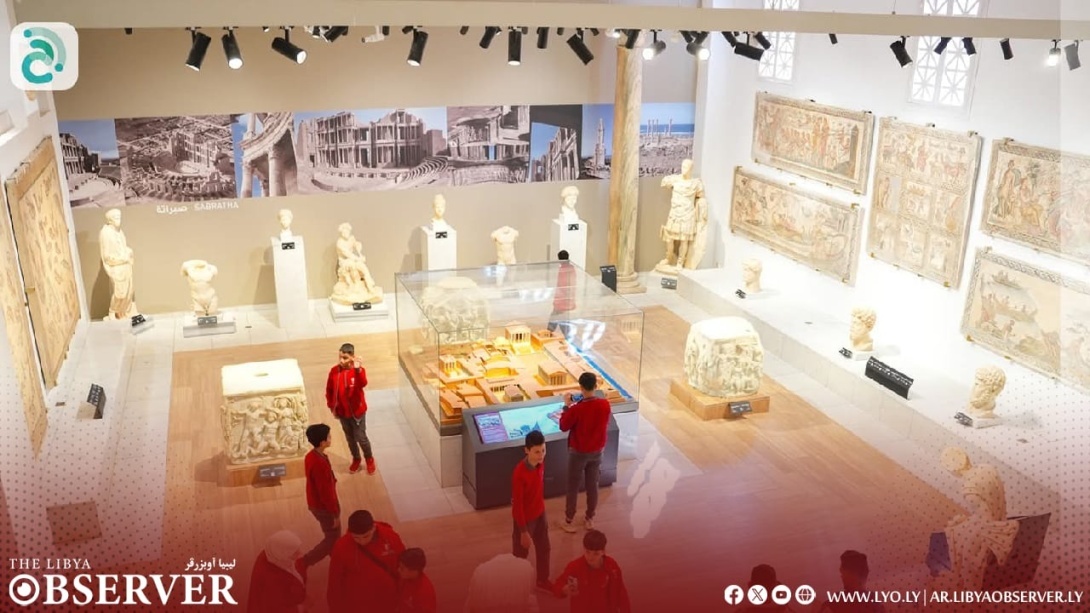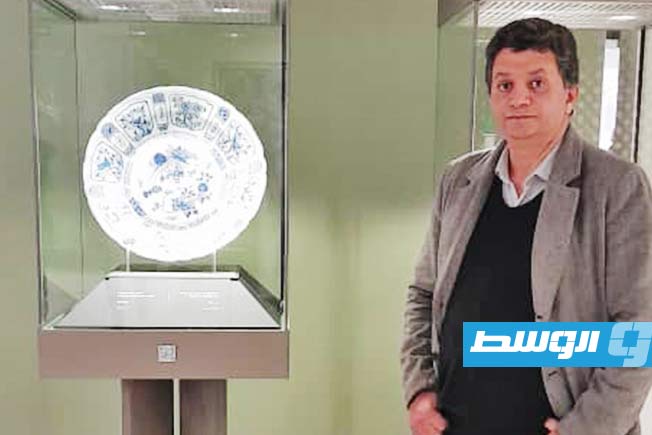
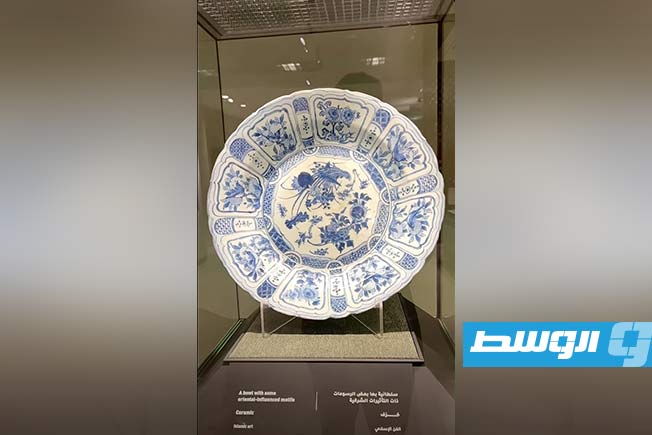
New historical information has been uncovered regarding a rare ceramic piece displayed in the Islamic wing of the Libyan National Museum, after its origin remained unknown for many years.
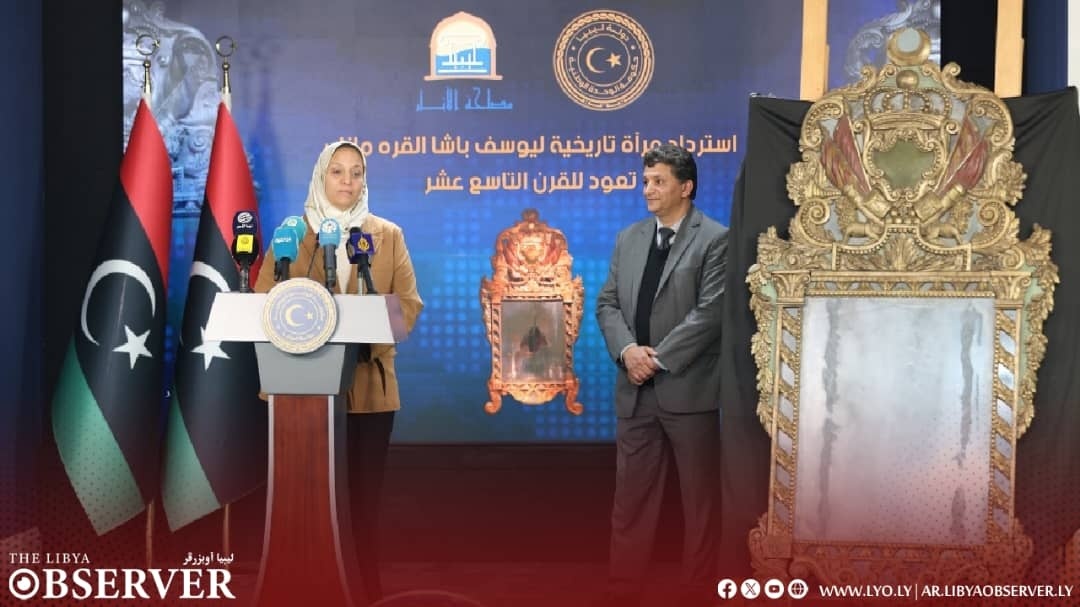
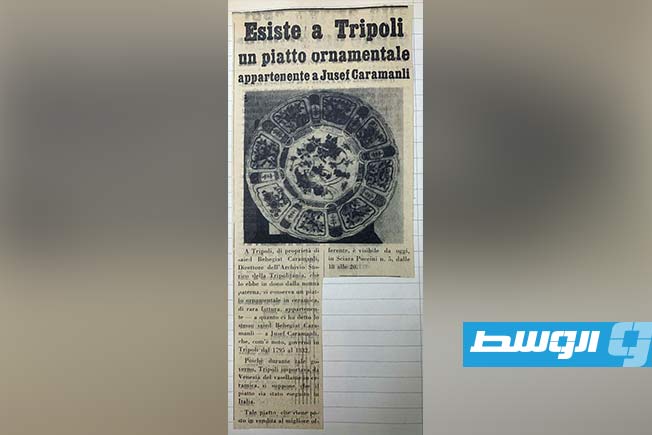
It was explained that the piece, a decorative ceramic bowl with blue patterns featuring Eastern influences, dates back to Yusuf Pasha Qaramanli (1766–1838), the ruler of Tripoli from 1795 to 1832. This identification is based on a clipping from an old Italian newspaper that includes a picture of the bowl and information confirming its attribution and history.
The old newspaper article indicates that the bowl was preserved by the director of the Historical Archives in Tripoli, having been received as a family gift before later being donated to the Libyan National Museum. It was added that the newspaper suggested the bowl was likely made in Italy, in light of the trade relations that linked Tripoli with a number of Italian cities, foremost among them Venice, during the rule of Yusuf Pasha Qaramanli.
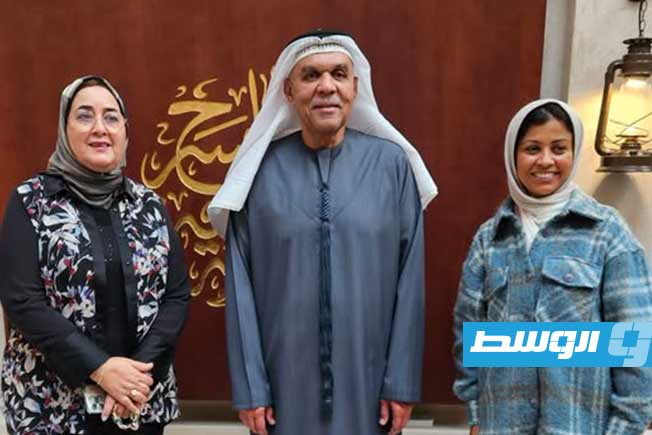
It was confirmed that a visit was made to the museum to verify that the displayed piece matches the picture and information in the old newspaper. Coordination with the museum’s management has taken place to update the item’s identification card to reflect its true origin and historical value.
The statement concluded by emphasizing the importance of re-studying Libyan museum collections and opening the way for researchers and interested parties to correct historical information whenever new and reliable sources become available. This contributes to preserving national memory and safeguarding Libyan heritage.
Yusuf Pasha Qaramanli
### **Who Was Yusuf Pasha Qaramanli?**
Yusuf Pasha Qaramanli (also spelled Karamanli or Caramanli) was the **Bey (later Pasha) of Tripoli** from **1795 to 1832**. He is best known for his role in the **First and Second Barbary Wars** against the United States and for his ambitious but ultimately disastrous reign that led to the end of his dynasty’s rule.
### **Key Aspects of His Reign:**
**1. Rise to Power:**
* The Qaramanli dynasty, of Turkish-Ottoman origin, had ruled the semi-autonomous Ottoman province of Tripolitania since 1711.
* Yusuf was not the designated heir. He seized power in a violent coup in 1795, overthrowing his older brother, Hamet (Ahmed), and murdering another brother. He then forced his father, Ali I, to abdicate.
**2. The Barbary Wars with the United States:**
* Like other Barbary States (Algiers, Tunis, Tripoli), Yusuf’s regime derived significant revenue from **state-sanctioned piracy** and the **extortion of “tribute”** from foreign nations to protect their shipping.
* In 1801, he demanded a large increase in tribute from the newly independent United States. When President Thomas Jefferson refused, Yusuf declared war by symbolically **chopping down the flagpole at the U.S. consulate**—an act that triggered the **First Barbary War (1801-1805)**.
* The war featured famous events like the **burning of the USS *Philadelphia*** after it ran aground in Tripoli harbor, and the **overland expedition** led by U.S. diplomat William Eaton and Yusuf’s deposed brother, Hamet, in an attempt to restore him to the throne.
* The war ended with the **Treaty of 1805**, which was favorable to the U.S., ending tribute payments (though a ransom was paid for released American prisoners).
**3. Domestic Rule and Ambition:**
* Yusuf was a capable but ruthless ruler. He modernized Tripoli’s military and economy, engaged in trade with Europe, and embarked on ambitious building projects, including the **Qaramanli Palace** (which still stands in Tripoli’s old city).
* He sought to expand his territory, leading to conflicts with neighboring Tunis and with Ottoman forces in the east.
**4. Downfall and Legacy:**
* His ambitions, coupled with the loss of “tribute” revenue after the Barbary Wars, led to **severe financial strain**.
* In 1830, facing bankruptcy and a popular revolt fueled by his heavy taxation, he took the drastic step of **executing a popular religious scholar and wealthy moneylender**. This act turned both the populace and the Ottoman Sultan against him.
* In **1832**, with his authority collapsing, he abdicated in favor of his son, Ali II. However, the Ottoman Sultan Mahmud II, seeing an opportunity to reassert direct control, sent troops.
* In **1835**, the Ottoman navy arrived, deposed Ali II, and **ended the Qaramanli dynasty**, restoring Tripolitania as a direct Ottoman province.
* Yusuf died in exile in **1838**, in Alexandria, Egypt.
### **Summary:**
Yusuf Pasha Qaramanli was a pivotal figure in both North African and American history. He was a **shrewd, ambitious, and ruthless autocrat** whose policies shaped the geopolitics of the Mediterranean. His conflicts with the United States helped establish the young U.S. Navy’s reputation. Ultimately, his financial mismanagement and brutality led to the collapse of his family’s 124-year rule and the re-absorption of Libya into the Ottoman Empire.