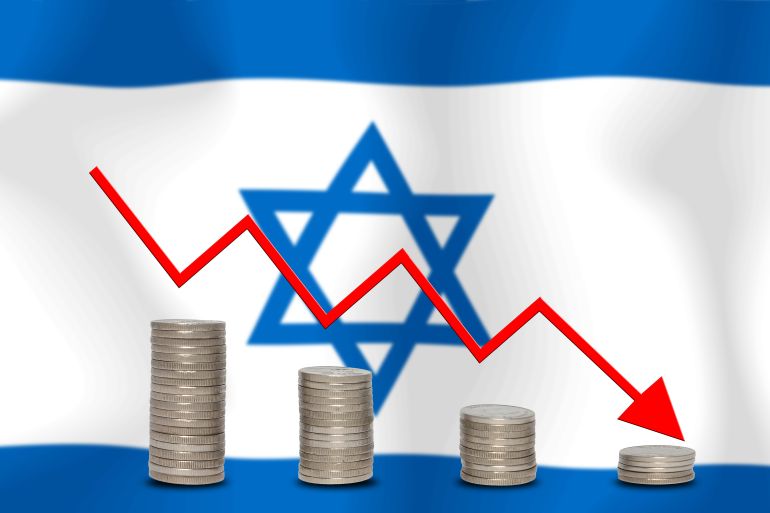
According to the latest research assessments, the Israeli economy stands at a highly sensitive point that threatens to turn the consequences of the ongoing war into a prolonged economic crisis. The increase in defense spending, the worsening deficit, and the slowdown in investment and productivity have become intertwined factors putting pressure on both the standard of living and growth simultaneously.
According to the “State of the Nation 2025” report issued by the Taub Center for Social Policy Studies, the absence of sufficient growth may push Israel into a vicious cycle that restricts civilian spending and weakens its ability to even fund future security requirements.
War Weighs on the Budget and Breaks the Debt Trajectory
The Taub Center report confirms that the large jump in military spending during the war raised the financial deficit and the debt-to-GDP ratio, increased the cost of debt servicing, and weakened productivity and private consumption.
After a decade of gradual decline in the debt burden before the war, the indicators have returned to an opposite trajectory. The debt-to-GDP ratio reached about 70% this year, which is 10 percentage points higher than its pre-war level, with a direct increase in the debt burden of about 8 billion shekels (2.5 billion dollars) in just one year.
Permanent Defense Spending Puts Pressure on Civilian Services
The report warns that the continued rise in defense budgets over the next decade will put pressure on civilian spending and create a “vicious cycle” of weak growth.
The report states that the lack of growth will lead to a worsening scarcity of resources, a reduction in necessary public investment, and a further lowering of the GDP growth rate—a path that may ultimately threaten the state’s own ability to finance its defense needs.
Although the government has so far maintained a pace of civilian spending in line with population growth, the report confirms that this cannot continue without a tangible acceleration in economic growth.
Working More and Producing Less
The report notes a striking paradox in the Israeli labor market, where the unemployment rate is only about 3%, but it is coupled with low productivity compared to similar countries such as Austria, Denmark, the Netherlands, Finland, and Sweden.
Between 2015 and 2023, the gap in value added per worker shrank from 20% to 12%, driven mainly by the disappearance of the gap in the information and communication technology sector.
However, the gap in productivity per hour worked remains wide, having shrunk across the economy from 36% to only 30%, while remaining stable at about 40% in the industrial sector.
The report partly attributes this to the fact that workers in Israel work on average about 25% more hours per year compared to the reference countries.
Strong but Insufficient Technology Economy
The Taub Center report emphasizes that the technology sector remains the engine of the Israeli economy, constituting about 60% of exports and contributing 20% of GDP and 40% of economic growth since 2018.
Weak productivity in the Israeli economy reveals a structural gap where individuals work longer hours without proportional output (Reuters)
Technology service exports rose from 15 billion dollars in 2013 to 55 billion dollars in 2024, according to data from the Israel Innovation Authority.
However, the report warns that this momentum does not compensate for weak productivity in the rest of the sectors, nor does it address the capital-per-worker gap, which remains at about half the level of comparable countries, limiting the overall economy’s ability to raise the standard of living.
High Cost of Living: A Chronic Structural Crisis
The report links the
Israel
Israel is a country in the Middle East, established as a modern state in 1948 following the United Nations partition plan for the British Mandate of Palestine. It is a historic homeland of the Jewish people, containing significant religious sites for Judaism, Christianity, and Islam, such as the Western Wall, the Church of the Holy Sepulchre, and the Al-Aqsa Mosque.
Taub Center for Social Policy Studies
The Taub Center for Social Policy Studies is an independent, non-partisan research institute in Israel, founded in 1982. It conducts socioeconomic research on issues such as education, health, labor, and welfare to inform public policy. The center is named for American philanthropist Henry Taub and aims to provide data-driven analysis for Israel’s long-term planning.
Austria
Austria is a Central European country with a rich cultural history, most notably as the former center of the powerful Habsburg Monarchy and the Austro-Hungarian Empire. Its capital, Vienna, is renowned as a historic hub for classical music, art, and intellectual thought, associated with figures like Mozart, Freud, and Klimt.
Denmark
Denmark is a Scandinavian country in Northern Europe with a rich history dating back to the Viking Age, when it was a major seafaring power. It later became the center of the expansive Kalmar Union in the late Middle Ages and today is a modern constitutional monarchy known for its high quality of life and distinctive cultural heritage.
Netherlands
The Netherlands, historically known as Holland, is a country in Northwestern Europe with a rich history shaped by its relationship with the sea, including major land reclamation projects. It emerged as a major commercial and naval power in the 17th-century Dutch Golden Age and is renowned for its artistic heritage, windmills, tulip fields, and progressive social policies.
Finland
Finland is a Nordic country in Northern Europe known for its vast forests, thousands of lakes, and distinct cultural identity shaped by centuries of Swedish and Russian rule. It gained independence from Russia in 1917 and is celebrated for its design, sauna tradition, and education system.
Sweden
Sweden is a Nordic country in Northern Europe with a rich history as a regional power during the 17th-century Swedish Empire. It is known for its modern welfare state, neutrality in foreign policy, and significant cultural contributions in design, music, and innovation.
Israel Shipyards Port
Israel Shipyards Port, located in Haifa Bay, is a major private shipbuilding and repair facility in the eastern Mediterranean. Established in 1959, it was founded to support Israel’s maritime industry and defense needs, constructing vessels for both commercial and naval purposes.
Haifa
Haifa is a major port city in northern Israel, situated on the slopes of Mount Carmel. It is historically significant as a center for the Baháʼí Faith, home to the Baháʼí World Centre with its iconic terraced gardens and Shrine of the Báb, which were designated a UNESCO World Heritage Site in 2008. The city has evolved from a small port over centuries into a modern hub known for its religious coexistence and industrial activity.
Syria
Syria is a country in the Middle East with a rich history as a cradle of ancient civilizations, including the influential city-states of Ebla and Ugarit and the later Roman city of Palmyra. Its cultural landscape is defined by historic sites like the old city of Damascus, one of the world’s oldest continuously inhabited cities, and the Krak des Chevaliers, a famed Crusader castle.
Turkey
Turkey is a transcontinental nation bridging Europe and Asia, with a rich history as the heart of the Byzantine and Ottoman Empires. Its cultural landscape is defined by iconic sites like the Hagia Sophia in Istanbul, which has served as a cathedral, mosque, and museum over its 1,500-year history. Modern Turkey, founded as a republic in 1923 by Mustafa Kemal Atatürk, blends this deep historical legacy with a contemporary secular state.
Sheikh Hussein Bridge
The Sheikh Hussein Bridge, also known as the Jordan River Crossing, is a border bridge connecting Jordan and Israel near the city of Beit She’an. It is named after a nearby Muslim shrine and has served as a key economic and tourist passage point since its opening in 1994 following the Israel-Jordan peace treaty.
Jordan
Jordan is a Middle Eastern country with a rich historical legacy, most famously home to the ancient city of Petra, a Nabatean capital carved into rose-red sandstone cliffs over 2,000 years ago. The region has been a crossroads of civilizations, later forming part of the Roman, Byzantine, and Ottoman empires before becoming the modern Hashemite Kingdom of Jordan in 1946.
Israel Innovation Authority
The Israel Innovation Authority is a government agency established in 1965 (originally as the Office of the Chief Scientist) to foster technological innovation and entrepreneurship within Israel’s economy. It provides funding, support, and infrastructure to startups, R&D projects, and established companies across various high-tech sectors.