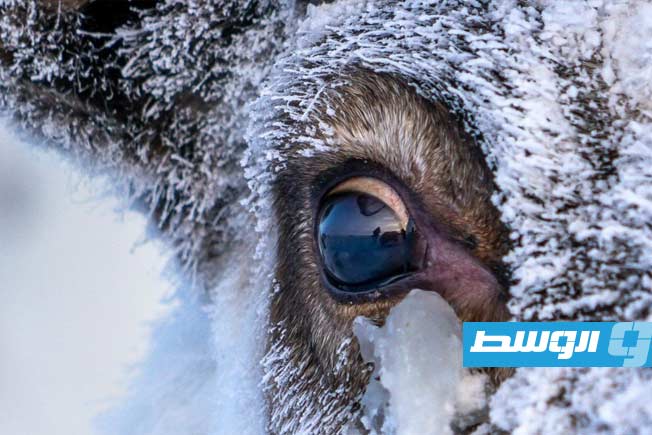
While myths tell tales of glowing reindeer “noses,” science has revealed a more astonishing truth hidden in their “eyes.” In a phenomenon unique among mammals, scientists have discovered that the reindeer (Rangifer tarandus) possesses the remarkable ability to completely change the color of its eyes between seasons, a stunning adaptation that helps it survive in the harsh Arctic environment.
When observing a reindeer in summer, where the sun shines all day, its eyes appear with a golden, turquoise-tinged shine, similar to the reflection in a cat’s eyes. But with the arrival of the long polar winter, where deep darkness prevails, these eyes undergo a radical transformation, turning into a deep, dark blue.
This change is not merely decorative; it is an advanced “vision system.” In winter, “blue light” dominates the long twilight periods in the Arctic, and the reindeer has evolved its eyes to specifically reflect this light, granting it visual ability in darkness that surpasses human capability by 1000 times.
Biological “Winter Tires”
This transformation is likened to changing car tires. Just as tire pressure is reduced to increase traction on ice, the reindeer performs a similar mechanism inside its eye.
– Reindeer pay the price of heatwaves in Finland
– Reindeer killed to prevent the spread of an infectious disease
Most mammals possess a reflective layer behind the retina called the “tapetum lucidum.” In the reindeer, the structure of this layer changes seasonally. In summer, the collagen fibers are spaced apart, reflecting yellow light. In winter, due to the pupil’s constant dilation in the dark, the pressure of the fluid inside the eye increases, compressing the collagen fibers tightly together, which then reflects short-wavelength blue light.
Although this transformation allows the reindeer to spot predatory wolves and search for “lichen” food in the dark, there is a cost to this adaptation. The winter blue vision, despite its intensity, lacks high resolution. Scientists describe it as similar to “looking through frosted glass,” but it remains the perfect trade-off for survival in the dark, icy world.