For years, the “terahertz” range has been described in physics as a “gap” between two worlds: the world of electronics and the world of optics. Now, physicists have managed to bring these two worlds together.
To understand the idea, let’s start by understanding the “electromagnetic spectrum,” which represents all radiation in the universe, including visible light, which represents a tiny part of this spectrum.
Imagine the electromagnetic spectrum as a long road with stations. At its beginning are radio waves, which we use to hear the “radio” every day, then microwaves (used in devices like Wi-Fi and kitchen microwaves), then infrared radiation (which we feel as heat and is used by some remote controls), then the visible light we see with our eyes, and so on.
The terahertz range is a station located between “microwave” and “infrared.” This means it is radiation higher than Wi-Fi waves, but it is not light like infrared or visible light.
Tiny Receptors
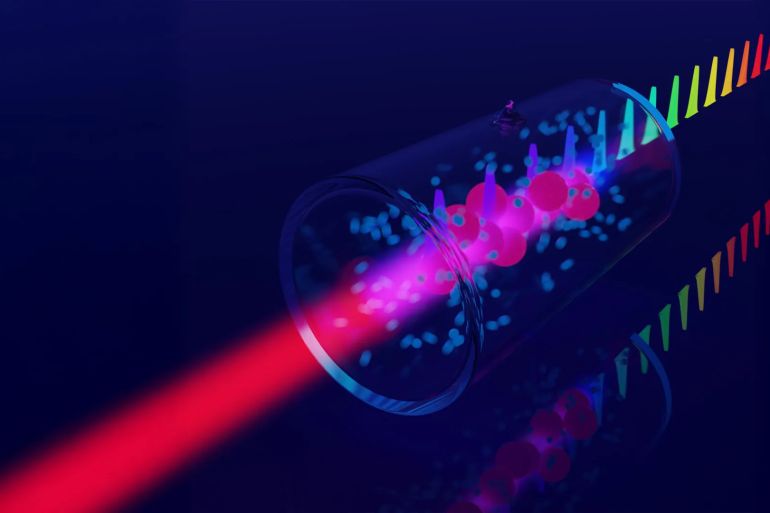
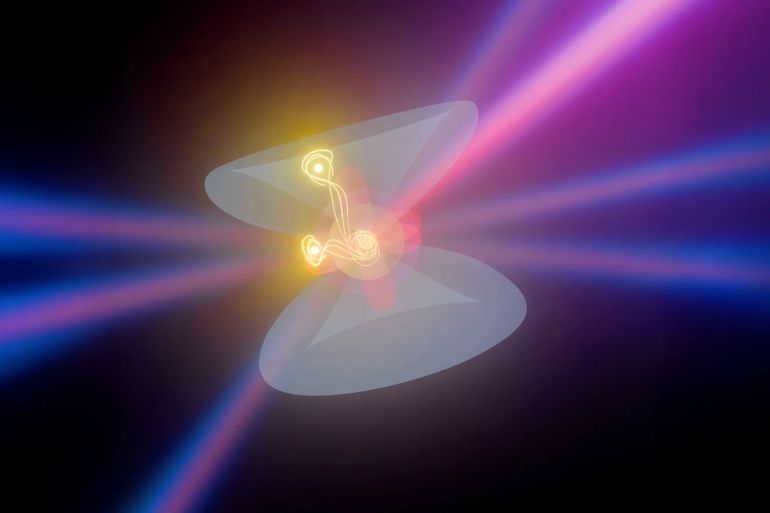
However, it seems scientists have come closer to probing the depths of the mysterious terahertz gap. In a new study published in the journal “Optica,” a team of scientists announced their invention of a so-called “quantum antenna” made of rubidium atoms.
These atoms are not ordinary; one of their electrons was pushed into a very distant orbit using precisely tuned lasers. In this state, the atom becomes extremely sensitive to any external electric field, like an “atomic-level signal receiver.”
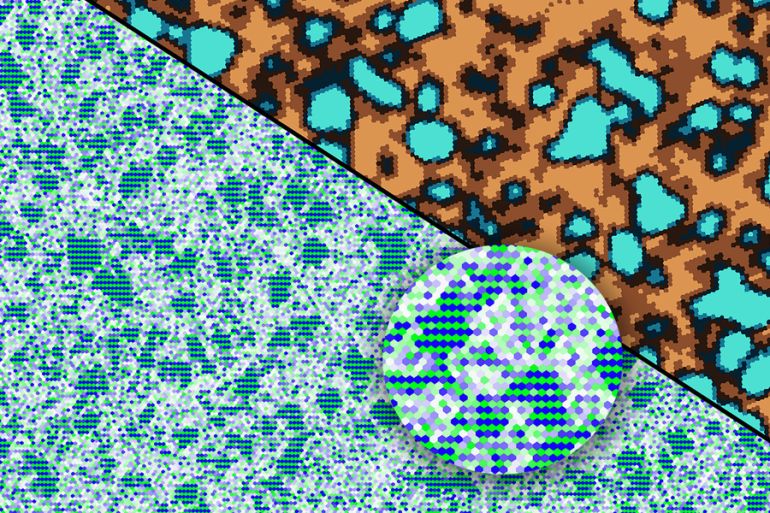
These atomic receptors can detect signals in the terahertz range, but these signals were very weak. Therefore, scientists converted the terahertz wave into light photons that can be counted with highly sensitive detectors (capable of detecting a single photon).
According to the study, this allowed scientists to combine two advantages: the first is that the atom provides a precise measurement standard, and the second is that the optical detector provides very high sensitivity.
The experiments conducted by the scientists remain preliminary.
Potential Applications
Of course, the experiments conducted by the scientists remain preliminary. However, understanding this gap and capturing its signals with a precise level opens the door to wide-ranging applications in the future.
For example, this could contribute to the development of safer inspection devices in airports and shipping, by examining packages and materials without X-rays, and with a better ability to distinguish certain materials.
It could also contribute to quality control of products in factories, inspection of medicines and food, and allow for much faster communications over short distances, through the development of ultra-high-speed wireless links between nearby devices—an idea being discussed within the paths of the sixth generation.
electromagnetic spectrum
The electromagnetic spectrum is not a physical place or cultural site, but a scientific concept describing the entire range of all types of electromagnetic radiation, from radio waves to gamma rays. Its theoretical foundations were developed in the 19th century, primarily through James Clerk Maxwell’s equations that unified electricity, magnetism, and light as different manifestations of the same phenomenon.
radio waves
Radio waves are a form of electromagnetic radiation, not a physical place or cultural site. Their history dates to the late 19th century when Heinrich Hertz first conclusively proved their existence through experiments, building upon James Clerk Maxwell’s theoretical work. This discovery paved the way for all wireless communication technologies, including radio, television, and mobile phones.
microwaves
Microwaves are not a specific place or cultural site, but a type of electromagnetic radiation and the technology that utilizes it. The microwave oven was invented accidentally in 1945 by Percy Spencer while testing radar equipment, leading to a common household appliance that revolutionized food preparation.
Wi-Fi
Wi-Fi is not a physical place or cultural site, but a technology for wireless local area networking. It was commercially introduced in 1997, following the development of the IEEE 802.11 protocol standards, and has since become a ubiquitous method for connecting devices to the internet without cables.
infrared radiation
Infrared radiation is not a place or cultural site, but a type of electromagnetic radiation with wavelengths longer than visible light. It was discovered in 1800 by astronomer Sir William Herschel through experiments measuring the heating effects of different colors of sunlight.
visible light
“Visible light” is not a physical place or cultural site, but rather the segment of the electromagnetic spectrum that is detectable by the human eye. Its scientific understanding developed over centuries, with key contributions from figures like Isaac Newton, who in the 17th century used a prism to demonstrate that white light is composed of different colors.
terahertz range
The terahertz range refers to a band of electromagnetic radiation between microwaves and infrared light, typically defined as frequencies from 0.1 to 10 THz. Historically, this region was difficult to generate and detect, earning it the nickname “the terahertz gap,” but advances in technology since the late 20th century have enabled its use in security imaging, medical diagnostics, and materials science.
rubidium atoms
Rubidium atoms are not a place or cultural site, but a chemical element. They were discovered spectroscopically in 1861 by Robert Bunsen and Gustav Kirchhoff. In modern times, ultra-cold rubidium atoms are a fundamental tool in physics research, notably for creating Bose-Einstein condensates and advancing quantum computing and precision timekeeping.
Optica
Optica is a contemporary art center in Madrid, Spain, founded in 2009, which focuses on visual arts, particularly photography and video. It serves as a key platform for emerging artists and experimental projects, contributing to the city’s modern cultural landscape.
airports
Airports are transportation hubs designed for aircraft takeoff, landing, and maintenance, with their modern development accelerating in the early 20th century alongside commercial aviation. Historically, they evolved from simple grass fields into major international complexes, becoming critical nodes for global travel, trade, and cultural exchange.
X-rays
X-rays are a form of electromagnetic radiation discovered in 1895 by Wilhelm Conrad Röntgen, a breakthrough that revolutionized medical diagnostics and materials science. Their cultural significance lies in their profound impact on healthcare, art authentication, and security, fundamentally changing how we see and interact with the invisible world.