A recent study led by a team from NASA’s Goddard Space Flight Center has revealed intriguing results concerning long-chain organic molecules known as “alkanes,” which were found in ancient clay rocks on the surface of Mars.
The study, published in the journal Astrobiology, discusses the presumed original abundance of these molecules before radiation destroyed large portions of them over millions of years, and how they are difficult to explain solely through currently known “non-biological” processes.
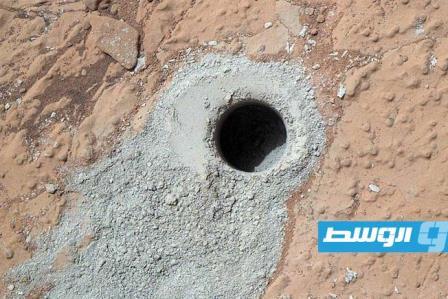
The conclusions were based on modeling how radiation breaks down organic materials over time; samples from the Curiosity rover had shown concentrations of “alkanes” ranging from 30 to 50 parts per billion, a seemingly small proportion.
– A NASA rover traverses the Martian surface without human control for two days
– Study reveals an unexpected role for Mars in determining Earth’s seasons and climate
– NASA displays rocks that reveal past life on Mars
Through laboratory experiments simulating the effects of ionizing radiation that the “Cumberland” clay rocks were exposed to for 80 million years, the team concluded that the original concentration of these materials must have ranged between 120 to 7,700 parts per million—an abundance far exceeding what could be left by meteorites, cosmic dust, or known thermochemical reactions on Mars.
Materials produced by living organisms
Although the study maintains extreme caution and does not assert that these molecules are definitive proof of past life, it clearly indicates that these “alkanes” could be fragments of long-chain “fatty acids,” materials primarily produced by living organisms on Earth.
This discovery opens the door to two possibilities: either there are undiscovered “abiotic” chemical pathways on Mars, or the planet was once the stage for more complex organic activity than is currently known, making the origin of these molecules worthy of careful and direct examination in future missions.
NASA
NASA, or the National Aeronautics and Space Administration, is the United States government agency responsible for the nation’s civilian space program and aerospace research. It was established in 1958 in response to the Soviet Union’s launch of Sputnik, marking the beginning of the U.S.-Soviet space race. NASA is renowned for landmark achievements like the Apollo moon landings and the operation of the Space Shuttle and International Space Station.
Goddard Space Flight Center
The Goddard Space Flight Center, established in 1959 in Greenbelt, Maryland, is NASA’s first major space flight complex. It is named for rocketry pioneer Robert H. Goddard and serves as a leading laboratory for developing and operating unmanned scientific spacecraft, conducting Earth and space science research.
Mars
Mars is the fourth planet from the Sun and is often called the “Red Planet” due to its iron oxide-rich surface. It has been a major focus of scientific exploration, with robotic missions revealing a history of ancient water flows and the potential for past habitability.
Astrobiology
Astrobiology is the scientific study of the origin, evolution, distribution, and future of life in the universe, rather than a specific physical place. It is an interdisciplinary field that emerged in the 20th century, combining astronomy, biology, and geology to investigate the potential for life beyond Earth. Its history is rooted in questions about the possibility of extraterrestrial life, gaining formal structure with NASA’s establishment of its Astrobiology Program in the 1990s.
Curiosity rover
The Curiosity rover is a car-sized robotic explorer that landed on Mars in 2012 as part of NASA’s Mars Science Laboratory mission. Its primary scientific goal is to assess whether the Gale Crater environment ever offered conditions favorable for microbial life, and it has been analyzing the planet’s climate and geology for over a decade.
Cumberland
Cumberland is a historic county in northwest England, known for its picturesque landscapes within the Lake District National Park. It was an administrative county from the 12th century until 1974, when it was merged into the new county of Cumbria. The area’s history is deeply tied to the Roman frontier at Hadrian’s Wall and later to the mining and farming industries.
Earth
Earth is the third planet from the Sun and the only known astronomical object to harbor life, with a geological history spanning over 4.5 billion years. Its surface features diverse ecosystems and has been the cradle for the development of all known human cultures and civilizations.