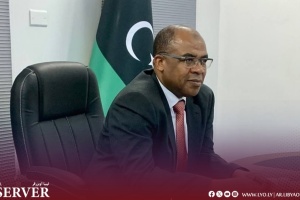
Libya will assume the presidency of the upcoming session of the Council of Ministers of the Organization of Arab Petroleum Exporting Countries (OAPEC), as well as the organization’s Executive Bureau, starting from January 1, 2026.
The Minister of Oil and Gas participated on Sunday in the 115th meeting of the OAPEC Council of Ministers in Kuwait, with the participation of ministers from the organization’s member states.
An official government platform stated in a post that the Council congratulated Libya on assuming the presidency of the upcoming session of the OAPEC Council of Ministers and the Executive Bureau as of January 1, 2026, in a step that reflects confidence in Libya’s role.
It added that the OAPEC Council also approved the appointment of a new Secretary-General of the organization for a three-year term starting in March 2026, succeeding the previous Secretary-General, in a move reflecting confidence in his expertise to manage the transitional phase and enhance coordination among member states and technical bodies, while commending the professional career of the outgoing Secretary-General.
The platform noted that the meeting reaffirmed the continuation of efforts to develop and restructure OAPEC and to launch its new identity under the name “Arab Energy Organization,” in a way that strengthens its regional role and keeps pace with global transformations in the energy sector.
The Council also announced the winners of the OAPEC Award for Scientific Research for 2024 in the field of new and renewable energy.
Libya
Libya is a North African country with a rich history rooted in ancient civilizations like the Phoenicians and Romans, followed by centuries of Arab and Ottoman influence. In the modern era, it was an Italian colony before gaining independence in 1951, later becoming known for Muammar Gaddafi’s lengthy rule from 1969 until the 2011 revolution. The country is home to UNESCO World Heritage sites, such as the ruins of Leptis Magna, which testify to its significant historical legacy.
Organization of Arab Petroleum Exporting Countries
The Organization of Arab Petroleum Exporting Countries (OAPEC) is an intergovernmental organization founded in 1968 by Kuwait, Libya, and Saudi Arabia. Its primary purpose is to foster cooperation in the petroleum industry among its Arab member states, focusing on economic integration and the development of their oil resources.
OAPEC
OAPEC, the Organization of Arab Petroleum Exporting Countries, is an intergovernmental organization founded in 1968 by Kuwait, Libya, and Saudi Arabia. Its primary purpose is to foster cooperation in economic activities within the petroleum industry among its member states, which are all also part of the broader OPEC.
Kuwait
Kuwait is a country on the Arabian Peninsula with a history as a major trading port and pearling center, historically tied to the Bani Utub tribe. It became a British protectorate in the late 19th century before gaining full independence in 1961, later developing into a modern state following the discovery of vast oil reserves. Its cultural sites include the iconic Kuwait Towers and the historic Sadu House, which showcases traditional Bedouin weaving.
Arab Energy Organization
The Arab Energy Organization (OAPEC) is an intergovernmental organization founded in 1968 by several Arab oil-exporting nations to foster cooperation in the petroleum industry and related economic activities. Its primary objectives include coordinating policies to safeguard members’ interests and promoting the development of the oil and gas sectors within Arab countries.
Doha
Doha is the capital city of Qatar, a modern metropolis that grew from a small fishing and pearling village into a major global hub following the discovery of oil and natural gas in the mid-20th century. Its history is showcased in sites like the Souq Waqif, a restored traditional market, and the Museum of Islamic Art, which houses artifacts from across the Muslim world.
US
The United States is a federal republic founded in 1776 after declaring independence from Great Britain. It expanded across North America and grew into a global superpower, shaped by events like the Civil War, westward expansion, and large-scale immigration. Its culture is a diverse blend of indigenous, European, African, and other global influences.