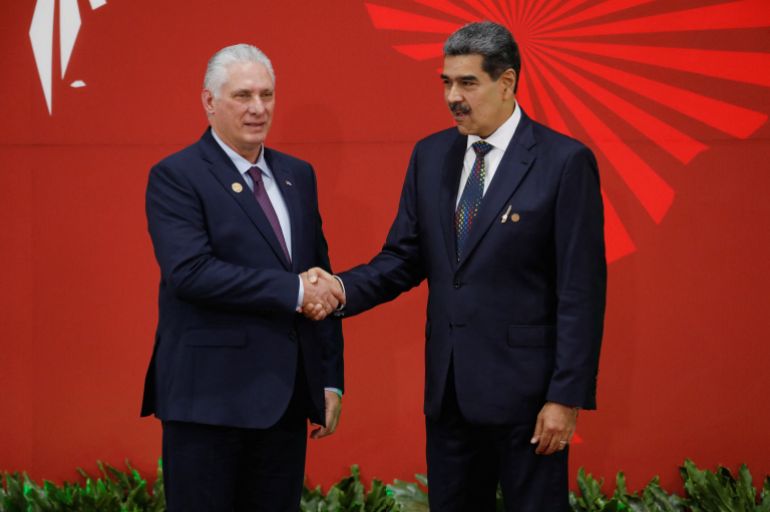
The economic repercussions of the United States’ blockade of Venezuelan oil tankers are not confined to Venezuela alone; they extend to Cuba, whose economy has relied on continuous support from Caracas for many years.
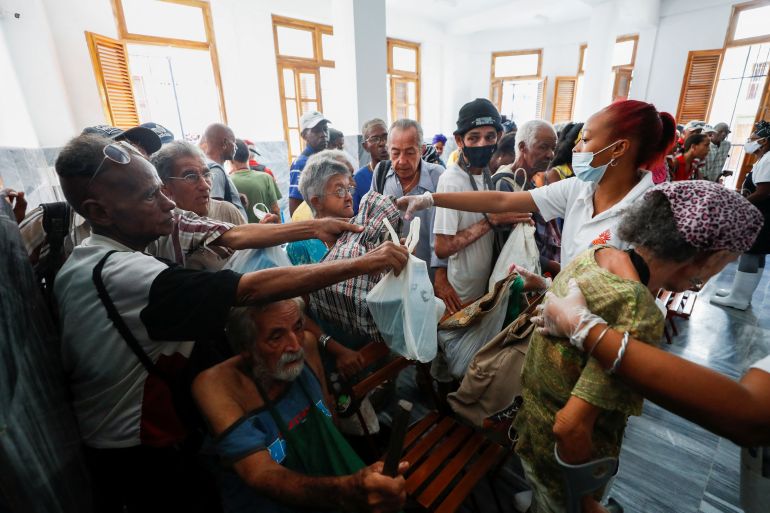
Cuba is already suffering from a severe economic crisis, with its economy shrinking by 15% since 2018, and it faces further difficulties as pressure mounts on its primary supporter, the Venezuelan president.
Cuba has been receiving 100,000 barrels per day of subsidized oil since 1999, when the former president of Venezuela, Hugo Chávez, emphasized the deep bonds between the two countries, which he described at the time as being connected by a “sea of happiness.”
In return, Cuba sent doctors, sports trainers, and intelligence agents to Venezuela to help protect the Chávez regime and continues to support the Maduro regime, which received training in socialist principles in the Cuban capital, Havana, during his youth.
The Importance of Venezuelan Oil for Cuba
Venezuelan crude oil covers approximately 40% of Cuba’s imported oil needs and is crucial for power generation plants and the transportation sector.
However, the volume of subsidized oil received by Havana has declined to 30,000 barrels per day as the United States detains Venezuelan oil tankers, and it could potentially stop entirely if the crisis escalates.
A halt to subsidized oil exports to Cuba “would undoubtedly lead to the collapse of the Cuban economy,” according to a Cuban refugee and oil researcher.
There are genuine concerns about a stoppage of Venezuelan oil exports. The continued U.S. blockade of Venezuelan oil tankers could lead to a complete halt in its oil exports, according to the head of emerging markets at an energy consulting firm.
Venezuela’s oil exports reached 900,000 barrels per day in November last year, with 80% directed to China, representing the lifeblood of Venezuela’s economy.
A Comprehensive Economic Crisis
The threat facing Cuba comes as the country endures its most severe economic crisis since the revolution came to power in 1959—a crisis reportedly more difficult than the one Cuba experienced following the collapse of the Soviet Union in 1991, which itself provided significant support to Havana.
According to estimates by a Cuban economic expert at a university in Washington:
Cuba’s economy has shrunk by 15% since 2018.
Cumulative inflation since the beginning of the Cuban economic crisis is approximately 450%.
The Cuban peso exchange rate has collapsed, trading at around 450 pesos per dollar on the black market, compared to about 30 pesos per dollar in 2020.
It was stated that “if the decline in Venezuelan oil shipments continues in the coming weeks or months, the situation will become unsustainable.”
The crisis has forced thousands in Havana to wait for aid
World Bank estimates indicate:
Cuba’s GDP contracted by 1.1% in 2024. The size of Cuba’s economy was approximately $107 billion annually in 2020.
Per capita income in 2020 averaged about $9,600, according to the latest available data from the Bank.
Cuba’s population is 10.9 million. The Bank lacks data on other important economic indicators in the country, such as the inflation rate, the size of government debt, or the volume of foreign direct investment.
A Quarter of Cuba’s Population Has Left
<
Cuba
Cuba is an island nation in the Caribbean with a complex history shaped by Spanish colonization, the Atlantic slave trade, and its 1959 revolution, which established a socialist state. Its culture is a renowned fusion of Spanish, African, and Caribbean influences, evident in its music, dance, and architecture. Key historical sites include Old Havana, a UNESCO World Heritage Site with well-preserved colonial-era buildings.
United States
The United States is a federal republic founded in 1776 after declaring independence from Great Britain, establishing itself through a revolutionary war and the ratification of its Constitution in 1789. It grew from thirteen original colonies into a global superpower, with a history shaped by westward expansion, industrialization, and significant internal conflicts such as the Civil War. Its diverse culture is a product of immigration and its influential role in 20th-century geopolitics, science, and popular culture.
Venezuela
Venezuela is a South American country known for its diverse natural landscapes, including the Andes Mountains, the Amazon rainforest, and Angel Falls, the world’s highest uninterrupted waterfall. Historically, it was a Spanish colony until the early 19th century, when it became a leading force in the independence movement led by Simón Bolívar, eventually emerging as one of the continent’s first sovereign republics.
Caracas
Caracas is the capital and largest city of Venezuela, founded in 1567 by Spanish conquistador Diego de Losada. It grew from a colonial settlement into a major political and economic hub, notably as the birthplace of Simón Bolívar, a key figure in South America’s independence movements. Today, it is a bustling metropolis marked by significant economic challenges and stark social contrasts.
Hugo Chávez
Hugo Chávez was a Venezuelan military officer and politician who served as the President of Venezuela from 1999 until his death in 2013. He founded the United Socialist Party of Venezuela and is known for his “Bolivarian Revolution,” which implemented socialist policies and extensive social programs funded by the country’s oil revenues.
Nicolás Maduro
Nicolás Maduro is the current president of Venezuela, having assumed the office in 2013 following the death of his predecessor, Hugo Chávez. His presidency has been marked by a severe political and economic crisis in the country, leading to significant international controversy and sanctions.
Miguel Díaz-Canel
Miguel Díaz-Canel is the current President of Cuba, having assumed the role in 2018 after the retirement of Raúl Castro. His presidency marks a generational shift in Cuban leadership, as he is the first person born after the 1959 Cuban Revolution to hold the country’s highest office.
Havana
Havana is the capital city of Cuba, founded by the Spanish in 1519. Its historic center, Old Havana, is a UNESCO World Heritage Site renowned for its well-preserved Spanish colonial architecture and its historical role as a major port for the Spanish treasure fleets.
Soviet Union
The Soviet Union was a socialist state that existed from 1922 to 1991, formed after the Russian Revolution and encompassing much of the former Russian Empire. It was a major global superpower characterized by a single-party communist system and a centrally planned economy before dissolving into multiple independent nations.
China
China is one of the world’s oldest continuous civilizations, with a recorded history spanning over four millennia, marked by successive dynasties and influential philosophical traditions like Confucianism. Today, it is a modern nation-state officially known as the People’s Republic of China, renowned for its significant global economic and cultural impact. Its vast territory contains numerous UNESCO World Heritage sites, including the Great Wall, which was built over centuries to protect imperial borders.
Washington
Washington, D.C., is the capital city of the United States, founded in 1790 following the ratification of the U.S. Constitution. It was established as a federal district to serve as the seat of the national government, distinct from any state, with its design heavily influenced by Pierre Charles L’Enfant. The city is home to iconic landmarks such as the White House, the U.S. Capitol, and the Washington Monument, which symbolize the nation’s history and democratic ideals.
World Bank
The World Bank is an international financial institution founded in 1944 at the Bretton Woods Conference to help rebuild nations after World War II. Its primary mission has since evolved to focus on providing loans and grants to the governments of low- and middle-income countries for the purpose of pursuing capital projects and reducing global poverty.