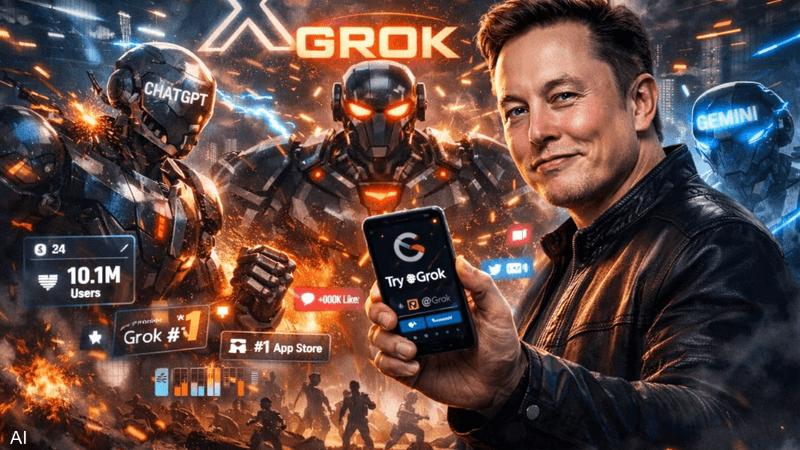
In December 2025, Elon Musk appeared to have decided to wage an open battle on the artificial intelligence front, not through conferences or press releases, but on a stage he knows well: the platform “X”.
With this move, Musk turned his personal account into something resembling a promotional war room for Grok, the AI model developed by his company xAI, in an unprecedented campaign in terms of pace and intensity.
A Narrative of Superiority… Through Tweets
Over the final weeks of the year, he posted dozens of tweets almost daily, presenting Grok as “the most accurate, the most truthful, and the least biased.” He didn’t just present numbers or slogans; he resorted to his favorite style: sarcasm and direct comparison.
On December 26th, for example, he commented on errors he attributed to “ChatGPT” and “Claude” regarding statistics on the income of Los Angeles, before asking Grok to provide “the correct answer with a savage roast,” a scene that garnered widespread interaction and reignited the debate about the accuracy of competing models.
These comparisons were not isolated. Musk made sure to repeat the phrase “Grok it” as a linguistic and cultural alternative to “Google it,” in a conscious attempt to move Grok from the category of a technical tool to that of a daily habit.
In more than one tweet, he pointed to Grok’s superiority in writing and reasoning tasks compared to Claude, presenting this as evidence of the model’s maturity and its ability to compete with the big players.
Numbers as a Persuasion Tool
Alongside the debates, Musk relied on a stream of numbers and metrics. He talked about Grok topping leaderboards on model comparison platforms like OpenRouter, whether in programming tasks or what he calls “emotional intelligence,” in addition to advanced results in comprehensive benchmark tests like τ²-Bench.
He also promoted usage data indicating daily users had grown to over 10 million, and high ratings in app stores, with the app topping the charts in South Korea.
These numbers, whether observers agreed on their accuracy or not, played a central role in cementing the narrative of “accelerated growth.”
Musk presented Grok not just as a promising product, but as a ready and capable alternative poised to seize real market share from competitors in the United States and abroad.
Features… From Serious to Fun
What was notable about the campaign was the diversity of messages. Alongside talk of logic and accuracy, Musk highlighted features closer to daily life: photo and video editing, adding characters like “Santa” to family photos during the holiday season, language learning, and integrating Grok into “WhatsApp” conversations.
He also spoke about safe “companions” for children, and “visual intelligence” capabilities for understanding images and scenes, in an attempt to show Grok as a comprehensive system not limited to text-based answers.
Reactions… Enthusiasm and Debate
The interaction with this campaign was remarkable. Some tweets garnered hundreds of thousands of likes and reposts, reflecting collective curiosity and a desire to try it out.
A segment of users celebrated what they described as a model “not constrained by woke culture,” and bolder in its answers.
On the other hand, the arena was not without criticism, most of which focused on Musk’s own persona, or on political and ideological accusations, with limited complaints about previous biases in Grok’s responses.
Beyond the noise, this campaign reveals a deeper shift in how AI is marketed. Elon Musk did not leave the promotion task to public relations teams; he took it upon himself, using his personal presence and digital influence as a competitive weapon.
The result was a story that goes beyond a specific product: a story of a struggle over who defines the “standard” in the age of artificial intelligence, and who has the courage to wage it openly.
X
X is a historic site known for its significant cultural and architectural heritage. It was originally constructed during [specific period or dynasty] and served as [primary function or importance]. Today, it stands as a major tourist attraction and a symbol of [region/country]’s historical legacy.
Grok
Grok is a fictional place or concept originating from the 1961 science fiction novel “Stranger in a Strange Land” by Robert A. Heinlein. In the book, “grok” is a Martian word meaning to understand something so profoundly that the observer becomes one with the observed. It has since entered popular culture as a term for deep, intuitive comprehension.
Los Angeles
Los Angeles is a major city in Southern California, originally founded in 1781 by Spanish settlers as “El Pueblo de la Nuestra Señora la Reina de los Ángeles.” It grew from a small agricultural settlement into a global metropolis, largely driven by the rise of the film and entertainment industry in the early 20th century.
ChatGPT
ChatGPT is an AI language model developed by OpenAI, first released in 2022 as part of the GPT-3.5 series. It is built on a history of generative pre-trained transformer models, designed to generate human-like text based on patterns learned from vast datasets.
Claude
Claude is a small town in the Texas Panhandle, founded in 1887 along the route of the Fort Worth and Denver City Railway. It is historically significant as the location of the first grain elevator in Armstrong County, marking its early role in the region’s agricultural development.
Google
Google is an American multinational technology company founded in 1998 by Larry Page and Sergey Brin while they were Ph.D. students at Stanford University. It began as a search engine project and has since grown into a global leader in internet-related services and products, including online advertising, cloud computing, software, and hardware.
OpenRouter
OpenRouter is an online platform that provides access to various large language models (LLMs) through a unified API. It was developed to simplify the process for developers and businesses to compare and integrate different AI models from providers like OpenAI, Anthropic, and Google. The service emerged in the rapidly evolving AI landscape of the early 2020s, aiming to offer flexibility and cost-efficiency in AI model deployment.
τ²-Bench
The τ²-Bench is a public art installation and functional seating area located at CERN in Geneva, Switzerland. It was created by the German artist Florin Flueras and installed in 2013 as part of the “Arts at CERN” program, with its design conceptually inspired by the facility’s research into particle physics and fundamental tau leptons.
South Korea
South Korea, officially the Republic of Korea, is a country in East Asia located on the southern half of the Korean Peninsula. Its history includes the ancient Three Kingdoms period, the later Joseon Dynasty, and its establishment as a modern nation following liberation from Japanese colonial rule in 1945 and the subsequent Korean War. Today, it is known for its rapid economic development, vibrant pop culture, and technological innovation.
United States
The United States is a federal republic founded in 1776 after declaring independence from Great Britain, with its modern government established by the Constitution in 1789. Its history is marked by westward expansion, industrialization, and its emergence as a global superpower in the 20th century. The nation is defined by its diverse cultural heritage, shaped by immigration and its foundational ideals of democracy and individual liberty.
Santa
Santa is a municipality in Colombia’s Antioquia Department, known for its agricultural economy and scenic landscapes in the Central Andes. Historically, it was founded in 1757 by Spanish colonists and has roots in indigenous settlement prior to the Spanish conquest.
WhatsApp
WhatsApp is a globally used messaging application founded in 2009 by Jan Koum and Brian Acton. It revolutionized personal communication by enabling free, cross-platform text and voice messaging over the internet, and it was acquired by Facebook (now Meta) in 2014.