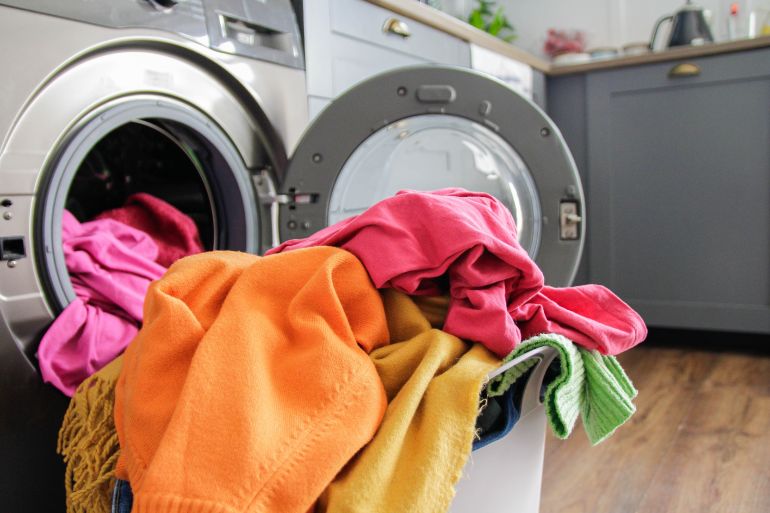
Laundry is one of the most resource-intensive household activities, involving costs for detergents, water consumption, electrical energy, and the need to buy new clothes periodically due to fading or wear from frequent washing. Here are some simple tricks to reduce these costs while keeping your clothes clean:
Simple Methods to Ensure Cleanliness and Savings
According to estimates, running a washer and dryer costs between one and two dollars per single wash cycle. For an average family performing about 300 wash cycles per year, total spending can range from 300 to 500 US dollars annually.
However, it is possible to cut these expenses by following these simple steps:
First: Methods for Using Detergents and Additives
Laundry efficiency depends heavily on the amount and quality of detergent used. A common misconception is that using more detergent leads to better results, but in reality, excess detergent causes chemical deposits on fibers, leading to color fading and residue buildup inside the washing machine parts. This means that using too much wastes your money and gives unsatisfactory results at the same time.
Experts recommend using half the amount suggested on packaging for normal loads, as one cap is often sufficient for a full load. Costs can also be significantly reduced by making a homemade detergent from washing soda, borax, and grated soap. Furthermore, white vinegar is an effective and inexpensive alternative for fabric softening and odor removal, eliminating the need for expensive commercial fabric softeners.
Second: Clothing Drying Strategies
The electric dryer is one of the most energy-consuming appliances in the laundry room, with a single cycle costing about a dollar. To reduce this consumption, reusable wool dryer balls can be used as a practical alternative to traditional dryer sheets. Adding a few drops of diluted essential oil to these balls helps impart a pleasant scent to clothes while reducing static electricity generated by fabric friction inside the dryer.
However, it is advised to wash dryer balls monthly with hot water to remove oil buildup and avoid any potential fire hazards. Natural air drying remains the cheapest and best option for preserving fabric quality and extending its lifespan. If using a dryer is necessary, it is preferable to separate cotton clothes from heavy fabrics like denim, as mixing them can affect the accuracy of moisture sensors and lead to unnecessarily longer cycle times.
Third: Controlling Temperatures and Operation Timing
Studies indicate that about 90% of a washing machine’s energy consumption goes toward heating water. Tests have shown that lowering the wash temperature from 40 to 30 degrees Celsius reduces energy consumption by approximately 38%, while savings reach about 62% when washing at 20 degrees Celsius. Since most modern detergents are designed to work efficiently in cold water, heating water becomes unnecessary for the majority of wash cycles.
Additionally, electricity rates vary throughout the day in some systems, making operation timing a factor affecting the bill. Therefore, it is preferable to run the washer and dryer outside of peak hours whenever possible to reduce consumption costs without affecting wash quality.
Using cold water for washing is recommended to save energy and protect fabrics.
Fourth: Operational Efficiency and Preventive Maintenance
The mechanical condition of the appliance and the load size directly impact resource consumption. The “full load” rule should be followed, filling the washer drum to about 75% capacity, which ensures optimal water and electricity consumption. Before placing clothes in the washer, it is preferable to perform spot cleaning of simple stains using dishwashing liquid; this reduces the number of full wash cycles and preserves fabric quality.
Regarding maintenance, the dryer’s lint filter should be cleaned after every use to ensure airflow, and a monthly empty hot water and vinegar wash cycle should be run to clean pipes of limescale deposits. This ensures the motor and
washer
A “washer” typically refers to a washing machine, a household appliance invented to automate laundry cleaning. Its history dates back to the late 18th century with early hand-cranked devices, evolving into the electric-powered machines first commercially successful in the early 20th century. This innovation dramatically reduced the manual labor of washing clothes and became a standard appliance in homes worldwide.
dryer
A clothes dryer is a household appliance used to remove moisture from laundry after washing, typically through heated air circulation. Its modern electric version was popularized in the mid-20th century, evolving from earlier mechanical wringers and ventilated drums.
washing machine
The washing machine is a household appliance that mechanizes laundry cleaning, evolving from early hand-cranked wooden tubs in the 18th century to James King’s 1851 drum design. Its widespread adoption was driven by the introduction of electric motors in the early 20th century, revolutionizing domestic labor and becoming a standard feature in homes.
detergent
“Detergent” is not a place or cultural site; it is a cleaning product. Its history as a modern chemical product began in the early 20th century with the development of synthetic surfactants to replace traditional soap.
washing soda
Washing soda, chemically known as sodium carbonate, is not a specific place or cultural site but a common household chemical compound. Historically, its natural form (soda ash) has been used since antiquity for cleaning and in glassmaking, with industrial production methods like the Solvay process being developed in the 19th century.
borax
Borax is a naturally occurring mineral compound that has been used since ancient times, notably by the Egyptians for mummification and later by the Romans. Its modern history is tied to large-scale mining in places like Death Valley, California, in the late 19th century, where it became a commercially important industrial and household chemical.
soap
Soap has been used for cleaning and hygiene for thousands of years, with evidence of soap-like substances dating back to ancient Babylon around 2800 BC. Its production methods evolved significantly in the Middle Ages in Europe and the Middle East, and it became a mass-produced commodity during the Industrial Revolution.
white vinegar
White vinegar is a clear, acidic liquid primarily produced through the fermentation of grain alcohol into acetic acid. Its history dates back thousands of years, with early forms likely discovered accidentally when wine or beer was left exposed to air, a process later scientifically understood as acetous fermentation. Today, it is a common household staple used for cooking, cleaning, and preservation.
fabric softener
“Fabric softener” is not a place or cultural site, but a laundry product used to soften fabrics and reduce static cling. It was first developed in the mid-20th century as a way to make clothes feel more comfortable after washing.
wool dryer balls
Wool dryer balls are a reusable laundry accessory, not a historical or cultural site. They are typically made from compressed wool and are used to soften fabrics, reduce drying time, and minimize static cling in modern household laundry. Their history is practical rather than cultural, emerging as a natural alternative to chemical fabric softeners and disposable dryer sheets.
dryer sheets
Dryer sheets are a common household product used to reduce static cling and add fragrance to laundry, first introduced in the 1960s by the Procter & Gamble company. They consist of a non-woven polyester sheet coated with a softening agent and scent, which is released by the heat of a clothes dryer.
essential oil
Essential oils are concentrated plant extracts historically used in ancient civilizations like Egypt, China, and India for medicinal, cosmetic, and religious purposes. Their production and application evolved through practices such as distillation and infusion, becoming central to traditional and modern aromatherapy and wellness.
denim
Denim is a durable cotton twill fabric, most famously used in blue jeans, which originated in the French city of Nîmes (hence “de Nîmes”) in the 17th century. It gained global cultural significance in the 20th century, largely through Levi Strauss & Co., transforming from workwear into a universal symbol of casual style and rebellion.
cotton
Cotton is not a specific place or cultural site, but a plant that has been cultivated for its fiber for thousands of years, with evidence of use in ancient civilizations like those in the Indus Valley and Peru. Its large-scale cultivation and processing, particularly through the labor of enslaved people in the American South, played a central and tragic role in global economic and social history. Today, it remains a vital commodity in the global textile industry.
dishwashing liquid
Dishwashing liquid is a modern cleaning product developed in the mid-20th century as a gentler, more effective alternative to traditional soaps for washing dishes by hand. Its history is tied to the innovation of synthetic detergents, which were created to work better in hard water and to cut through grease more efficiently.
lint filter
A lint filter is a mesh screen or trap found in household clothes dryers designed to catch lint and debris from fabrics during the drying cycle. Its invention and widespread use became essential with the popularization of electric dryers in the mid-20th century, improving safety by reducing the risk of fire from accumulated lint.
hot water
“Hot water” is not a specific place or cultural site, but often refers to natural hot springs, which are geothermal pools used for bathing and relaxation across many cultures. Historically, hot springs like those in Bath, England, or Beppu, Japan, have been valued for their therapeutic properties and often developed into social and spiritual centers.
vinegar
Vinegar is not a specific place or cultural site, but a fermented liquid with a long history of production and use across many cultures. Its origins for culinary and preservation purposes date back to ancient Babylon around 3000 BC, and it has held significant roles in food, medicine, and household tasks throughout history. Today, it remains a global culinary staple and is central to many regional food traditions.