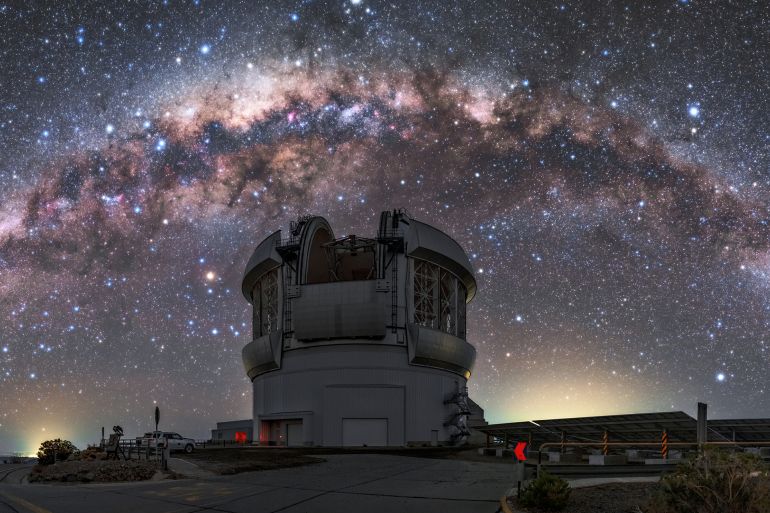
On the peaks of the Chilean Andes, where the air is clear and city lights are distant, the sky opens like a vast cosmic book. From there, a Chilean night appears as a breathtaking celestial display: the colorful band of the Milky Way hangs over the silver dome of the Gemini South Telescope, studded with sparkling star clusters and dark cosmic dust lanes, in a scene not seen with such intensity and clarity by visitors from the Earth’s Northern Hemisphere.
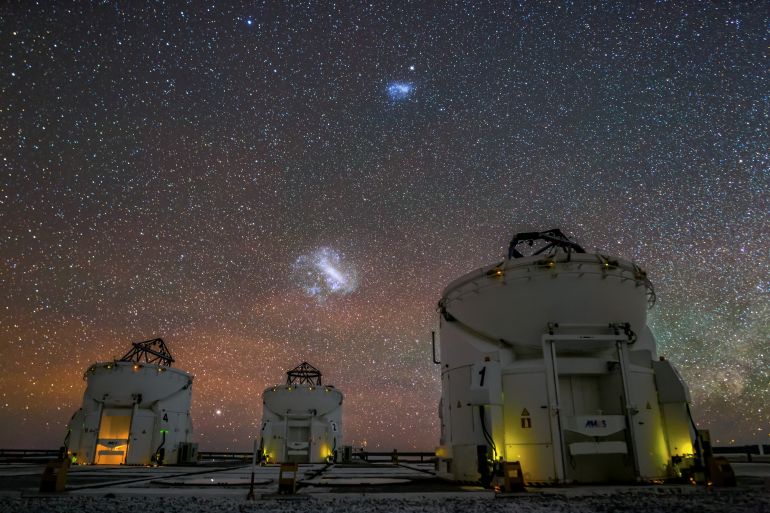
Here, rare southern stars and constellations appear, and two nearby galaxies shine – the Large and Small Magellanic Clouds – like two jewels suspended on the horizon.
The image preserves its original description, with the center of our galaxy positioned directly above the telescope, framing one of the most powerful astronomical observatories in the Southern Hemisphere. To the left of the scene, the Magellanic Clouds loom, two dwarf satellite galaxies of the Milky Way, lacking clear spiral arms but teeming with billions of stars, forming a distinctive marker of the southern sky.
About the Telescope and Location
The Gemini South telescope is located atop Cerro Pachón in Chile, with an 8.1-meter diameter mirror. It is one of a twin pair that forms the International Gemini Observatory: Gemini South in Chile, and Gemini North atop Mauna Kea in Hawaii. The observatory operates in both visible and infrared light and uses advanced technologies like Adaptive Optics, systems of deformable mirrors that compensate for disturbances in the upper atmosphere, which can distort images of distant stars and galaxies. This enables ultra-sharp images and precise observation of galaxy structures, star-forming regions, and distant black hole environments. The observatory was established at the turn of the new millennium to give scientists near-complete coverage of the night sky from both hemispheres of the Earth.
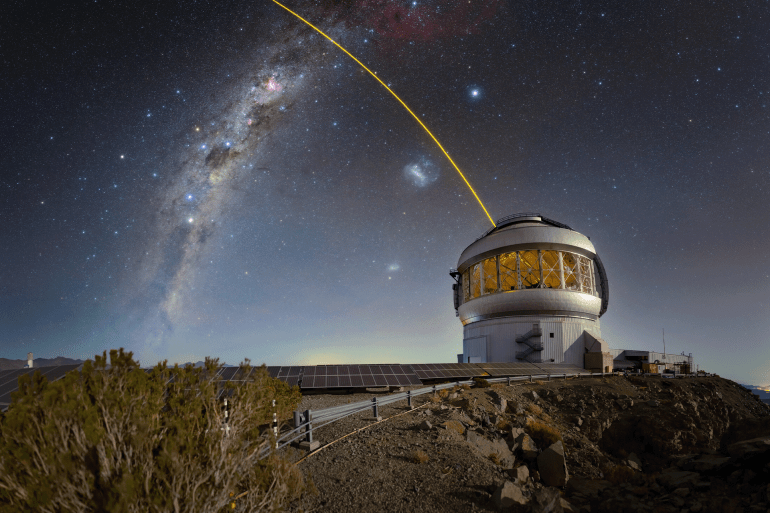
The Gemini telescope uses a laser to calibrate adaptive optics systems that help overcome the effect of the atmosphere.
Why Chile?
Chile is not just a location; it is a cosmic window, with its high altitudes, dry stable skies, and near-absence of light pollution. This is why the Magellanic Clouds appear so clearly; Chile’s southern location makes these two galaxies – invisible from most northern areas – a constant feature of clear nights, adding a mythical dimension to the scene.
It is an open invitation to visit this place on a journey to the distant past. To stand under the Milky Way in Chile is to see the universe as it was, and to feel – if only for a moment – that you are part of its story. Here you don’t need a telescope to be amazed… it’s enough to look up.
Milky Way
The Milky Way is the spiral galaxy that contains our Solar System, appearing as a hazy band of light across Earth’s night sky. Its name originates from ancient Greek mythology, where it was described as a stream of spilled milk from the goddess Hera. Modern astronomy has revealed it to be a vast structure of stars, gas, and dust, with our Sun located about halfway out from its center.
Gemini South telescope
The Gemini South telescope is one of the twin optical/infrared telescopes of the International Gemini Observatory, located on Cerro Pachón in Chile. It began operations in the early 2000s and, along with its northern counterpart in Hawaii, was built to provide astronomers with unparalleled coverage of both the northern and southern skies.
US National Optical-Infrared Astronomy Research Laboratory
The US National Optical-Infrared Astronomy Research Laboratory (NOIRLab) is a federally funded center formed in 2019, consolidating several major US observatory operations like Kitt Peak and Cerro Tololo. It operates world-class ground-based optical and infrared astronomy facilities, enabling research into the universe’s origins, galaxies, and dark matter.
Gemini Observatory
The Gemini Observatory consists of twin 8.1-meter optical/infrared telescopes located on Maunakea in Hawai‘i and Cerro Pachón in Chile, providing full sky coverage. It was built through an international partnership led by the United States and began scientific operations in the early 2000s. The observatory’s advanced adaptive optics systems allow astronomers to obtain exceptionally clear images of the universe.
Chilean Andes
The Chilean Andes form the western edge of the broader Andes mountain range, running the length of Chile and creating a dramatic natural border with Argentina. These mountains have a complex geological history spanning hundreds of millions of years and were central to the Inca Empire’s southern expansion before becoming a significant region for Spanish colonial exploration and mining. Today, they are a vital source of water, a hub for adventure tourism, and hold deep cultural significance in Chilean identity.
Large Magellanic Cloud
The Large Magellanic Cloud is a satellite galaxy of the Milky Way, visible from the Southern Hemisphere. It has been observed and documented for centuries, notably serving as a celestial reference for navigators like Ferdinand Magellan during his 16th-century voyage.
Small Magellanic Cloud
The Small Magellanic Cloud is a dwarf irregular galaxy and a satellite of the Milky Way, visible from the Southern Hemisphere. Historically, it was documented by European explorers in the 16th century, though it was known to indigenous cultures long before. It is named after Ferdinand Magellan, whose expedition provided its widespread Western description.
Earth
Earth is the third planet from the Sun and the only known astronomical object to harbor life. Its geological history spans over 4.5 billion years, with the development of a biosphere that has profoundly shaped its atmosphere and surface through processes like plate tectonics and biological evolution.
Northern Hemisphere
The Northern Hemisphere is the half of Earth that lies north of the equator, containing approximately 68% of the planet’s landmass and the majority of its human population. Historically, it has been the primary location for the development of many major ancient civilizations, including those in Mesopotamia, the Indus Valley, China, and the Mediterranean.
Southern Hemisphere
The Southern Hemisphere refers to the half of Earth that lies south of the Equator, containing continents like South America, Australia, and Antarctica, as well as vast oceans. Historically, its exploration and mapping accelerated during the Age of Discovery, with European voyages fundamentally altering global understanding of geography and leading to widespread cultural exchange and colonization.
Auxiliary Telescopes
The Auxiliary Telescopes are part of the Very Large Telescope array at the Paranal Observatory in Chile. They are movable 1.8-meter telescopes used for interferometry, allowing astronomers to combine their light to achieve extremely high-resolution observations. The system became operational in the early 2000s to enhance the VLT’s capabilities.
ESO’s Very Large Telescope
The Very Large Telescope (VLT) is a world-leading astronomical observatory located in Chile’s Atacama Desert, operated by the European Southern Observatory (ESO). It consists of four main unit telescopes, which began operations between 1998 and 2000, and can work together to form a giant interferometer. The facility was built to provide astronomers with an unprecedented detailed view of the universe, from planets around other stars to distant galaxies.
Paranal
Paranal is a mountain in Chile’s Atacama Desert, home to the European Southern Observatory’s Very Large Telescope (VLT). The site was chosen for its exceptionally clear skies and arid conditions, with construction of the observatory beginning in the 1990s. It is now one of the world’s most advanced optical observatories for astronomical research.
Chile
Chile is a long, narrow country stretching along South America’s western edge, known for its diverse landscapes ranging from the Atacama Desert to Patagonian glaciers. Its history is marked by pre-Columbian cultures like the Mapuche, Spanish colonization beginning in the 16th century, and independence achieved in 1818. The 20th century included significant political periods, including a military dictatorship from 1973 to 1990.
Cerro Pachón
Cerro Pachón is a mountain peak in northern Chile that serves as a major astronomical observatory site. It is home to the Gemini South Telescope and the future Vera C. Rubin Observatory, chosen for its exceptionally clear and dry skies. The site’s modern astronomical history began with construction in the late 1990s, leveraging the region’s long-standing reputation for ideal observing conditions.
International Gemini Observatory
The International Gemini Observatory consists of twin 8.1-meter optical/infrared telescopes located on mountains in Hawaii and Chile, providing full sky coverage. It was built and is operated by a partnership including the United States, Canada, Chile, Brazil, Argentina, and Korea, with its first telescope beginning operations in 1999. The observatory’s primary mission is to advance astronomical research by providing state-of-the-art observational facilities to the international scientific community.
Gemini North
Gemini North is one of the twin 8.1-meter optical/infrared telescopes that make up the International Gemini Observatory, located atop Maunakea in Hawaiʻi. It began scientific operations in 1999 and, along with its southern counterpart in Chile, provides astronomers with full-sky coverage for exploring the universe.
Mauna Kea
Mauna Kea is a dormant volcano on the island of Hawaiʻi, considered the tallest mountain in the world when measured from its base on the ocean floor. It is a deeply sacred site in Native Hawaiian culture, historically used for ceremonies and as a connection to ancestors. Today, its summit is also home to one of the world’s most important astronomical observatories.
Hawaii
Hawaii is a U.S. state comprising a volcanic archipelago in the central Pacific Ocean, originally settled by Polynesian voyagers around 300-600 CE. It was a unified kingdom in the early 19th century before being annexed by the United States in 1898, eventually achieving statehood in 1959. The islands are renowned for their unique indigenous culture, natural beauty, and historical significance as a strategic and cultural crossroads.