The Sun has been in a state of relative calm for some time, but scientific indicators warn of potential changes in the coming days. Astronomical observatories have recorded a gradual increase in the number of active solar regions on the Sun’s surface over the past 24 hours, following the detection of weak, mid-level “C-class” solar flares, which can sometimes cause very minor disruptions to high-frequency radio communications.
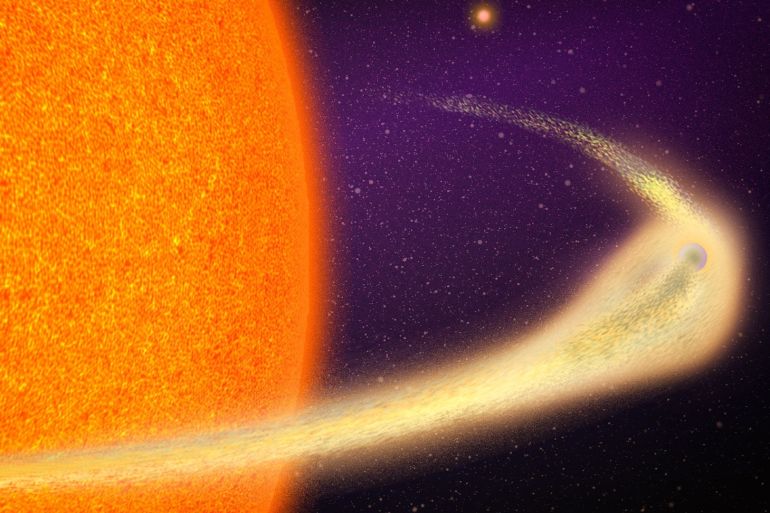
Although no recent solar explosions directly aimed at Earth have been recorded in the previous period, the return of old solar regions (sunspots from last month) – known for their strong activity – will increase the likelihood of above-average “M-class” solar explosions starting today, Wednesday, until the day after tomorrow, Friday, December 26th.
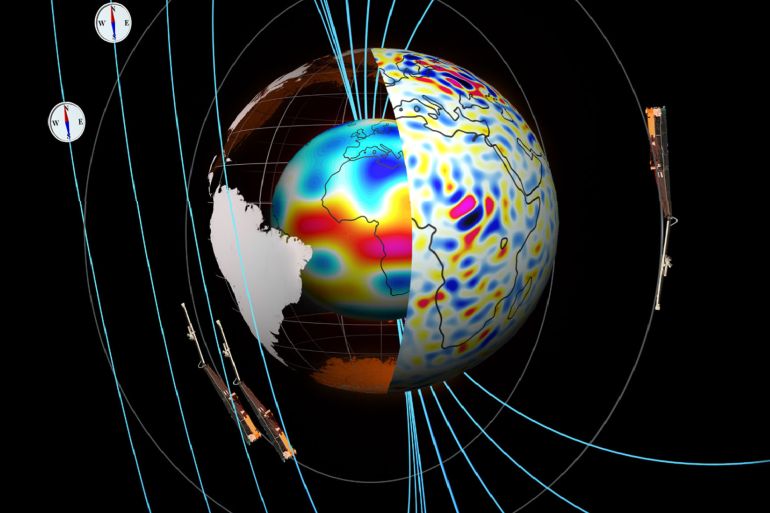
At the same time, Earth will be affected by fast solar winds reaching speeds of about 700 kilometers per second, resulting from a coronal hole, which is a relatively dark area in the Sun’s outer atmosphere (or solar corona). This will lead to noticeable disturbances in Earth’s magnetic field.
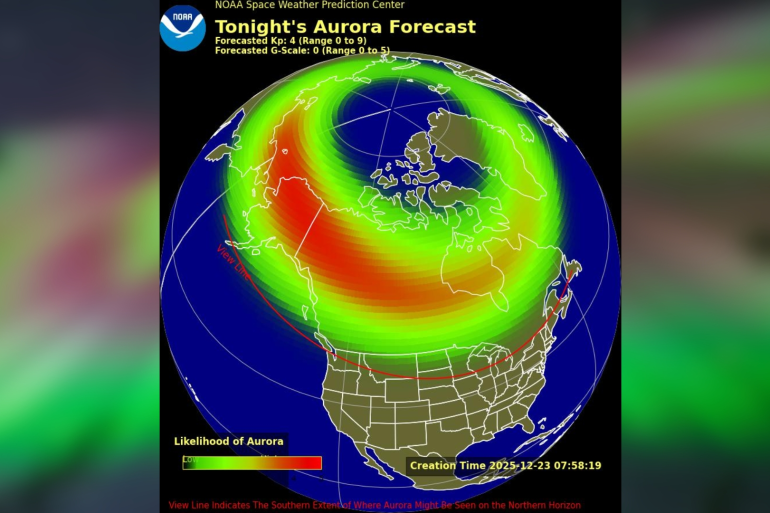
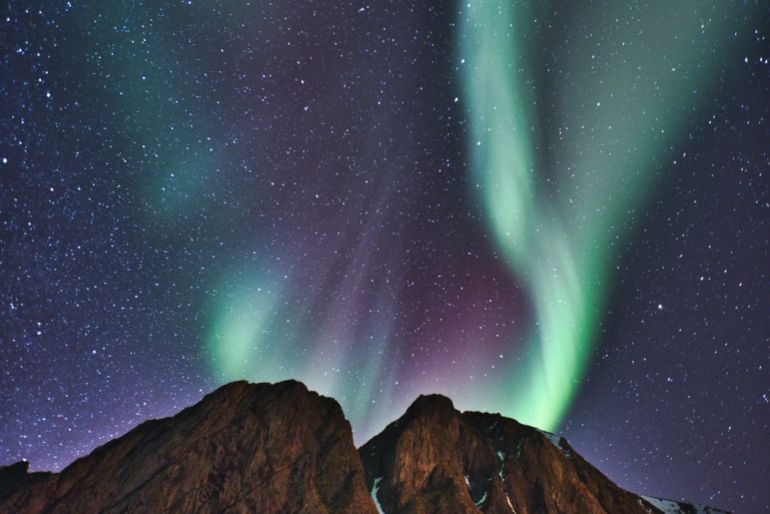
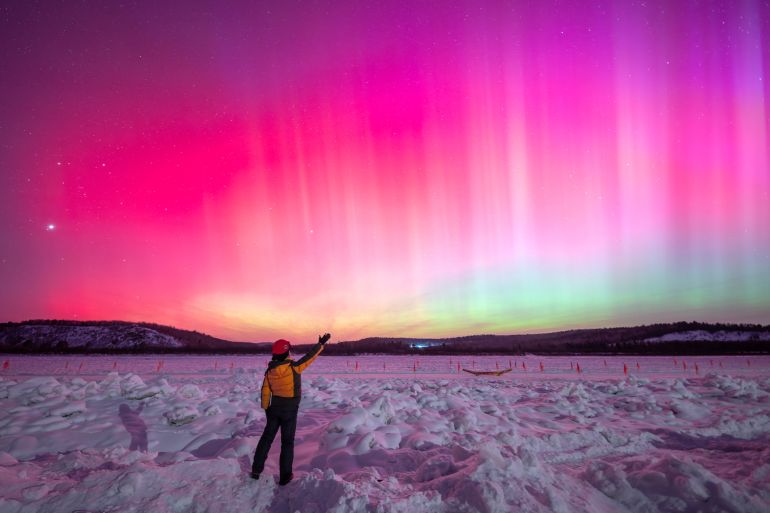
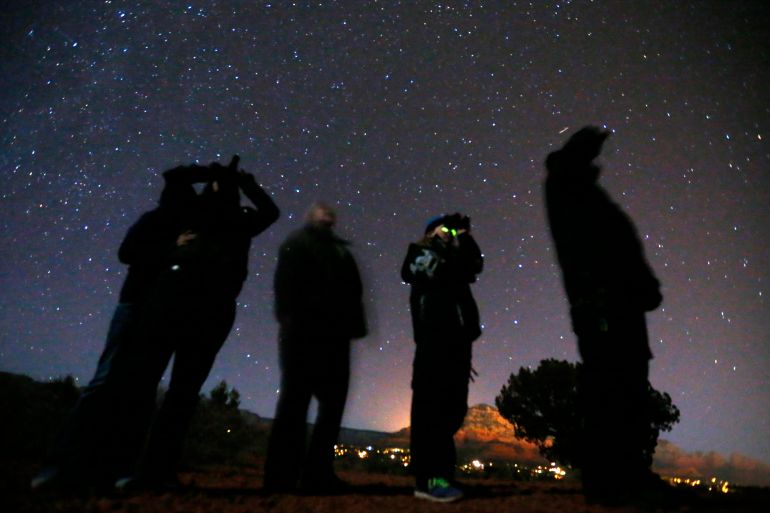
This will also increase the chances of auroral displays in northern regions with latitudes above 45 degrees north and south. This is an opportunity for residents of the upper United States, Canada, most European countries, Scandinavian nations, Central Asian countries, Russia, and northern China to witness auroral displays tonight and in the next few nights.
Scientists warn that these conditions may affect satellites, radio communications, and navigation systems before the situation gradually returns to stability by the end of this week.
Earth
Earth is the third planet from the Sun and the only known astronomical object to harbor life, with a geological history spanning over 4.5 billion years. Its surface features diverse ecosystems and environments shaped by processes like plate tectonics and biological evolution, and it is the origin and home of all known human cultures and civilizations.
National Oceanic and Atmospheric Administration
The National Oceanic and Atmospheric Administration (NOAA) is a United States federal agency, established in 1970, responsible for monitoring and predicting changes in the Earth’s environment. It manages the nation’s weather service, conducts oceanographic research, and protects coastal and marine ecosystems.
Washington
Washington, D.C., is the capital city of the United States, founded in 1790 following the ratification of the U.S. Constitution. It was established as a federal district to serve as the seat of the national government, distinct from any state, with its design largely planned by Pierre Charles L’Enfant. The city is home to iconic landmarks like the White House, the U.S. Capitol, and the Washington Monument, which symbolize the nation’s history and democratic ideals.
Sun
The Sun is not a specific place or cultural site but the star at the center of our solar system. It has been central to human cultures throughout history, often worshipped as a deity in ancient civilizations like those of Egypt and Mesoamerica. Its predictable cycles have shaped calendars, agriculture, and mythologies worldwide.
United States
The United States is a federal republic founded in 1776 after declaring independence from Great Britain, with its modern government established by the Constitution in 1789. Its history is marked by westward expansion, industrialization, and its emergence as a global superpower in the 20th century. The nation is defined by its diverse cultural heritage, shaped by immigration and the complex legacy of its indigenous populations and the institution of slavery.
Canada
Canada is a North American country formed in 1867 through Confederation, evolving from earlier British and French colonial territories. It is known for its vast natural landscapes, bilingual English and French heritage, and a multicultural society shaped by centuries of immigration.
Europe
Europe is a continent with a rich and complex history, shaped by ancient civilizations like Greece and Rome, the Middle Ages, the Renaissance, and periods of both conflict and cooperation, such as the World Wars and the formation of the European Union. It is renowned for its diverse cultural heritage, encompassing countless historic landmarks, artistic movements, and influential philosophical and political ideas.
Scandinavia
Scandinavia is a historical and cultural region in Northern Europe, traditionally comprising the kingdoms of Denmark, Norway, and Sweden, which share deep-rooted linguistic and cultural ties stemming from the Viking Age. The term is often expanded to include Finland and Iceland due to their close geographic and political associations, particularly within the Nordic Council.
Central Asia
Central Asia is a vast historical region at the crossroads of Eurasia, traditionally encompassing the modern nations of Kazakhstan, Kyrgyzstan, Tajikistan, Turkmenistan, and Uzbekistan. It has a rich history as the heart of the ancient Silk Road, serving as a conduit for trade, ideas, and cultures between China, the Middle East, and Europe, and was later home to powerful empires like the Timurids. In the modern era, much of the region was incorporated into the Russian Empire and later the Soviet Union before gaining independence in 1991.
Russia
Russia is the world’s largest country by area, spanning Eastern Europe and Northern Asia. Its history is marked by the rule of the Tsars, the Soviet Union era following the 1917 revolution, and its establishment as the Russian Federation in 1991. It is renowned for its vast landscapes, rich literary and artistic traditions, and iconic sites like the Kremlin and Red Square in Moscow.
China
China is one of the world’s oldest continuous civilizations, with a recorded history spanning over four millennia. It is home to numerous UNESCO World Heritage sites, such as the Great Wall and the Forbidden City, which reflect its long imperial past and profound cultural achievements.