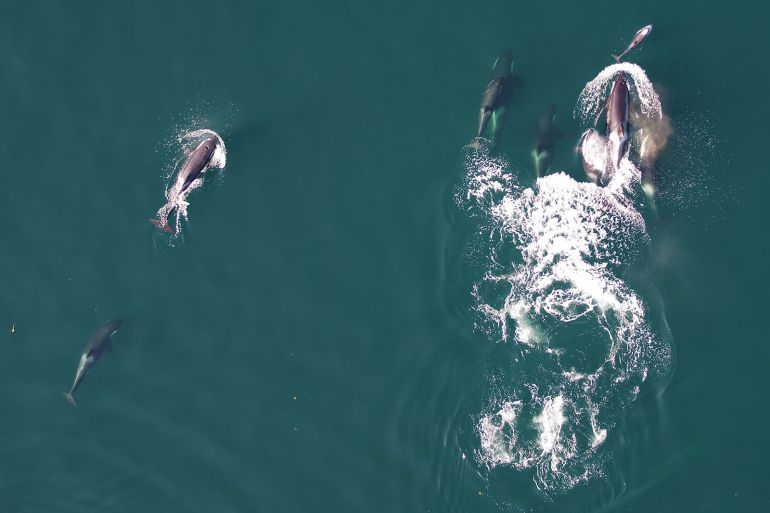
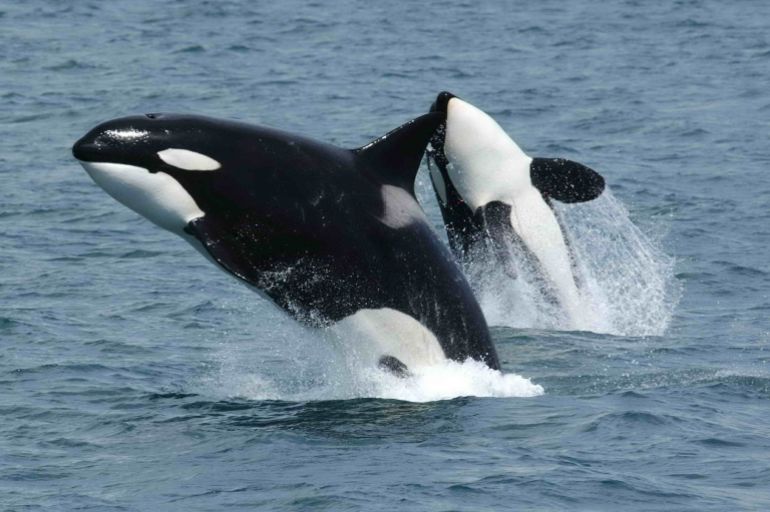
While orcas in some parts of the world prey on dolphins, and dolphins in other places harass or collectively attack orcas, marine biologists have observed a rare and unusual behavior off the coast of Canada’s British Columbia. Orcas were seen cooperating in hunting with Pacific white-sided dolphins, sometimes even allowing them to benefit from the remains of salmon after a catch.
For the first time, the study—recently published in the journal “Scientific Reports”—documents this interaction, a scene that contradicts the common image of orcas as predators of dolphins in other regions of the world.
Below is a short video clip recorded by researchers of this unique phenomenon:
Advanced Techniques
The research team relied on a combination of advanced techniques, including aerial drone footage, underwater cameras, and temporary bio-logging tags attached to the whales’ bodies, to track the movements of 9 orcas from the group known as the “Northern Resident orcas” during August 2020 near Vancouver Island.
The data showed 258 instances where dolphins swam near the orcas, all coinciding with activities related to foraging or hunting salmon—a large fish that is difficult for dolphins to catch or swallow on their own.
The researchers documented 8 cases where orcas successfully caught and dismembered salmon. Dolphins were present in half of these cases and were even observed on one occasion feeding on the leftover fish pieces.
The team also noted 25 instances where orcas changed their course after encountering dolphins, before both parties dove together—a behavior that potentially indicates indirect coordination while searching for prey.
The lead researcher of the study stated in an official press release: “The orcas may benefit from the echolocation clicks emitted by dolphins to detect salmon aggregations.”
Cooperation or Food Theft?
Despite the striking nature of these observations, debate continues among scientists regarding the interpretation of this behavior. While the study team suggests it may represent the first documentation of cooperative hunting and prey sharing between orcas and dolphins, other researchers are skeptical.
Some point out that what is happening could be kleptoparasitism, where dolphins exploit the orcas’ successful hunts to obtain food scraps without providing a clear benefit in return. Others suggest that the behavior of prolonged diving and reduced vocalizations might indicate the orcas are trying to avoid the dolphins, not cooperate with them.
The lead researcher acknowledges that the definitive interpretation remains open, emphasizing that the relationship could be a mix of cooperation and opportunism. However, it is noted that dolphins, despite their attempts, are not physically equipped to hunt large fish like Chinook salmon, making cooperation with orcas a real opportunity to obtain food.
This discovery, according to the researchers, reflects the advanced social intelligence and behavioral learning of whales and dolphins, adding a new chapter to the understanding of complex relationships within marine ecosystems.