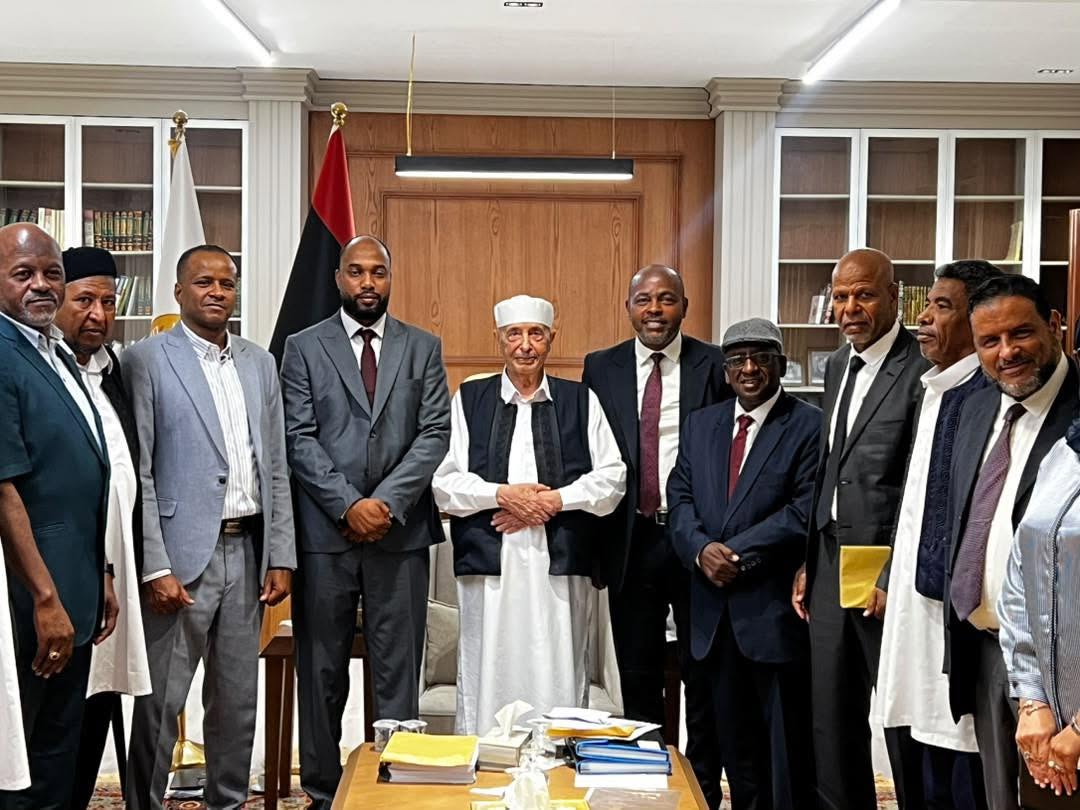
Speaker of Parliament meets Fazzan National Forum representatives, stresses unity needed to complete electoral process.
Speaker of Parliament meets Fazzan National Forum representatives, stresses unity needed to complete electoral process.
Benghazi, July 26, 2026 (WAL) – The Speaker of the House of Representatives, Counselor Aguila Saleh, discussed with representatives of the National Fezzan Forum the latest political and economic developments, listening to their visions and proposals regarding the current phase.
According to the media center of the Speaker of the House, during the meeting, Aguila Saleh listened to the opinions and observations of the forum’s representatives, which includes a number of academics, activists, and opinion leaders, regarding the general situation in the Fezzan region and Libya, and proposals capable of addressing the Libyan crisis, leading to a comprehensive political settlement through organizing parliamentary and presidential elections as soon as possible.
During the meeting, the Speaker of the House of Representatives emphasized the national and historical role of the Fezzan region in building the modern Libyan state, praising the efforts made by academics, intellectuals, sheikhs, and members of the National Fezzan Forum in supporting the dialogue path and participating in political decision-making, reflecting their commitment to achieving the national interest.
He also reviewed developments in the political scene, stressing the necessity of moving forward towards holding parliamentary and presidential elections as the final solution to end the transitional phase, achieve lasting stability, and complete the development and reconstruction process in various regions of the country, foremost among them the Fezzan region.
At the conclusion of the meeting, members of the National Fezzan Forum renewed their support for the House of Representatives as the elected legislative authority, affirming their commitment to continued communication and coordination with the presidency of the Council, contributing to unifying positions and strengthening national consensus, according to the media office.
Benghazi
Benghazi (بنغازي) is the second largest city in Libya and an important port on the Mediterranean Sea, with a rich history dating back to antiquity when it was known as Euesperides. Over the centuries, it was under Greek, Roman, Arab, and Ottoman rule, and in the 20th century, it played a central role in the resistance against Italian colonization and in the 2011 Libyan Civil War. Today, the city preserves historical remnants, such as Greco-Roman ruins and old mosques, but has suffered significant damage from recent conflicts.
Fezzan
Fezzan is a historical region located in southwestern Libya, which was an important center on ancient trans-Saharan trade routes. It was famous for its ancient cities like Ghadames and Sabha, and played a key role in the Berber and Roman civilizations. Today, it is known for its stunning desert landscapes and rich cultural heritage reflecting its ancient history.
Benghazi
Benghazi (بنغازي) is a historic city in Libya, located on the Mediterranean coast, known as an important commercial and cultural center since the Hellenistic period, when it was founded under the name Euesperides. It was the capital of Cyrenaica and played a significant role during Italian colonization, as well as in the fight for Libya’s independence. Today, the city is known for its mix of ancient and modern architecture, although it has suffered considerable damage during recent conflicts.
Fezzan
Fezzan (فزان) is a historical region in southwestern Libya, known for its oases and its important role in trans-Saharan trade. It has been inhabited since antiquity by Berber peoples and was part of various empires, including the Roman and Ottoman. Today, the region is known for its desert landscapes and historic cities like Sabha and Murzuk.
Libya
Libya is a country located in North Africa, famous for its rich historical heritage dating back to ancient times, where it was home to Phoenician, Roman, and Islamic civilizations. Among its most prominent cultural landmarks is the archaeological site of Leptis Magna, an ancient Roman city listed as a UNESCO World Heritage site. In modern times, Libya witnessed major political transformations after the 2011 revolution that overthrew the regime of Muammar Gaddafi.
Ghadames
Ghadames, known as the “Pearl of the Desert,” is a historic city in Libya, renowned for its traditional architecture and ingenious natural cooling system. It was an important commercial center on trans-Saharan caravan routes, with a history dating back to the Roman and Berber periods. Today, the site is listed as a UNESCO World Heritage site, preserving the charm of its covered streets and mud-brick houses.
Sabha
Sabha (سبها) is a historic city located in southwestern Libya, known as an important oasis and commercial center along trans-Saharan caravan routes. It was the capital of the historical Fezzan region and played a significant role during the Ottoman and Italian colonial periods. Today, the city preserves traces of its past, including the old fortress and traditional markets.
Mediterranean Sea
The Mediterranean Sea is an inland sea located between Europe, Africa, and Asia, with a rich history as the cradle of ancient civilizations, such as the Greek, Roman, and Phoenician. Over the centuries, it was an important commercial and cultural corridor, facilitating exchanges between the peoples around it. Today, it remains a major tourist destination, renowned for its picturesque landscapes and cultural diversity.