Turkey and Iraq agree to double oil flows and boost trade
Turkey and Iraq agree to double oil flows and boost trade
They agreed – on Tuesday – to expand cooperation in the fields of energy, trade, and transportation, with both sides announcing work to double oil flows and proceed with the implementation of the “Development Road” project, alongside their efforts to raise bilateral trade to 30 billion dollars in the medium term.
The Turkish President said – following talks with the Iraqi Prime Minister in – that his country seeks to sign a comprehensive cooperation agreement in the field of energy with Iraq as soon as possible, pointing out that al-Zaidi offered to supply Turkey with one million barrels of oil per day.
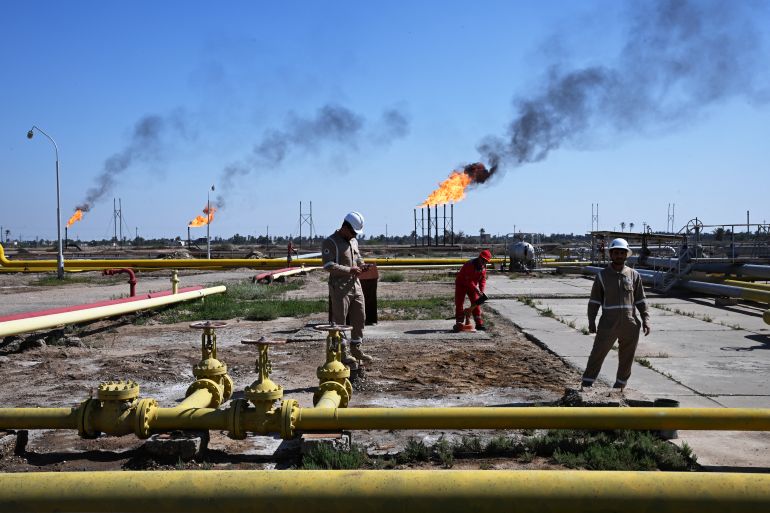
Erdogan added that the Turkish state oil and gas company could work in the Kirkuk oil field operated by BP, following a ceremony that witnessed the signing of an agreement expected to include extending the operation of the Kirkuk-Ceyhan pipeline for an additional year.
Development Road
Iraqi Prime Minister Ali al-Zaidi announced that the two countries will begin implementing the Development Road project, describing it as a “third economic river” linking Iraq and Turkey, transforming the two countries into a connection point between East and West.
Al-Zaidi affirmed that and Ankara will work to double oil flows and enhance their economic resources, noting that his visit to Ankara included signing agreements in the fields of energy, transportation, education, and water, and that Iraq seeks to develop its relations with Turkey to the level of partnership.
The Development Road project extends for about 1,200 kilometers inside Iraq, and includes a railway line and a highway, connecting the Grand Faw Port to the Turkish border and onwards to Europe.
The visit witnessed the signing of three memorandums of understanding between the two countries, covering cooperation in the fields of academic education, youth and sports, and industrial property.
Bilateral Trade
In this context, Turkish Trade Minister Omar Bolat said that Ankara and Baghdad aim to raise the volume of bilateral trade to 30 billion dollars in the medium term, compared to about 17 billion dollars currently, noting that Iraq is Turkey’s fifth largest trading partner.
He added that recent geopolitical developments have enhanced the importance of
Turkey
Turkey is a country located between the continents of Europe and Asia, characterized by a rich history dating back to ancient times, having been a center for the Ottoman Empire and the Byzantine Empire. It is famous for its cultural and historical sites such as Hagia Sophia and Topkapi Palace in Istanbul, as well as the ruins of Ephesus and Cappadocia. Turkey combines Eastern and Western traditions, making it a unique tourist destination.
Iraq
Iraq, known as the cradle of civilization, hosts ancient historical sites like Babylon and Ur, dating back thousands of years. The country has witnessed successive empires, from the Sumerians and Assyrians to the Persians and Arabs. Despite recent conflicts, Iraq remains a cultural treasure, with a rich heritage that includes Islamic art and the holy city of Najaf.
Ankara
Ankara is the modern capital of Turkey, characterized by its ancient history dating back to antiquity, where it was known as “Ancyra” in the Roman era. The city played an important role during the Turkish War of Independence and became the official capital in 1923 under the leadership of Mustafa Kemal Ataturk. Today, Ankara combines historical landmarks like Ankara Castle and Anitkabir with modernity as the political and administrative center of the country.
Kirkuk
Kirkuk is a historical city located in northern Iraq, characterized by its ethnic and cultural diversity, home to Arab, Kurdish, and Turkmen communities. Its history dates back thousands of years; it was an important center in ancient times such as the Assyrian era, and it is famous for its rich oil fields which have made it a focal point of modern conflicts.
Ceyhan
Ceyhan is an important cultural and historical site in the Anatolia region of Turkey, known for its ancient ruins and the influence of Hittite and Roman civilizations. Over time, it was a strategic and commercial center, preserving traces of its rich past, including temples and fortifications. Today, it attracts visitors interested in the history and archaeology of the region.
Development Road
The “Development Road” is an ambitious infrastructure project aimed at connecting Iraq with Turkey and Europe through a network of railways and highways. It seeks to transform Iraq into a regional commercial hub, leveraging its strategic position and natural resources. Although a modern concept, the project draws inspiration from historical trade routes, such as the Silk Road, which crossed this region for centuries.
Faw Port
Faw Port is a strategic Iraqi port located on the Arabian Gulf, established in the 1970s to be Iraq’s main maritime gateway. The port played a vital role in trade and maritime transport, but it was severely damaged during the wars in the region. In recent years, projects have been launched for its development and rehabilitation as part of Iraq’s plan to enhance its economic standing.
Europe
Europe is a continent with a rich and diverse history, being the cradle of Western civilization and powerful empires such as the Roman and Byzantine Empires. Over the centuries, it witnessed major events, from the Renaissance and the Industrial Revolution to the two World Wars, which shaped its borders and culture. Today, Europe is known for its impressive cultural heritage, historical cities, and linguistic and artistic diversity.
Baghdad
Baghdad, the capital of Iraq, is a city with a rich history, founded in the 8th century by the Abbasid Caliph Al-Mansur, quickly becoming a major center of culture, science, and commerce during the Islamic Golden Age. Known for its library (House of Wisdom) and stories from “One Thousand and One Nights,” the city suffered severe destruction from the Mongol invasions of the 13th century and modern conflicts, but remains a symbol of cultural heritage and resilience.