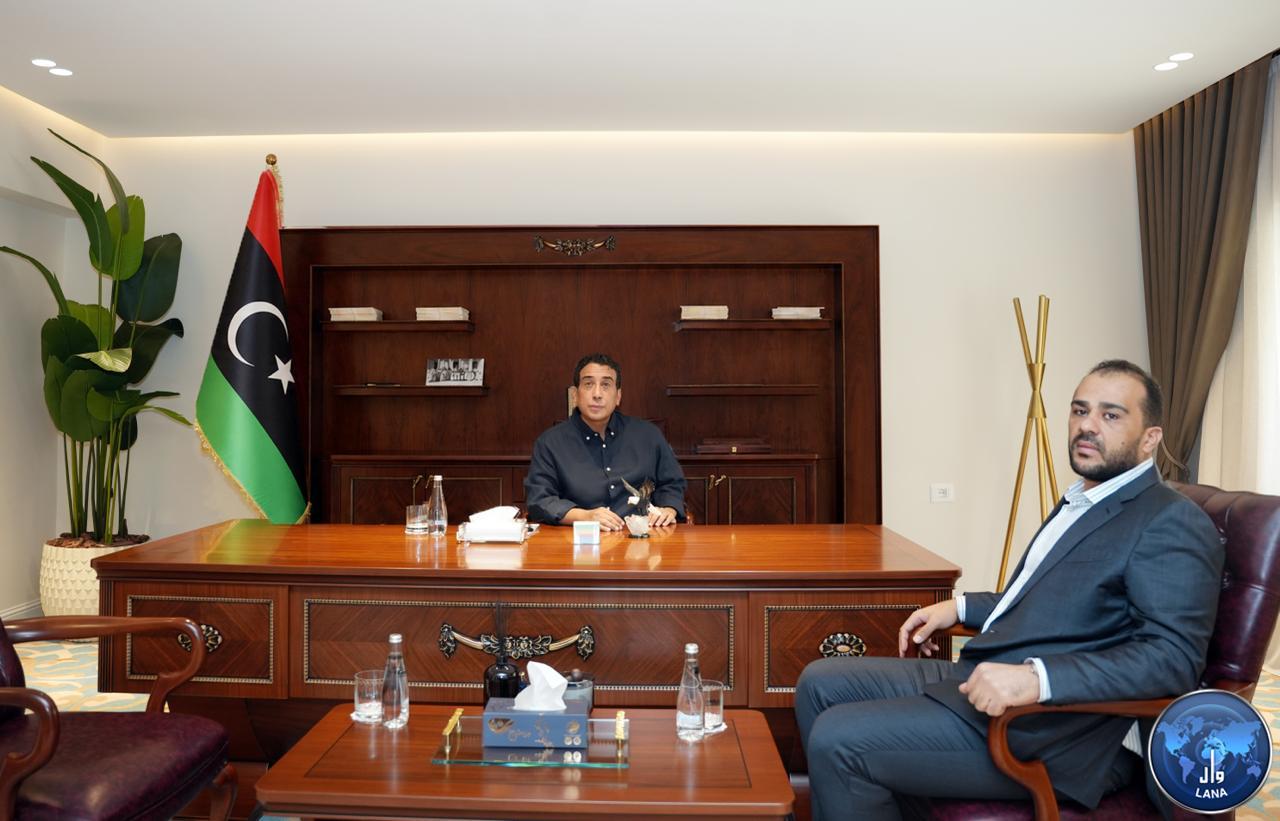
Al-Manfi discusses with Al-Zoubi unifying the military institution, pensions, and raising Libyan army salaries.
Al-Manfi discusses with Al-Zoubi unifying the military institution, pensions, and raising Libyan army salaries.
Tripoli, July 27, 2026 – The President of the Presidential Council, Supreme Commander of the Libyan Army, Mohamed al-Menfi, reviewed on Monday in the capital Tripoli, with the Deputy Minister of Defense of the Government of National Unity, Lieutenant General Abdel Salam al-Zoubi, “developments in the general military situation, the Supreme Commander’s efforts to unify the military institution and other state institutions, as well as efforts aimed at supporting security and stability in Libya.”
The media office of the Presidency reported that the meeting addressed the files of military retirement and salary increases for members of the Libyan army, including officers, non-commissioned officers, soldiers, and employees, including those of retirement age among the martyrs, in recognition of the efforts made by army members to defend the nation’s territory, security, and the stability of its citizens.
Tripoli
Tripoli is the capital of Libya and its largest city, located on the coast of the Mediterranean Sea. Its history dates back to ancient times, when it was founded by the Phoenicians under the name “Oea,” then developed into an important commercial center under Roman and Ottoman rule. Today, the city combines historical landmarks such as the Old City and the Red Castle with modern architecture.
Libya
Libya is a country in North Africa, known for its rich history, which includes ancient Greco-Roman ruins such as Leptis Magna, and Berber, Arab, and Ottoman cultural influences. Over the centuries, it was under the domination of the Roman Empire, the Ottoman Empire, and later Italian colonization, becoming independent in 1951. This mix of civilizations has left a unique cultural heritage, visible in its architecture, traditions, and local art.
Tripoli
Tripoli, the capital of Libya, is a historic city located on the coast of the Mediterranean Sea, with a history dating back to ancient times when it was founded by the Phoenicians under the name “Oea.” The city witnessed rule by the Romans, Arabs, Ottomans, and Italians, making it a rich cultural blend visible in its landmarks such as the Old City and the Red Castle. Today, Tripoli is considered a major political and economic center in Libya.
Libya
Libya is a country located in North Africa, distinguished by an ancient history dating back to classical times, where it was home to civilizations such as the Phoenicians and Romans. The country is famous for its archaeological sites such as Leptis Magna and Sabratha, which are listed as UNESCO World Heritage sites. Modern Libya was also influenced by Ottoman and Italian colonization before gaining its independence in 1951.
Mediterranean Sea
The Mediterranean Sea is a vast inland sea that was the cradle of important ancient civilizations, such as the Egyptian, Greek, and Roman. Throughout history, it has been an essential trade route and a meeting point between cultures, profoundly influencing the development of Europe, North Africa, and the Middle East. Today, it remains a major tourist destination, known for its picturesque landscapes and historical richness.
Red Castle
The Red Castle (Al-Saraya Al-Hamra) is a historic monument located in the city of Tripoli, Libya, built over several centuries by various rulers including the Spanish, Ottomans, and Karamanlis. It has served as a fortress and a seat of government, and today it houses the Red Castle Museum, containing a vast collection of artifacts spanning Libya’s history from prehistoric to modern times. It is one of the most prominent landmarks of the city.
Leptis Magna
Leptis Magna is one of the most spectacular Roman archaeological sites in North Africa, located in Libya. Originally founded by the Phoenicians, the city experienced remarkable development under Emperor Septimius Severus, who was born there, becoming an important commercial and cultural center. Its well-preserved ruins, such as the triumphal arch, basilica, and forum, offer a fascinating glimpse into the splendor of the Roman Empire.