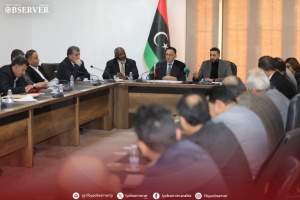
The Minister of Economy and Trade called for a shift from a purely trade-based partnership with Turkey to a long-term investment partnership, stressing that Ankara is a strategic partner for Libya across various economic sectors.
The remarks were made during a meeting at the ministry’s headquarters in the capital, Tripoli, with a delegation of Turkish businesspersons and industrialists. The visit aimed to explore prospects for economic and trade cooperation and to enhance investment and partnership opportunities between the two countries.
Discussions focused on ways to develop economic relations, review promising investment opportunities in the Libyan market, and examine mechanisms for cooperation in the fields of industry, agriculture, urban planning, and the organization of exhibitions and conferences. These efforts aim to support the national economy, create an attractive investment environment, and strengthen strategic partnerships with the Turkish private sector, according to a statement published on the ministry’s official page.
The Minister reaffirmed the government’s aspiration to enhance cooperation and exchange expertise in implementing agricultural projects, increase production rates in existing projects involving grains, fruits, and other crops, meet local demand, and move toward exporting to African markets, in coordination with relevant authorities in both countries.
The Turkish delegation presented an overview of activities and investment centers, particularly in agriculture and small and medium-sized enterprises, as well as extensive experience in external markets for agricultural products and technologies. They expressed the desire to establish sustainable agricultural partnerships and to exchange experiences and expertise.
The meeting also addressed the incentives and advantages granted by Libya’s Investment Law to local and foreign investors, reviewed available investment opportunities in the agricultural sector within the official investment map, and discussed mechanisms for cooperation in organizing joint economic and investment conferences and exhibitions, with the participation of chambers of commerce, to enhance networking between investors and business owners.
Participants emphasized the importance of organizing specialized exhibitions, workshops, and direct bilateral meetings between business owners from both countries, under official supervision, to strengthen institutional communication, exchange expertise, and build effective and sustainable investment partnerships.
The Minister called for, in coordination with relevant authorities, the exploration of avenues for cooperation with municipalities and the implementation of twinning memoranda to exchange expertise and data related to sectoral activities, as part of efforts to develop local management of natural resources and support the achievement of sustainable spatial and economic development.