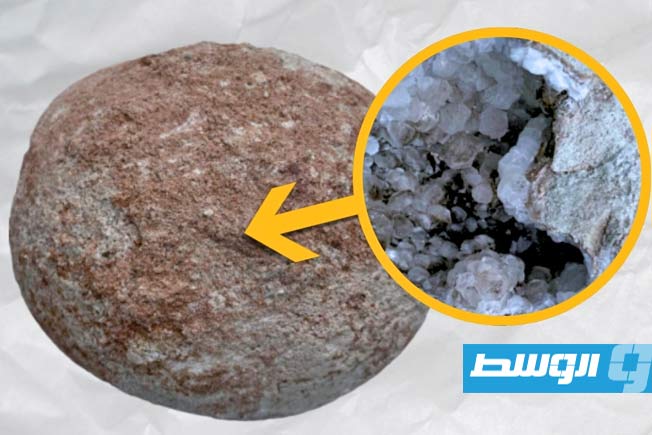
A dinosaur egg the size of a grapefruit was found in a fossil layer in China, forming a stunning surprise for paleontologists. Instead of the usual dinosaur embryo or clay sediment, researchers discovered sparkling calcite crystals lining the inner shell, resembling a natural “geode”—those small stone caves lined with crystals.
This rare discovery provided researchers with unique information about the shell’s structure, leading to the identification of a new type of dinosaur egg never seen before. It was named Shixingoolithus qianshanensis in a study published this December.
This discovery is among the first evidence of dinosaurs in the Qianshan Basin’s Qishan Formation, which dates back about 70 million years to the Late Cretaceous period.
The area is of particular importance because it was previously known for fossils of turtles, mammals, and birds from the Paleocene epoch, making the find of dinosaur eggs a qualitative addition to the region’s historical map.
– Discovery of a set of dinosaur footprint fossils in Italy may be ‘the largest in the world’
– Discovery of remains of one of the world’s oldest dinosaurs in Argentina
– Discovery of additional remains of a new type of dinosaur in western France
The researchers explained that the discovered egg was one of two classified within the same “ootaxon” (egg genus). Despite the absence of associated embryos or skeletons, the “microscopic” structure of the shells confirmed they belonged to dinosaurs, as their characteristics match dinosaur eggs more closely than those of modern reptiles or birds.
How did the egg turn into a crystalline “gem”?
The formation of mineral crystals inside a dinosaur egg requires precise geological and environmental conditions. It begins with the decomposition of the embryo over time, leaving a void inside the egg. Groundwater then slowly seeps through the fine pores and cracks in the shell, depositing dissolved minerals like calcite inside the shell, which gradually accumulate to form crystals.
Beyond their visual beauty, these crystals offer scientists valuable insights into the site’s environmental conditions. Analyzing the calcite can reveal the nature of the fluids that passed through the fossil layers and the geochemical environment of the original nest.
This “crystal egg” joins the list of astonishing ways the Earth preserves ancient life’s history, alongside previous discoveries of cave bones coated in minerals and dinosaur bones that, over millions of years, transformed into sparkling opal stones.