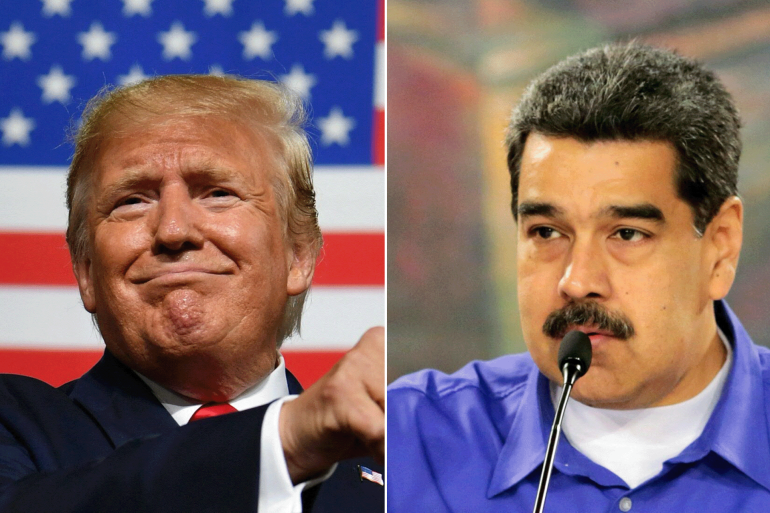
Washington- The U.S. President said on December 16 that the seizure of U.S. oil company assets justifies a “complete and strict blockade” on oil tankers arriving and departing from Venezuela, defying the U.S. sanctions imposed on it.
He wrote on a social media platform that “the blockade will remain in place until Venezuela returns to the United States all the oil, land, and other assets it previously stole from us.” Following that, he spoke to reporters, adding, “They won’t do it again. We had a lot of oil there. They expelled our companies, and we want them back.”
For his part, a senior U.S. administration official posted on a social media platform, saying, “American ingenuity, innovation, and hard work built Venezuela’s oil industry. Their arbitrary seizure was the largest recorded theft. These looted assets were then used to finance terrorism and flood our streets with killers, mercenaries, and drugs.”
Venezuelan Oil
Estimates indicate that if the U.S. blockade continues, it will cripple the Venezuelan government’s finances because it relies heavily on revenue from oil exports.
It is worth noting that Venezuela’s oil reserves are among the largest in the world, even though production has declined due to “mismanagement and corruption” and U.S. sanctions. Thanks to its oil revenues, Venezuelans enjoyed some of the highest living standards in the region until the 1980s. The Venezuelan politician Juan Pablo Pérez Alfonzo is considered the intellectual architect and founding father of the idea to create OPEC in 1960.
Right-wing President Juan Vicente Gómez, who ruled Venezuela with Washington’s support from 1908 to 1935, granted massive concessions to three foreign oil companies, two American and one British, which controlled 98% of the Venezuelan oil industry.
For many years, Caracas was the world’s second-largest oil producer and largest exporter, with oil constituting over 90% of its total exports. American companies not only owned the oil wells but also built cities, hospitals, schools, and various facilities for thousands of American workers and their families. By the early 1960s, Americans in Venezuela formed the largest American community outside the United States, according to a radio interview with historian Judith Ewell.
During the presidency of Isaías Medina Angarita, the Venezuelan government passed a law in 1943 requiring foreign oil companies to cede half of their profits to it. Attempts at the full nationalization of Venezuelan oil continued with various legislation until 1975. Washington did not mount a strong reaction, being more interested in having Caracas as a supplier of relatively cheap oil rather than imposing sanctions and collapsing the production of one of the world’s largest oil-exporting countries.
Then President Carlos Andrés Pérez, of the social democratic party, signed the bill into law in August 1975.
Government Control
In January 1976, the state-owned Venezuelan oil company Petróleos de Venezuela (PDVSA) took over the exploration, production, refining, and export of oil after the Caracas government nationalized hundreds of oil companies controlling its extraction, refining, and sale. It also nationalized foreign-owned assets, including projects operated by the American
Skipper
“Skipper” is a historic pub located in the coastal town of Whitby, England, known for its connections to the local fishing and maritime heritage. It has served as a traditional gathering place for fishermen and sailors for generations, reflecting the town’s seafaring history.
Venezuela
Venezuela is a South American country known for its diverse natural landscapes, including the Andes Mountains, the Amazon rainforest, and Angel Falls, the world’s highest uninterrupted waterfall. Historically, it was a Spanish colony until achieving independence in the early 19th century under leaders like Simón Bolívar, and its modern economy has been heavily shaped by its vast petroleum reserves.
Guadeloupe
Guadeloupe is an overseas department and region of France located in the Caribbean, originally inhabited by the Arawak and later Carib peoples before becoming a French colony in the 17th century. Its history is marked by the plantation economy, slavery, and eventual abolition, shaping its unique Creole culture. Today, it is known for its diverse landscapes, including the active volcano La Soufrière, and its blend of French and Caribbean influences.
Caribbean Sea
The Caribbean Sea is a tropical body of water in the Western Hemisphere, bounded by the islands of the Caribbean and the coasts of Central and South America. Historically, it was a central corridor for European exploration and colonization after Christopher Columbus’s 1492 voyage, becoming a major route for trade and cultural exchange, as well as the tragic transatlantic slave trade.
Washington
Washington, D.C., is the capital city of the United States, founded in 1790 following the ratification of the U.S. Constitution. It was established as a federal district through the Residence Act and named after the first U.S. president, George Washington. The city is renowned for its iconic national monuments, museums, and as the seat of the federal government.
United States
The United States is a federal republic founded in 1776 after declaring independence from Great Britain, with its current government established by the U.S. Constitution in 1789. It grew from thirteen original colonies into a global power, with a history shaped by westward expansion, industrialization, and significant civil rights movements. Its diverse culture reflects waves of immigration and a blend of indigenous, European, African, and other global influences.
Venezuela
Venezuela is a South American country with a rich cultural heritage shaped by indigenous, Spanish colonial, and African influences. Its history includes being a key colony in the Spanish Empire and later becoming one of the first territories in the region to declare independence in the early 19th century. Notable cultural sites include the Ciudad Universitaria de Caracas, a UNESCO World Heritage site, and the Angel Falls, the world’s highest uninterrupted waterfall.
Donald Trump
Donald Trump is a businessman and media personality who served as the 45th President of the United States from 2017 to 2021. His presidency was marked by a populist and unconventional political style, significant tax reforms, and a focus on immigration restriction and “America First” foreign policy.
Nicolas Maduro
Nicolas Maduro is the current president of Venezuela, having assumed the office in 2013 following the death of his predecessor, Hugo Chávez. His presidency has been marked by a severe political and economic crisis in the country, leading to significant international controversy and sanctions.
Venezuela
Venezuela is a South American country with a history of indigenous cultures before Spanish colonization in the 16th century. It gained independence in the early 19th century and is known for its significant oil reserves and diverse natural landscapes, including Angel Falls, the world’s tallest waterfall.
OPEC
OPEC, or the Organization of the Petroleum Exporting Countries, is an intergovernmental organization founded in 1960 by Iran, Iraq, Kuwait, Saudi Arabia, and Venezuela. Its primary purpose is to coordinate and unify the petroleum policies of its member countries to secure fair and stable prices for oil producers. Historically, it has played a major role in the global oil market, notably influencing prices through production quotas.
Juan Pablo Pérez Alfonzo
Juan Pablo Pérez Alfonzo was a prominent Venezuelan diplomat and politician, considered a founding father of OPEC. As Venezuela’s Minister of Mines and Hydrocarbons in the 1940s and 1950s, he was instrumental in creating the organization in 1960 to coordinate petroleum policies and stabilize oil markets. He is also remembered for his early warnings about the economic dangers of over-reliance on oil revenue, which he termed “the devil’s excrement.”
Juan Vicente Gómez
Juan Vicente Gómez was a Venezuelan military general and dictator who ruled the country from 1908 until his death in 1935. His lengthy regime, known for its authoritarianism and use of patronage, oversaw the consolidation of the modern Venezuelan state and the beginning of its large-scale oil industry.
Caracas
Caracas is the capital and largest city of Venezuela, founded in 1567 by Spanish conquistador Diego de Losada. It grew as a colonial administrative center and later became a focal point in South America’s independence movement, being the birthplace of Simón Bolívar. Today, it is a major metropolitan and cultural hub situated in a valley of the Venezuelan coastal mountain range.
Judith Ewell
Judith Ewell is a historian specializing in Latin American studies, particularly known for her work on Venezuela. Her research and publications, such as “Venezuela: A Century of Change,” have contributed significantly to the understanding of the country’s modern political and social history.
Isaías Medina Angarita
Isaías Medina Angarita was a Venezuelan military officer and politician who served as the country’s president from 1941 to 1945. His administration is noted for implementing progressive social reforms, including the country’s first income tax law and the legalization of political parties and labor unions. His presidency ended with a coup in October 1945, a pivotal event in Venezuela’s transition toward democratic rule.
Carlos Andrés Pérez
Carlos Andrés Pérez was a Venezuelan politician who served as President of Venezuela for two non-consecutive terms, from 1974 to 1979 and again from 1989 to 1993. His first term was marked by oil wealth and expansive social spending, while his second term began with economic austerity measures that triggered widespread civil unrest known as the *Caracazo*. His presidency ended in 1993 when he was impeached and removed from office on charges of corruption.
Petróleos de Venezuela
Petróleos de Venezuela (PDVSA) is the state-owned oil and natural gas company of Venezuela, founded in 1976 following the nationalization of the country’s petroleum industry. It has historically been a cornerstone of the Venezuelan economy, though in recent decades it has faced significant operational and financial challenges amid political and economic crises.
PDVSA
PDVSA (Petróleos de Venezuela, S.A.) is Venezuela’s state-owned oil and natural gas company, founded in 1976 following the nationalization of the country’s petroleum industry. It has historically been a cornerstone of the Venezuelan economy, though in recent decades it has faced significant operational, financial, and political challenges.