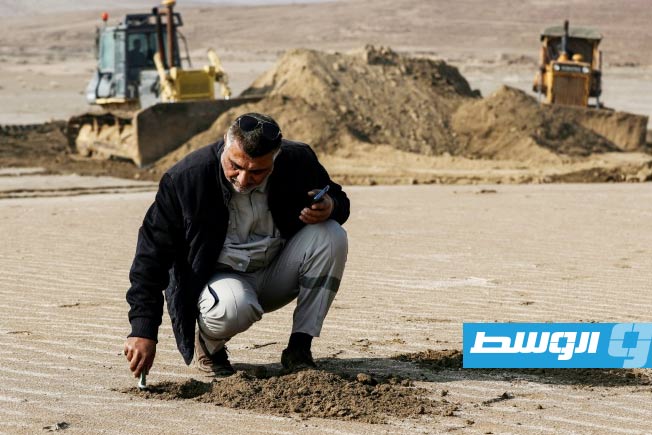
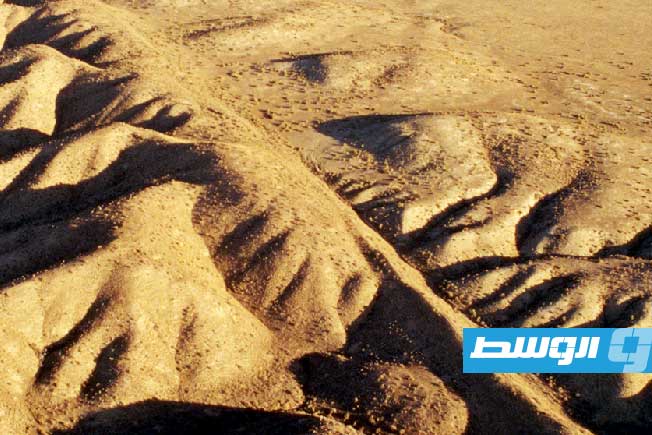
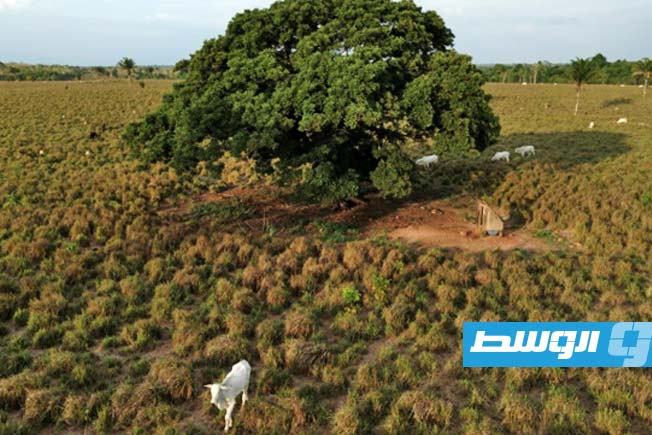
Excavators and heavy machinery extract layers of wet clay from deep within the desert in southern Iraq, dumping it over sand dunes to cover them, as part of urgent efforts to combat increasing dust storms. The intensity of these storms has escalated in recent years due to severe drought, water shortages, and declining vegetation, making Iraq one of the countries most affected by climate change.
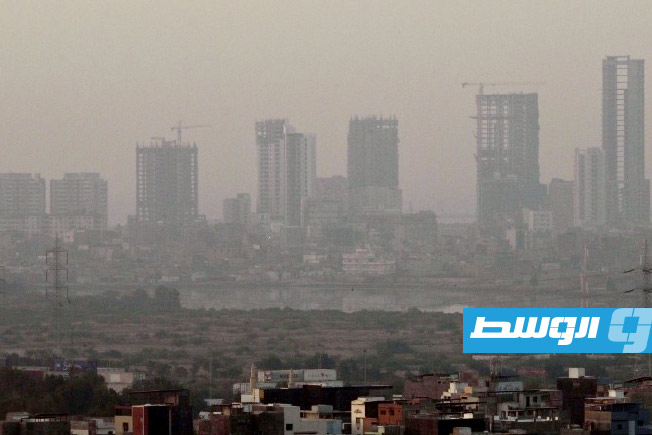
These storms, which blanket cities in a thick orange haze during spring and summer, cause air traffic paralysis and increase respiratory illnesses. Faced with this reality, authorities warn of a worsening crisis in the future, stressing the need to address it at its roots.
Workers in the area between Nasiriyah and Samawah are busy stabilizing the soil by spreading layers of clay up to 25 centimeters thick. This project, managed in cooperation with Iraqi experts, involves planting heat-resistant vegetation to enhance soil cohesion.
–
–
–
The goal is to “reduce the impact of cross-border dust storms, which can reach Kuwait, Saudi Arabia, and Qatar,” adding that “the area is vital despite its small size, and it is hoped it will help reduce dust storms next summer.” The project also urgently aims to protect highways from traffic accidents caused by poor visibility.
300 Dusty Days Annually
The Ministry of Environment predicts the number of dusty days in Iraq could reach 300 per year by 2050 if deterrent measures are not taken. Therefore, the internationally supported project, in partnership with the Kuwait Fund for Arab Economic Development, relies on digging water channels and providing electricity to pump water from the Euphrates River to reclaim arid land.
Stabilizing the soil is the key to the success of the agricultural effort. “When sand is left mobile, any agricultural effort is temporary. Stabilizing the soil is what gives the project a chance to continue.” This process is carried out by spreading soil or creating barriers and trenches that act as traps for drifting sand.
It is noted that climate change has revived these efforts, which began in the 1970s and then stopped due to wars, concluding: “We are progressing with slow but steady steps.”
Iraq
Iraq, historically known as Mesopotamia, is home to some of the world’s earliest civilizations, including Sumer, Akkad, and Babylon, and is often called the “Cradle of Civilization.” The country contains major cultural sites such as the ancient city of Ur, the ruins of Babylon with its famed Ishtar Gate, and the architectural treasures of Samarra. Its rich history spans millennia, though in recent decades it has faced significant conflict and instability.
Nasiriyah
Nasiriyah is a city in southeastern Iraq, founded in the late 19th century near the ancient ruins of Ur, one of the world’s earliest cities and the traditional birthplace of Abraham. It serves as the capital of Dhi Qar Governorate and is a major cultural and administrative center for the region’s Marsh Arab population.
Samawah
Samawah is a city in southern Iraq, located along the Euphrates River, and serves as the capital of the Muthanna Governorate. Historically, it has been a significant agricultural and trade center, with its origins dating back to ancient Mesopotamia, though it gained modern prominence during the Ottoman era and later under British influence in the early 20th century.
Kuwait
Kuwait is a sovereign Arab state located at the head of the Persian Gulf, historically established as a sheikhdom in the 18th century by clans from the Arabian interior. Its modern history was shaped by the discovery of oil in the 1930s, which transformed it into a wealthy nation, and it regained full sovereignty in 1991 after liberation from a seven-month Iraqi occupation.
Saudi Arabia
Saudi Arabia is a Middle Eastern nation founded in 1932 by King Abdulaziz Al Saud, unifying the regions of Najd and Hejaz. It is the birthplace of Islam, home to the religion’s two holiest cities, Mecca and Medina, and its history and culture are deeply intertwined with the Islamic faith. The modern kingdom is a major global economic power due to its vast reserves of petroleum.
Qatar
Qatar is a sovereign country located on the northeastern coast of the Arabian Peninsula, historically shaped by its Bedouin heritage and maritime traditions like pearling. Its modern history was transformed by the discovery of vast oil and natural gas reserves in the mid-20th century, leading to rapid development and its emergence as a major global economic and diplomatic player. The nation is also known for cultural sites such as the Museum of Islamic Art in Doha and the archaeological site of Al Zubarah, a UNESCO World Heritage location.
Euphrates River
The Euphrates River is one of the two major rivers defining the historical region of Mesopotamia, often called the “cradle of civilization.” It has been a vital water source and agricultural lifeline for ancient empires like Sumer, Assyria, and Babylon. Today, it flows through Turkey, Syria, and Iraq, where its waters remain crucial for irrigation and are managed by modern dams.
Kuwait Fund for Arab Economic Development
The Kuwait Fund for Arab Economic Development (KFAED) is a Kuwaiti public institution established in 1961, making it the first development fund in the Arab world. It was created to provide financial and technical assistance for economic and social development projects in other Arab, and later developing, countries.