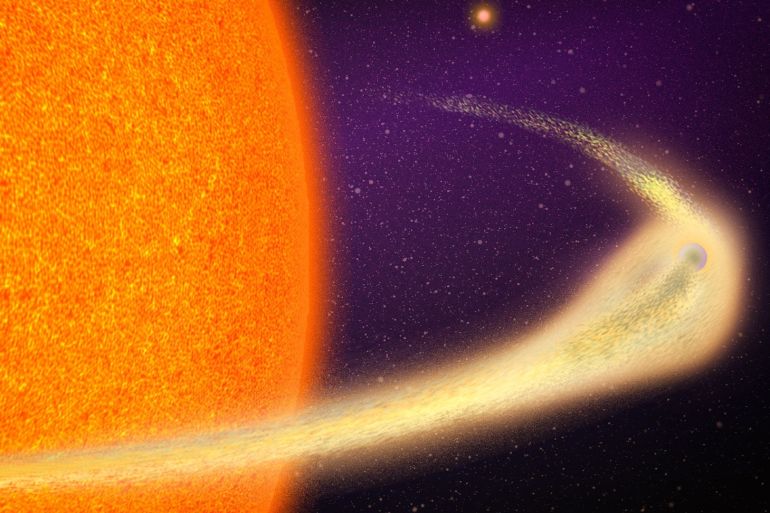
When “black hole” is mentioned, those “cosmic monsters” that swallow light and stars immediately come to mind. The question that has dominated scientists’ minds for decades is the extent to which they obey the rules of quantum mechanics that govern the world of atoms and particles.
One of the most important rules of the quantum world is that every quantum system has a ground state, the lowest energy level it can reach. When the system is cooled to its coldest point, it settles into this ground state, and its entropy (a measure of the system’s internal disorder) approaches nearly zero.
The question scientists have tried to answer is: Do black holes, despite their immense gravity, also behave according to these quantum rules? In other words: Do they have a stable ground state like small quantum systems?
Traditional calculations by scientists indicated that the entropy of a black hole would flip to “negative values,” a scientifically illogical result akin to saying one’s empty library has “negative 10 books” instead of “zero.” This placed scientists in a dilemma, leading them to question whether these cosmic monsters defy quantum laws or if the calculation method used was not leading to the correct result.
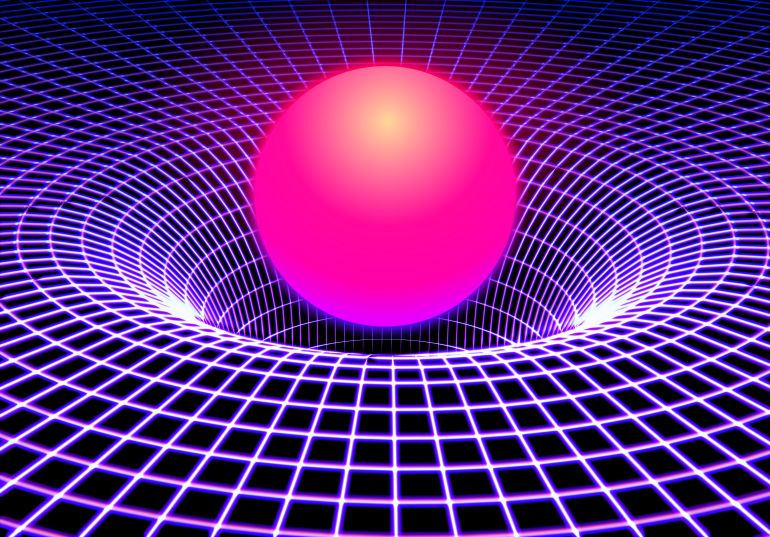
A Journey Through Spacetime Tunnels
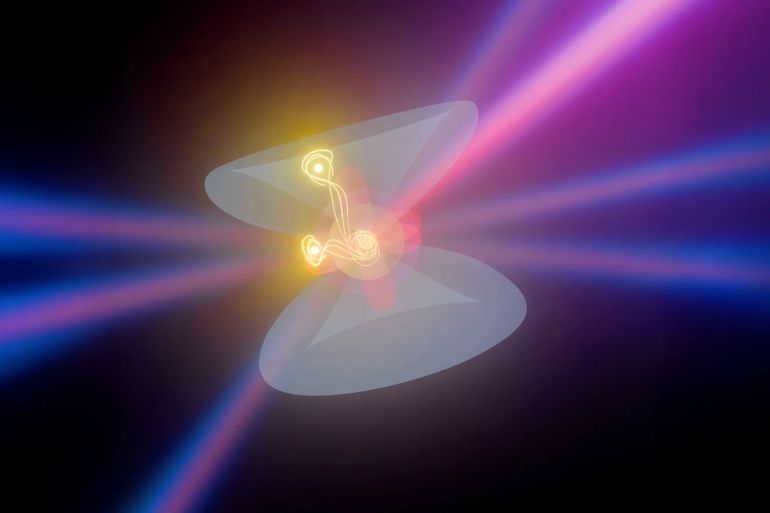
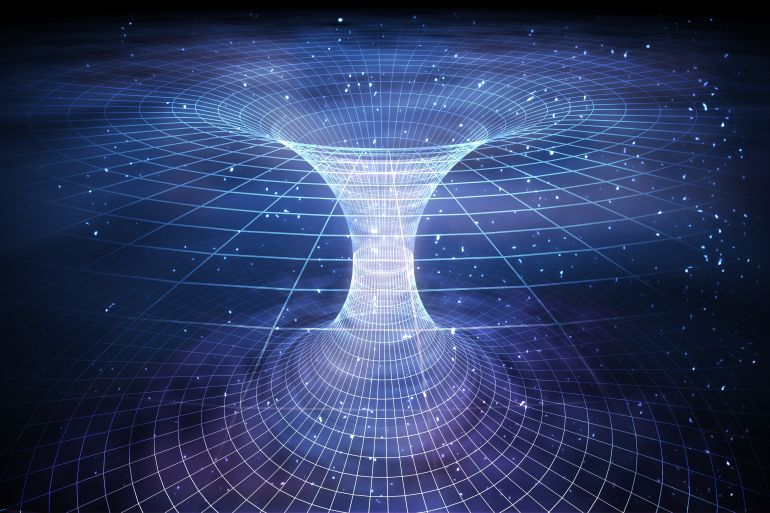
To solve this puzzle, researchers used new mathematical tools and decided to examine the “secret paths” that spacetime itself might take at low temperatures. These paths are known in physics as “wormholes,” and incorporating them into the calculation helped clarify the picture.
“Wormholes” are passages connecting different regions of spacetime. Including them in calculations represents additional sets of possibilities or ways in which the energy and internal states of a black hole can be distributed.
In other words, incorporating these wormholes allows for a more accurate calculation of all possible arrangements of the black hole, including the more exotic and hidden states. The result is that after accounting for their effect, it became possible to correctly calculate the “quasi-frozen entropy.”
This method showed that entropy remains positive and approaches zero at the coldest temperatures, confirming that a black hole has an isolated ground state and behaves like any natural quantum system.
To understand what the researchers did, imagine having boxes filled with balls, where each ball represents a possible energy state inside the black hole. In traditional calculations, researchers computed disorder or entropy based on only a limited set of boxes, sometimes leading to illogical results, such as entropy becoming negative.
However, scientists realized there are hidden pathways between the boxes, like small tunnels allowing balls to move from one box to another. These tunnels represent “wormholes.” When scientists added these passages to the calculations, it became possible to consider every possible arrangement of the balls, including those previously “hidden.”
The result is that the calculations became accurate, and entropy became positive and approached zero at the coldest temperatures, exactly as expected in natural quantum systems.
A Step Towards Understanding Quantum Gravity
This discovery represents significant progress in solving one of the most difficult questions in modern physics: how to unify quantum mechanics and gravity. Quantum mechanics accurately describes the world of tiny particles, while gravity (general relativity) describes the motion of very large bodies like stars, planets, and black holes. Unifying the two has always been extremely difficult.
Since scientists have proven that black holes have precise internal states—meaning they have a “specific order” at the quantum level despite their immense gravity—it is akin to discovering that a massive object has very fine details that can be measured and studied, just like atoms and particles.
These results could open the door to bridging quantum mechanics and gravity to understand the so-called “microstructure of spacetime”—the internal structure of the universe at the smallest scales—and how matter and energy behave at the quantum level inside a black hole.