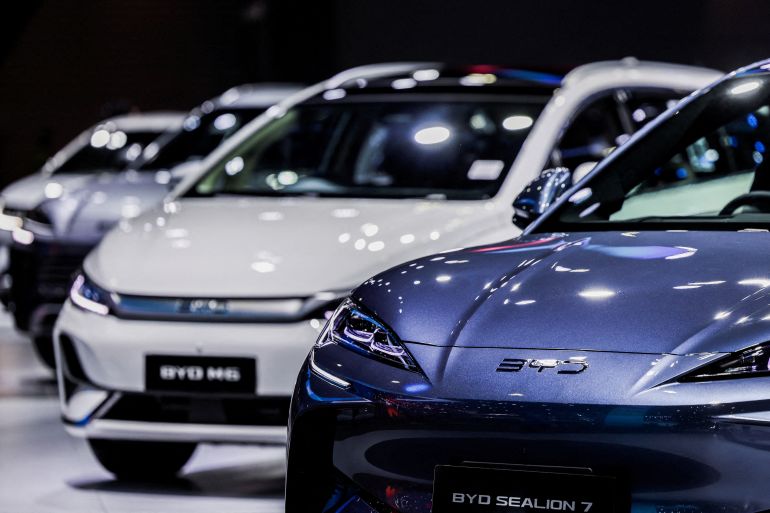
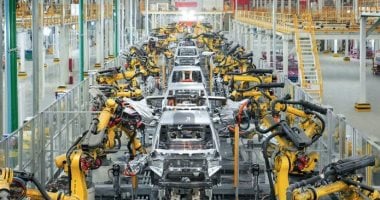
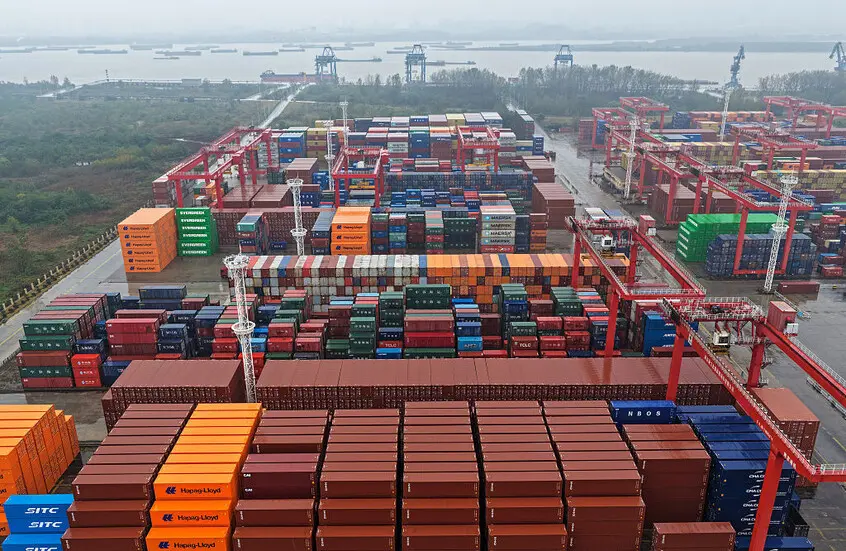
Global exports of electric vehicles surged by 87% year-on-year in November, reaching 199,836 vehicles.
According to Chinese customs data, China’s exports of electric vehicles to Mexico in November soared by 2367% year-on-year to 19,334 vehicles, the highest growth rate among all countries and regions.
By region:
Asia was the largest importer (110,061 electric vehicles, a 71% year-on-year increase).
Followed by Europe (42,927 vehicles, a 63% year-on-year increase).
Then Latin America and the Caribbean (35,182 vehicles, a 283% year-on-year increase).
Exports to Africa rose by 39% year-on-year to 25,792 electric vehicles.
Chinese Dominance
According to reports, the domestic Chinese market is already seeing electric vehicle sales surpass those of traditional gasoline-powered cars, with EVs currently exceeding 50% of total new car sales monthly.
China now leads the global race for dominance in the electric vehicle market. A slowdown in policy support in Europe and a retreat by American automakers have eased competition, while Chinese EV manufacturers are aggressively pursuing expansion into foreign markets.
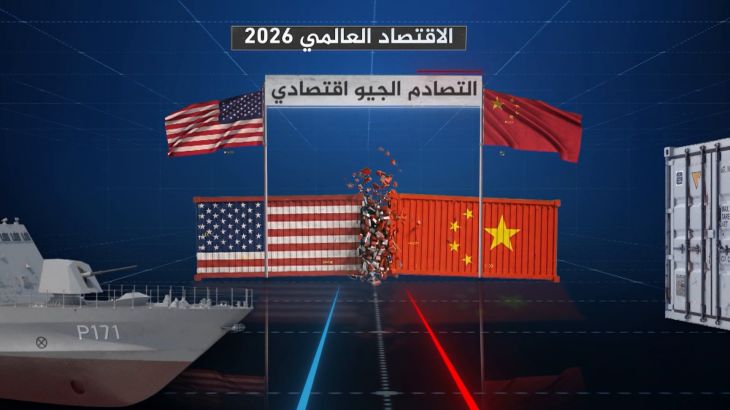
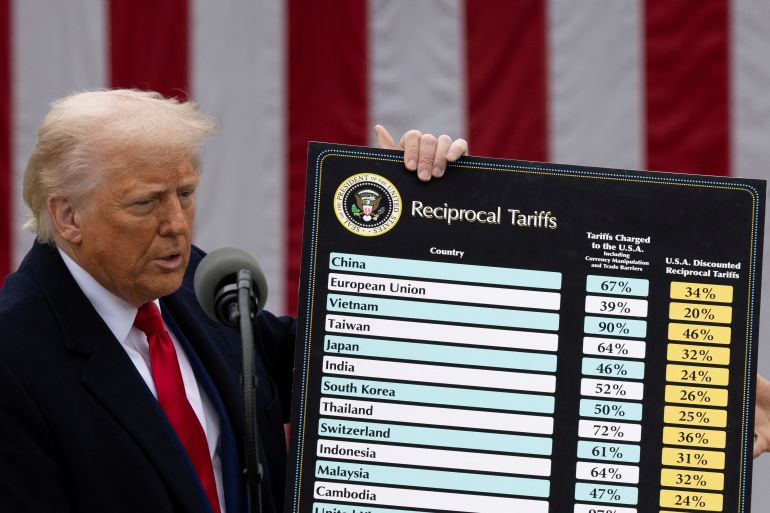
China’s export market has narrowed over the past two years due to high tariffs in the United States, where duties of 100% are imposed on vehicles, and tariffs in the European Union ranging from 17% to 38%, depending on the manufacturer.
Nevertheless, China is capturing key emerging markets, with its sales rising in Indonesia and Singapore in Southeast Asia, and in Latin America, where Uruguay, Mexico, and Brazil are also experiencing a boom in electric vehicle sales.
Since mid-2023, most of the growth in Chinese electric vehicle exports has come from markets outside the OECD, according to a report published earlier this month by the clean energy research center Ember.
Brazil, Mexico, and Indonesia are among the top 10 destinations for Chinese electric vehicle exports, thanks to supportive government policies for EV adoption in those countries.
An analyst stated, “Emerging markets will shape the future of the global car market.”
Global Electric Vehicle Sales
Global sales of fully electric vehicles increased by 35% during the third quarter of 2025 compared to the same period the previous year.
For the first time, the share of fully electric vehicles surpassed the 21% threshold of total global car sales, equating to one in every five cars sold, according to data from a global strategic consulting firm.
The number of electric vehicles on the roads reached approximately 40 million in 2023 before
BYD EV cars
BYD is a Chinese automotive company founded in 1995 that has become a global leader in electric vehicle (EV) manufacturing. It initially specialized in rechargeable batteries before expanding into automobiles, and it now produces a wide range of all-electric and plug-in hybrid cars, buses, and trucks.
46th Bangkok International Motor Show
The 46th Bangkok International Motor Show is an annual automotive exhibition held in Thailand, typically showcasing the latest vehicles and technology from global manufacturers. First organized in 1979, it has grown into one of Southeast Asia’s premier auto events, historically serving as a key platform for brand launches and industry networking in the region.
Bangkok
Bangkok is the capital and largest city of Thailand, founded in 1782 by King Rama I as the capital of the Rattanakosin Kingdom. It is renowned for its ornate temples and palaces, such as the Grand Palace and Wat Arun, which reflect its deep historical and cultural significance as a center of Thai royalty, religion, and tradition.
Thailand
Thailand, officially the Kingdom of Thailand, is a Southeast Asian country with a rich history dating back to ancient kingdoms like Sukhothai and Ayutthaya. It is renowned for its ornate Buddhist temples, vibrant street food culture, and tropical beaches, and it is the only nation in the region never to have been colonized by a European power.
China
China is one of the world’s oldest continuous civilizations, with a recorded history spanning over four millennia and major contributions to philosophy, science, and governance. It is home to numerous UNESCO World Heritage sites, including the Great Wall, which was built over centuries starting in the 7th century BC to protect against northern invasions. Modern China is a major global power, blending its ancient traditions with rapid economic and technological development.
Mexico
Mexico is a country with a rich pre-Columbian history, including advanced civilizations like the Maya and Aztecs, followed by Spanish colonization in the 16th century. Its cultural sites, such as the ancient city of Teotihuacán and the historic center of Mexico City, reflect this layered heritage. Today, it is known for its vibrant traditions, cuisine, and UNESCO World Heritage sites that preserve its complex past.
Asia
Asia is the world’s largest and most populous continent, home to ancient civilizations such as those in Mesopotamia, the Indus Valley, and China. Its history spans thousands of years, featuring the rise and fall of vast empires, the development of major world religions, and significant contributions to science, art, and philosophy. Today, it is a region of immense cultural, economic, and political diversity.
Europe
Europe is a continent with a rich and complex history, shaped by ancient civilizations like Greece and Rome, the transformative periods of the Middle Ages and the Renaissance, and the profound impacts of two World Wars. Culturally, it is renowned for its diverse artistic heritage, architectural landmarks, and as the birthplace of influential movements in philosophy, science, and politics.
Latin America
Latin America is a vast region encompassing the parts of the Americas where Romance languages—primarily Spanish and Portuguese—are spoken, stemming from centuries of colonization by Spain and Portugal. Its history is defined by ancient indigenous civilizations, European conquest, and a series of independence movements in the early 19th century. The region’s culture is a rich fusion of these indigenous, European, and African influences.
Caribbean
The Caribbean is a region of the Americas consisting of the Caribbean Sea, its islands, and surrounding coasts, historically inhabited by indigenous peoples like the Taíno before European colonization began in the 15th century. Its complex history is marked by the transatlantic slave trade, plantation economies, and colonial rule by various European powers, leading to a diverse cultural heritage that blends African, European, Indigenous, and Asian influences. Today, it is renowned for its vibrant music, cuisine, and as a major tourist destination.
Africa
Africa is the world’s second-largest continent and the cradle of humankind, with fossil evidence suggesting it is where the human species first evolved. Its history encompasses the rise of powerful ancient civilizations like Egypt and Mali, followed by periods of colonization by European powers and a widespread movement for independence in the 20th century. Today, it is a continent of immense cultural, linguistic, and ecological diversity, comprising 54 sovereign nations.
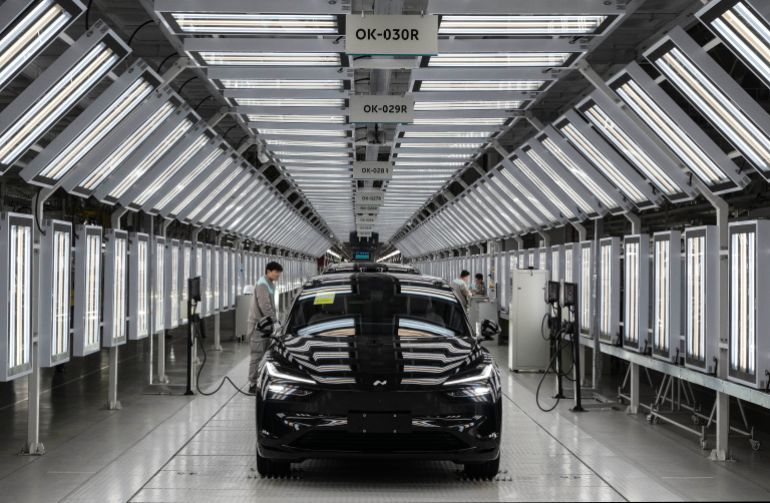
NIO
NIO is a Chinese multinational automobile manufacturer specializing in designing and developing electric vehicles. Founded in 2014 by William Li, the company is known for its premium electric cars, battery-swapping technology, and innovative user community. It represents a significant player in the global shift toward smart, connected, and sustainable automotive technology.
Hefei
Hefei is the capital of Anhui Province in eastern China, with a history dating back over 2,000 years to the Qin Dynasty. It is historically known as a strategic military stronghold and the hometown of Lord Bao Zheng, a famous Song Dynasty official revered for his integrity. Today, it is a major modern city and a hub for science, education, and manufacturing.
U.S.
The United States of America is a federal republic founded in 1776 after declaring independence from Great Britain. Its history is marked by westward expansion, a civil war over slavery, and its emergence as a global superpower in the 20th century.
South America
South America is a continent known for its diverse landscapes, ranging from the Amazon rainforest to the Andes mountains. Its rich history includes powerful pre-Columbian civilizations like the Inca, followed by European colonization primarily by Spain and Portugal, which shaped its modern nations and cultures.
United States
The United States is a federal republic founded in 1776 following the American Revolution, which established its independence from Great Britain. Its history is marked by westward expansion, a civil war over slavery, and its emergence as a global superpower in the 20th century. The nation is defined by its diverse population, democratic institutions, and significant cultural influence worldwide.
European Union
The European Union (EU) is a political and economic union of 27 European countries, founded after World War II to foster economic cooperation and prevent future conflict. Its origins trace to the 1951 European Coal and Steel Community, which evolved through key treaties into the modern EU, featuring a single market and a common currency used by many member states.
Indonesia
Indonesia is a Southeast Asian archipelago of over 17,000 islands, historically shaped by powerful Hindu-Buddhist kingdoms like Srivijaya and Majapahit, followed by centuries of Dutch colonial rule. It declared independence in 1945 and is now the world’s largest Muslim-majority nation, renowned for its vast cultural and linguistic diversity across its many islands.
Singapore
Singapore is a sovereign city-state and island country in Southeast Asia, founded as a British trading colony in 1819 by Sir Stamford Raffles. It gained independence in 1965 and rapidly developed into a global hub for trade, finance, and transportation. Today, it is known for its multicultural society, modern skyline, and significant historical sites like the colonial-era Raffles Hotel and the war memorials at the Kranji War Cemetery.
Southeast Asia
Southeast Asia is a diverse geographic and cultural region comprising mainland nations like Vietnam and Thailand, as well as archipelagic states such as Indonesia and the Philippines. Its history is marked by powerful indigenous empires, extensive trade networks, and successive periods of influence from India, China, and later, European colonial powers. The region’s modern identity was largely shaped by decolonization in the mid-20th century.
Uruguay
Uruguay is a South American country known for its progressive social policies and stable democracy, having gained independence from Brazil in 1825 after a period of Spanish and Portuguese colonial rule. Its cultural identity is strongly tied to the gaucho (cowboy) tradition, the tango music and dance of the Río de la Plata region, and its historic quarter in the capital, Montevideo, which features well-preserved colonial architecture.
Brazil
Brazil is the largest country in South America, known for its vast Amazon rainforest and vibrant cultural mix. Its modern history began with Portuguese colonization in 1500, leading to a complex heritage shaped by indigenous peoples, European settlers, and enslaved Africans. It gained independence as an empire in 1822 and became a republic in 1889.
OECD
The Organisation for Economic Co-operation and Development (OECD) is an international forum founded in 1961 to stimulate economic progress and world trade, evolving from the post-World War II Organisation for European Economic Co-operation (OEEC). It is best known for producing data-driven policy analysis and setting international standards on a wide range of economic and social issues.
Ember
“Ember” is not a widely recognized historical place or cultural site, so it cannot be accurately summarized. It may refer to a fictional location, a modern establishment, or be a misspelling. For a proper summary, please provide the full and correct name of the specific place.