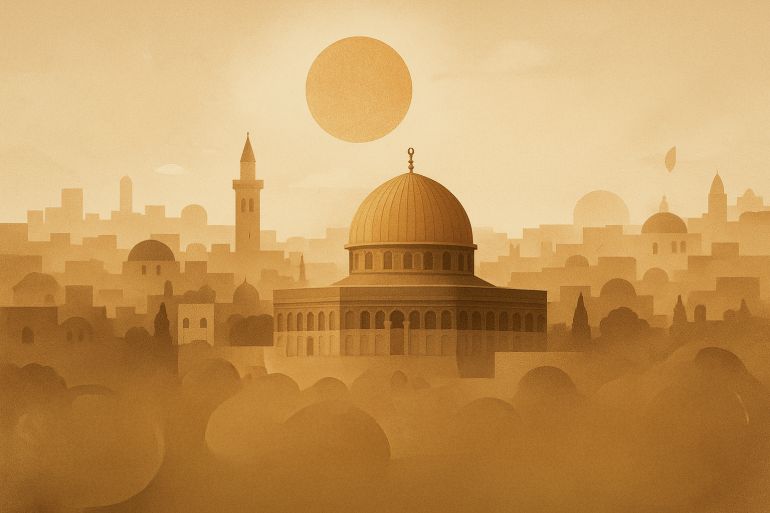
It is not merely a geography burdened by occupation, nor a field contested by politics and maps, but a symbolic entity that inhabits the human consciousness before it is inhabited by borders. Here, the sky meets the earth, and history meets awareness, making it more than a city besieged by walls. It is a memory for the world and a mirror for its moral conscience, where humanity’s ability to remain faithful to the idea of justice and dignity is tested.
Over a century of transformations, Jerusalem has been flooded with contradictory narratives, “religious ones attempting to monopolize sanctity, and political ones reducing it to the concept of sovereignty,” until its cultural image receded in global consciousness. Thus, it was emptied of its deepest meaning, from being a space that unites religions and cultures, to becoming an address for conflict instead of a symbol of convergence.
This approach seeks to return Jerusalem to its natural position, “a Palestinian Arab city with a human character and global consciousness.” It is to be regained not through geographical liberation alone, but by reviving its cultural and civilizational meaning in human consciousness. Protecting Jerusalem does not begin merely with reclaiming its land, but with reclaiming its meaning, because a city that is understood is regained. When Jerusalem is understood as a unifying human value, its Arab identity is restored, and it is reconnected to the world as a symbol of freedom and the human sacred.
First: The Cultural Identity of Jerusalem from Palestinian Roots to Human Consciousness
The identity of the city of Jerusalem is rooted in Palestinian and Arab consciousness as a city of resistance, sanctity, and history. Yet, at the same time, it acquires a universal dimension that makes it present in the conscience of humanity worldwide.
For centuries, Jerusalem has been a meeting point for cultures and religions, a city of passage and rare civilizational interaction. It never knew isolation, but rather knew the diversity that made it a symbol for humanity before it became an address for conflict. Despite the occupation’s attempts since 1948 to empty this identity of its substance, the collective memory of the Palestinians has remained stronger than the attempts at erasure. In popular consciousness, Jerusalem has been carried as a symbol of dignity and steadfastness, not merely as a political subject.
The future of Jerusalem’s identity lies in merging its local belonging with its universal symbolism, so that it becomes a model for a city where humanity lives without losing its Palestinian and Arab roots. Identity transforms from a subject of confrontation into a comprehensive national and human project.
Second: Jerusalemite Culture as a Front of Steadfastness “When Consciousness Becomes a Weapon”
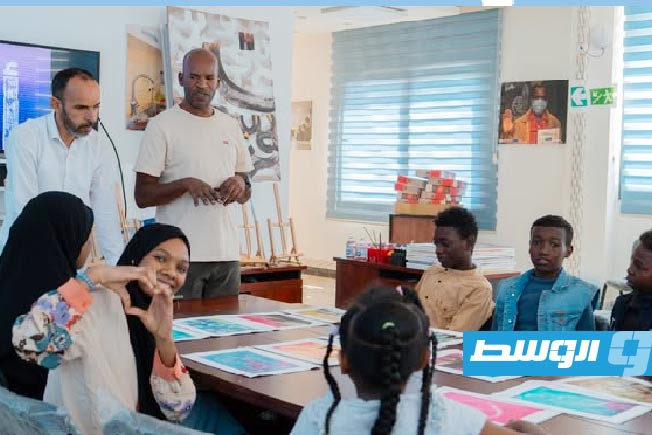
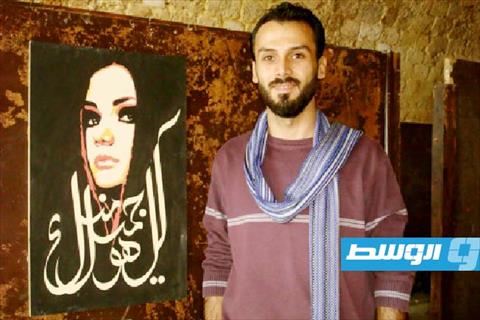
Jerusalem’s resistance today is manifested in culture more than in politics. Under occupation and the retreat of the Arab presence, the cultural space has become a strategic weapon for preserving memory and protecting identity. The artist paints to keep existence alive, the teacher teaches to preserve the language, and the writer documents to resist erasure.
The occupation realized that the most dangerous form of steadfastness is that which grows in consciousness. Therefore, it targets education, curricula, and the public visual space, attempting to impose its historical and political narrative. However, Palestinian art and literature have rebuilt the visual and literary narrative, working to connect the land with dignity and the symbol with the human being.
Hence, Jerusalemite culture is not neutral, nor is it merely a creative activity. It is a symbolic defensive structure that reproduces identity from within and confronts the project of “Israelization” with a system of meaning and practice. Jerusalem resists with the poem as with the stance, with the painting as with the cultural institution, and with the collective consciousness that rejects symbolic normalization as it rejects political normalization.
Third: Jerusalem as a Global Human Conscience “From Political Symbol to Universal Meaning”
What distinguishes Jerusalem is not merely that it is a Palestinian Arab city, but that it carries within its consciousness the meaning of shared humanity. It is a center for the Abrahamic religions, a place for the meeting of civilizations, and a mirror for the human experience in its search for justice and peace.
Historically, describing Jerusalem was not only a matter of sentiment but also of law. Since Resolution 181 of 194
Jerusalem
### **Historical & Religious Significance**
– **Holy City**: Sacred to three major Abrahamic religions:
– **Judaism**: Site of the ancient Temples (Western Wall remnant).
– **Christianity**: Location of Jesus’ crucifixion and resurrection (Church of the Holy Sepulchre).
– **Islam**: Third-holiest city (Al-Aqsa Mosque, Dome of the Rock).
– **Ancient Capital**: Historically the capital of Israelite, Roman, Byzantine, and Crusader kingdoms.
### **Modern Political Status**
– **Contested Sovereignty**:
– **Israel**: Claims unified Jerusalem as its “eternal capital” since 1980.
– **Palestine**: East Jerusalem claimed as capital of a future Palestinian state.
– **International View**: Most countries do not recognize Israeli sovereignty over East Jerusalem (pre-1967 borders). Embassies are often in Tel Aviv.
– **Key Conflict Point**: Central to Israeli-Palestinian disputes, especially regarding settlements, holy sites, and borders.
### **Geography & Demographics**
– **Location**: Judean Mountains, between Mediterranean and Dead Sea.
– **Sections**:
– **West Jerusalem**: Predominantly Jewish, Israeli administration.
– **East Jerusalem**: Predominantly Palestinian, annexed by Israel after 1967 war.
– **Population**: ~1 million; mixed Jewish, Muslim, Christian, Armenian communities.
### **Cultural & Archaeological Richness**
– **UNESCO World Heritage**: Old City and walls (listed as endangered due to tensions).
– **Archaeology**: Layers of history from Canaanite, Jewish, Roman, Islamic, Crusader, Ottoman periods.
– **Pilgrimage & Tourism**: Major destination for religious pilgrims and visitors.
### **Current Issues**
– **Settlement Expansion**: Israeli construction in East Jerusalem is internationally criticized as illegal under international law.
– **Access to Holy Sites**: Periodic tensions, especially around Al-Aqsa/Temple Mount.
– **Status in Peace Talks**: One of the most sensitive “final status” issues in negotiations.
Jerusalem remains a powerful symbol of faith, identity, and conflict—a city where ancient history and modern geopolitics intensely intersect.