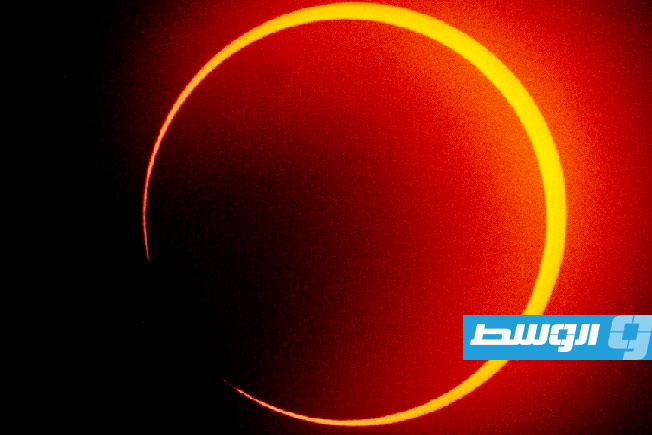
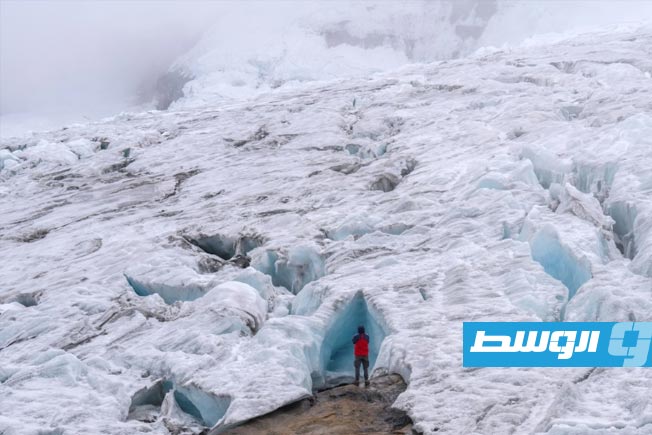
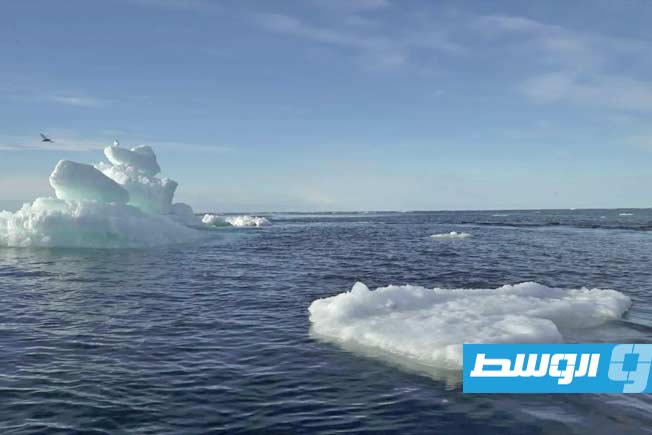
The skies over Antarctica will witness the first solar eclipse of the year this Tuesday, in a cosmic display known as the “Ring of Fire.” However, only a handful of researchers, inhabitants of scientific stations, and penguins will have the chance to observe it.
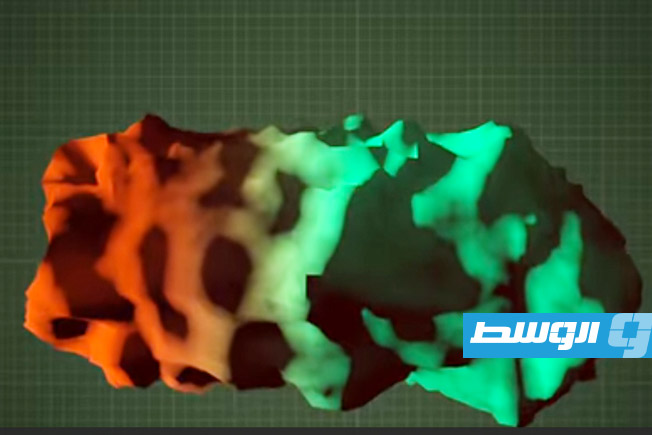
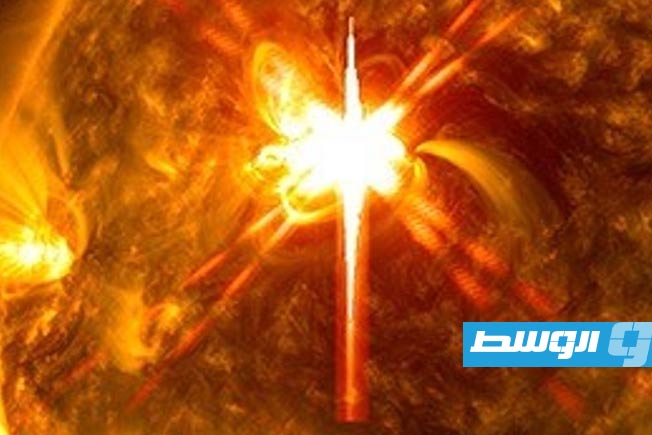
An annular solar eclipse occurs when the Moon aligns between the Earth and the Sun at its farthest orbital point, making it appear too small to completely cover the Sun’s disk. This leaves a bright, glowing ring resembling a fiery band.
According to a report, residents in parts of Chile, Argentina, and South Africa may be able to see a partial eclipse, where the Sun appears to have small sections taken out of it.
“A Geometrical Coincidence”
Astrophysicists explained that this phenomenon reflects “a beautiful geometrical coincidence” in the sizes and distances between the three celestial bodies.
– Astronomy enthusiasts in America await the chance to see the “Ring of Fire.”
– Residents of East Africa witnessed the “Ring of Fire.”
Despite the spectacle’s beauty, experts emphasized the necessity of using specialized eclipse glasses (ISO 12312-2) to avoid permanent eye damage, warning against relying on regular sunglasses.
The report also noted that astronomy enthusiasts have another total solar eclipse to look forward to next August. Its path will include areas in Greenland, Iceland, and Spain, offering broad segments of the populations in Europe and North America another opportunity to observe the phenomenon.
Antarctica
Antarctica is Earth’s southernmost continent, characterized by its extreme cold, vast ice sheets, and unique ecosystems. It has no native human population or recorded ancient history, but its modern story is one of exploration, with the first confirmed sighting in 1820 and the heroic era of expeditions in the early 20th century. Governed internationally by the Antarctic Treaty System since 1959, it is dedicated to peace, scientific research, and environmental protection.
Chile
Chile is a long, narrow country stretching along South America’s western edge, known for its diverse landscapes ranging from the Atacama Desert to Patagonian glaciers. Its history is marked by pre-Columbian cultures like the Mapuche, Spanish colonization beginning in the 16th century, and independence achieved in 1818. Modern Chile is recognized for its stable democracy and significant cultural contributions in literature and the arts.
Argentina
Argentina is a South American nation with a rich cultural heritage shaped by indigenous traditions, Spanish colonization, and subsequent waves of European immigration. Its history includes declaring independence from Spain in 1816 and periods of economic prosperity, political turmoil, and the development of a distinct national identity famously expressed through tango, literature, and cuisine.
South Africa
South Africa is a country located at the southern tip of the African continent, known for its diverse cultures, languages, and dramatic landscapes. Its modern history is profoundly shaped by colonialism and the institutionalized racial segregation of apartheid, which ended in 1994 with the establishment of a constitutional democracy and the election of Nelson Mandela as president.
America
The United States of America is a federal republic founded in 1776 after declaring independence from Great Britain. Its history is marked by westward expansion, industrialization, and its development into a global superpower with a diverse cultural landscape shaped by immigration.
East Africa
East Africa is a region of the African continent historically known for powerful trade empires like the Swahili Coast city-states and the Kingdom of Aksum. It is renowned for its diverse cultures, the Great Rift Valley, and being a significant area for the study of human origins. The region’s history includes influences from Arab, Persian, and European traders and colonizers.
Greenland
Greenland is the world’s largest island, located between the Arctic and Atlantic Oceans, and is an autonomous territory within the Kingdom of Denmark. It has been inhabited for millennia, first by Paleo-Inuit peoples and later by Norse settlers in the 10th century, before coming under Danish control in the 18th century. Today, its culture is shaped primarily by its Indigenous Inuit population, known for traditions adapted to the extreme Arctic environment.
Iceland
Iceland is a Nordic island nation in the North Atlantic, first settled by Norse and Celtic explorers in the late 9th century. It is renowned for its dramatic volcanic landscapes, geothermal activity, and a rich cultural heritage preserved in medieval sagas. The country established one of the world’s oldest parliamentary assemblies, the Alþingi, in 930 AD.
Spain
Spain is a country in southwestern Europe with a rich and diverse cultural history shaped by Roman, Visigothic, and Moorish rule, culminating in the unification of the Christian kingdoms in the late 15th century. Its global influence expanded significantly during the Age of Exploration, and today it is renowned for its distinct regional identities, artistic heritage, and architectural landmarks like the Alhambra and Sagrada Família.
Europe
Europe is a continent with a rich and complex history, shaped by ancient civilizations like Greece and Rome, the Middle Ages, the Renaissance, and periods of both conflict and cooperation. It is home to countless cultural sites, from prehistoric cave paintings to grand cathedrals and castles, reflecting its diverse artistic and architectural heritage. The modern political and economic entity of the European Union emerged in the latter 20th century from a desire to foster peace and unity after two devastating world wars.
North America
North America is a continent comprising countries such as Canada, the United States, and Mexico, with a human history spanning thousands of years from its indigenous civilizations to European colonization beginning in the late 15th century. Its modern political and cultural landscape was largely shaped by this colonial period, subsequent independence movements, and waves of immigration.