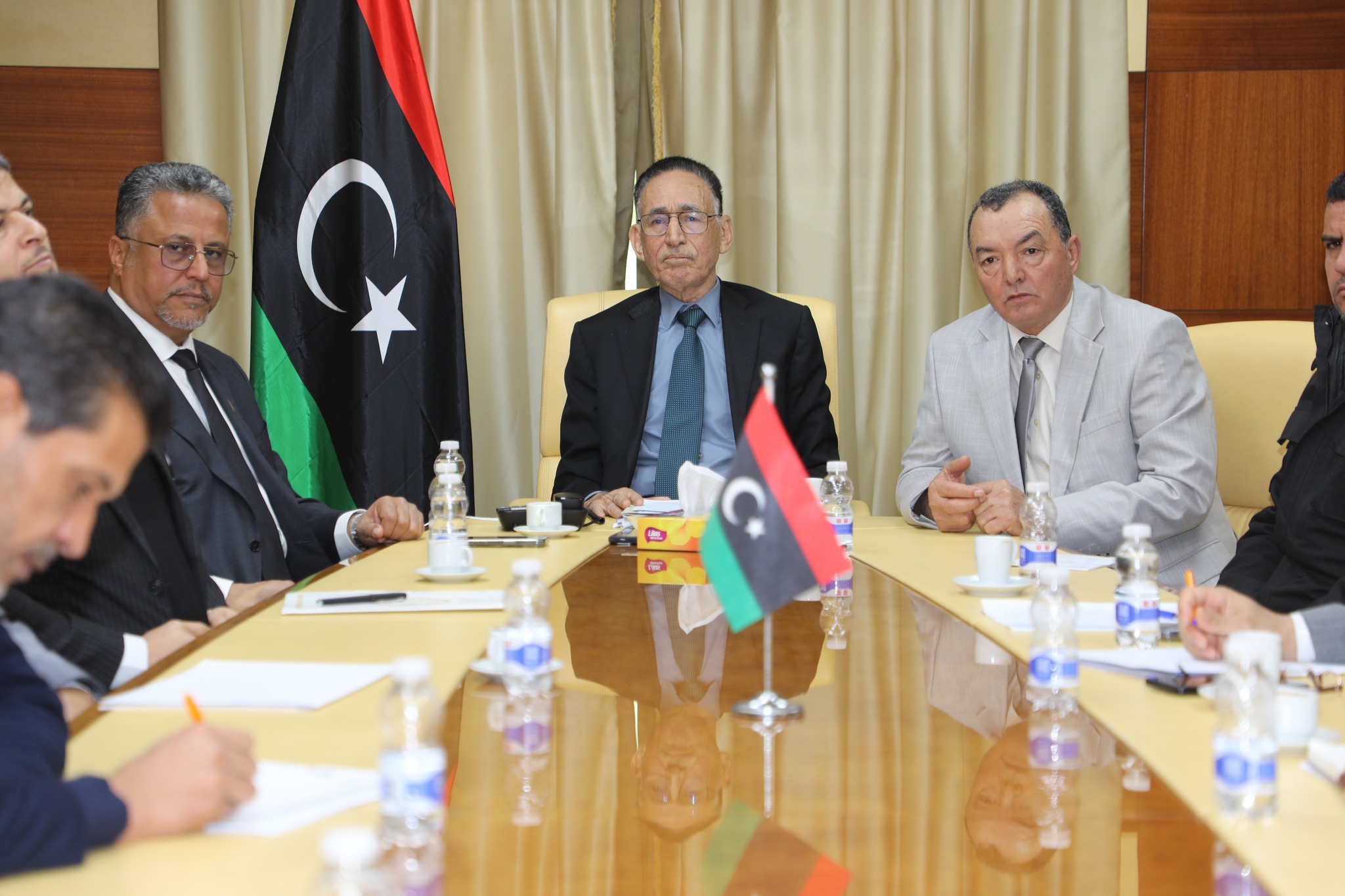
Tripoli, January 1, 2026 – The expanded meeting held by the Minister of Economy and Trade of the Government of National Unity at the ministry’s headquarters focused on regulating the local market, controlling prices, and ensuring the availability of essential goods for citizens.
The meeting was attended by the head of the Municipal Guard apparatus, the director of the legal office, the deputy minister of labor and rehabilitation, the director general of the Federation of Chambers of Commerce, Industry and Agriculture, the chairman of the board of the Tripoli Chamber of Commerce, Industry and Agriculture, along with directors of departments and offices at the Ministry of Economy.
The meeting discussed the situation of foreign labor and its impact on the Libyan market, particularly wholesale and retail activities. The minister emphasized the necessity of following up on and implementing the regulatory procedures outlined in Minister of Economy and Trade Decision No. (508) of 2022 regarding the regulation of commercial activity, specifically the prohibition of non-Libyans from engaging in wholesale and retail trade activities.
The minister stressed the importance of joint coordination with the Ministry of Labor and Rehabilitation and the Municipal Guard apparatus to monitor the status of foreign labor and prices. He indicated that the ministry will issue a decision this week specifying a price list for essential goods, in addition to preparing a blacklist for traders involved in price speculation and taking all legal measures against them in coordination with the relevant authorities and the Central Bank of Libya.
The minister confirmed that the ministry will adopt a daily mechanism to follow up on the implementation of price control measures, especially with the approaching holy month of Ramadan. He emphasized that supporting the citizen and alleviating living burdens comes amid the deterioration of the dinar’s value against foreign currencies and the tendency of some traders to speculate on prices and sell according to the parallel market rate, which has led to a worsening of citizens’ living conditions due to rising prices.
It was announced that a meeting will be held this week with traders to review production estimates, available goods, and inventories of various commodities, and to work on referring the indicative import budget for supplying essential goods.
For his part, the head of the Municipal Guard apparatus confirmed that weekly reports will be submitted regarding the regulation of labor and monitoring of prices for goods that will be covered by an official decision.
In turn, the Deputy Minister of Labor and Rehabilitation clarified that the ministry will provide all necessary facilities to regulate the labor market and enhance continuous coordination with the Municipal Guard apparatus and regulatory bodies. He pointed to the launch of the “Wafed” system in the previous period to register foreign labor, which contributes to facilitating registration procedures for business owners and traders.
Tripoli
Tripoli is the capital and largest city of Libya, historically founded in the 7th century BCE by the Phoenicians. It later became a significant Roman city and a major center under various empires, including the Ottoman Empire, which left a strong architectural and cultural imprint on its old medina.
Government of National Unity
The Government of National Unity (GNU) is a term most notably applied to the post-apartheid coalition government in South Africa, formed in 1994 following the country’s first multiracial elections. Led by Nelson Mandela as President, it brought together the African National Congress, the National Party, and the Inkatha Freedom Party to oversee the transition from minority rule to a multiracial democracy.
Ministry of Economy and Trade
The Ministry of Economy and Trade is a government department responsible for formulating and implementing national economic and commercial policy. Its history is typically tied to the modern formation of the state, evolving from earlier departments of commerce or industry to oversee trade regulation, economic development, and business affairs.
Municipal Guard apparatus
The Municipal Guard apparatus refers to the historical law enforcement and security forces in Portuguese cities, most notably the Lisbon Municipal Guard. Established in the 19th century, it was responsible for maintaining public order and municipal policing until it was disbanded in the 1970s following the Carnation Revolution.
Ministry of Labor and Rehabilitation
The Ministry of Labor and Rehabilitation is a governmental department responsible for overseeing labor policies, employment, and vocational rehabilitation services. Its history is typically tied to the development of a nation’s modern labor laws and social welfare systems, often established to protect workers’ rights and promote social equity following industrialization.
Federation of Chambers of Commerce, Industry and Agriculture
The Federation of Chambers of Commerce, Industry and Agriculture is a national organization in Lebanon that coordinates and represents the country’s private sector interests. It was established in the 20th century, formally created in 1995, to unify the various regional chambers and serve as a central body for economic advocacy and policy dialogue.
Tripoli Chamber of Commerce, Industry and Agriculture
The Tripoli Chamber of Commerce, Industry and Agriculture is a key economic institution in northern Lebanon, established to support and regulate local trade and business. It was founded in 1889, making it one of the oldest chambers of commerce in the region, and has played a significant role in the economic history of Tripoli and Lebanon.
Central Bank of Libya
The Central Bank of Libya is the primary monetary authority of Libya, established in 1956 to issue currency and manage the country’s financial reserves. Its history has been deeply affected by political conflict following the 2011 revolution, leading to a prolonged period where rival administrations in the east and west claimed control over separate branches of the institution.
Ramadan
Ramadan is the ninth month of the Islamic lunar calendar, observed by Muslims worldwide as a month of fasting, prayer, reflection, and community. Its history is rooted in the Islamic belief that during this month in 610 CE, the first verses of the Quran were revealed to the Prophet Muhammad.
Wafed system
The Wafed system is a traditional water management practice historically used in arid regions of Iran, particularly in Yazd, to distribute water from qanats (underground channels) for agricultural irrigation. It operates on a time-based rotation, allocating specific periods for different users or villages to access the water, ensuring a fair and organized distribution. This ancient system reflects a deep understanding of hydraulic engineering and communal cooperation in challenging desert environments.