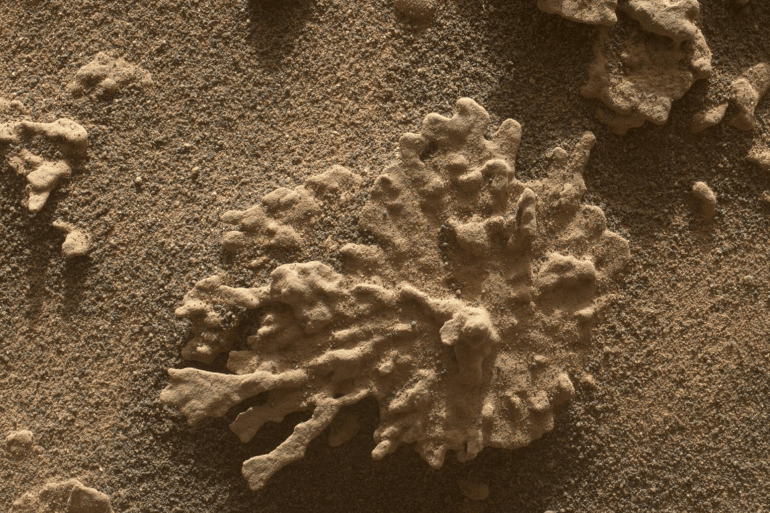
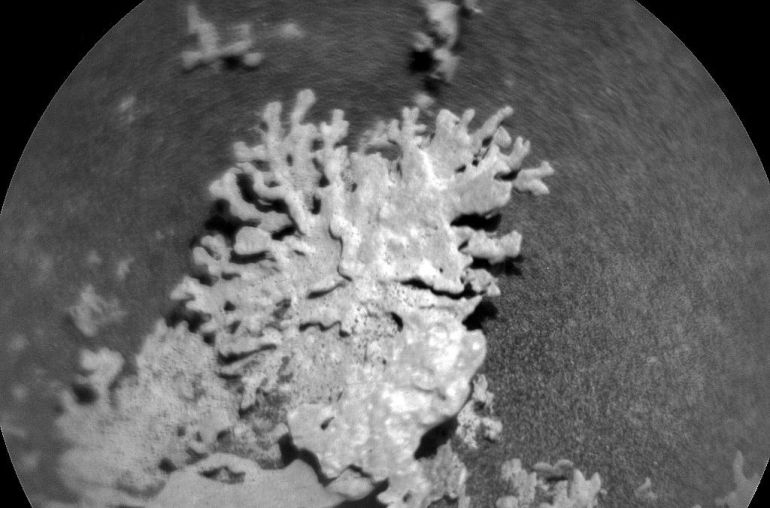
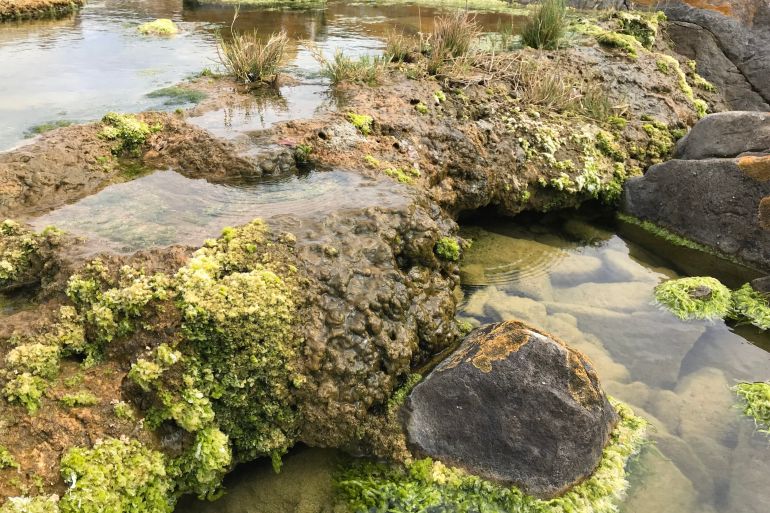
On July 24, 2025, during sol 4608 (the 4,608th Martian day of its mission in Gale Crater), NASA’s Curiosity rover captured an image of a small rock only a few centimeters wide, but with an unusually striking appearance.
The surface appeared branched and winding, reminding many of coral or coral reefs on Earth. The image did not immediately become widespread news, as the rovers capture thousands of images daily, which undergo a slow and precise scientific process starting with verification, calibration, comparison, and then geological analysis, before determining whether a shot represents an exceptional phenomenon or is merely a visual variation of known processes.
The delay in announcing the news until early 2026 is not due to concealment or hesitation, but rather the nature of scientific work itself. Institutions managing the Curiosity mission do not propose a public explanation before confirming the complete geological context of the image, comparing it with previous discoveries, and reviewing it with multidisciplinary teams.
When the image was reintroduced to the media months later, it was after the scientific consensus had settled on describing it as a clear example of the role of ancient water in shaping the Martian surface, nothing more.
The “Coral-Like” Rock… How Was It Formed Scientifically?
According to data and geologists’ analyses, this rock does not represent the remains of any living organism, but is the product of a geological process well-known on both Earth and Mars.
The hypothesis states that in the distant past, when Mars was warmer and wetter, groundwater laden with minerals seeped through fine cracks in sedimentary rock. As the water evaporated, the minerals deposited inside those cracks and hardened, forming solid veins.
Later, over millions of years, wind laden with sand eroded the surrounding weaker rock, leaving these mineral veins protruding on the surface in intertwined shapes that sometimes resemble coral or flowers.
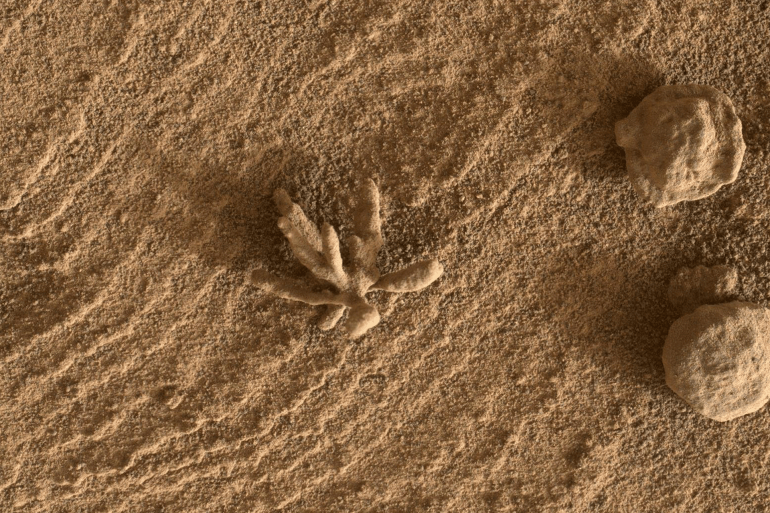
Scientists have observed this pattern repeatedly. In 2022, Curiosity documented a Martian “flower” rock formed in almost the same way.
It is confirmed that these processes are common in harsh desert environments, where long-term wind erosion is the dominant factor after the disappearance of liquid water.
The Curiosity rover found a coral-shaped flower on Mars.
Is This Evidence of Life on Mars?
Despite the catchy headlines, the position of scientific institutions was clear and cautious. It was emphasized that the visual similarity to coral does not imply a biological similarity.
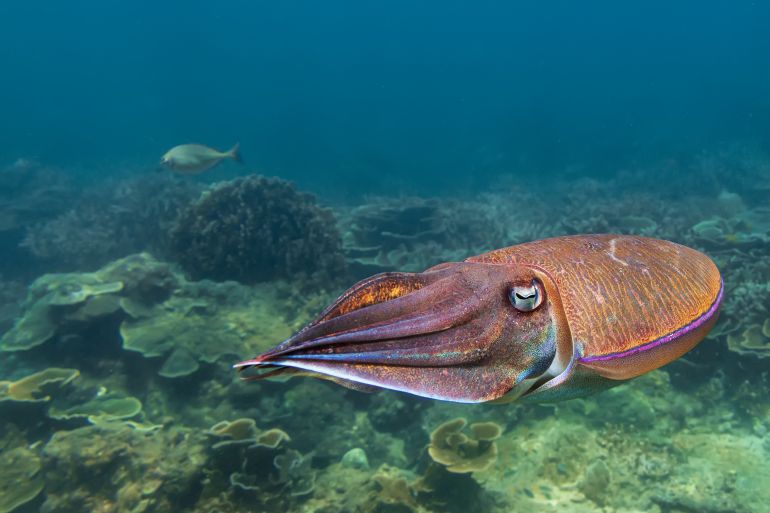
Coral on Earth is a complex marine organism, belonging to invertebrates, building its calcareous structures through biological processes within oceans rich with life. The Martian rock, however, is a purely mineral structure, containing no biological indicators such as cellular patterns or complex organic compounds associated with life.
It was clarified that “visual similarity alone is not a criterion for proving life,” noting that nature is capable of producing visually convergent forms through radically different processes.
Scientists also pointed out that these discoveries, rather than being evidence of life, are strong evidence of ancient aqueous systems, which are a necessary, but insufficient, condition for the emergence of life.</
NASA
NASA, or the National Aeronautics and Space Administration, is the United States government agency responsible for the nation’s civilian space program and aerospace research. It was established in 1958 in response to the Soviet Union’s launch of Sputnik, marking the beginning of the U.S.-Soviet space race. NASA is renowned for the Apollo moon-landing missions, the Space Shuttle program, and its ongoing exploration of the solar system and universe.
Curiosity Mars rover
The Curiosity Mars rover is a car-sized robotic vehicle that landed on Mars in August 2012 as part of NASA’s Mars Science Laboratory mission. Its primary scientific goal is to assess whether the Gale Crater environment ever offered conditions favorable for microbial life, and it has made significant discoveries about the planet’s past habitability and geology.
Mars
Mars is the fourth planet from the Sun and is often called the “Red Planet” due to its iron oxide-rich surface. It has a history of scientific fascination, with early telescopic observations leading to modern robotic exploration seeking evidence of past water and potential for ancient life.
Gale Crater
Gale Crater is a large impact basin on Mars, believed to have formed around 3.5 to 3.8 billion years ago. It is a significant site for planetary science as NASA’s Curiosity rover landed there in 2012 to study its layered mountains, which provide evidence that the crater once held a lake with conditions potentially suitable for microbial life.
Earth
Earth is the third planet from the Sun and the only known astronomical object to harbor life, with a geological history spanning over 4.5 billion years. Its diverse surface features and ecosystems have provided the environment for the development of all known human cultures and civilizations.
Martian rock
“Martian rock” typically refers to meteorites that originated from Mars, which were ejected into space by asteroid impacts and later landed on Earth. The most famous of these is ALH84001, discovered in Antarctica in 1984, which gained significant attention in 1996 when scientists proposed it might contain microscopic fossils of Martian bacteria. These rocks provide direct physical evidence about the geological history and past potential for life on Mars.
coral
Coral reefs are underwater ecosystems formed from the calcium carbonate skeletons of coral polyps, often found in shallow tropical waters. They have existed for millions of years, with some modern reef structures beginning to form after the last ice age. These biodiverse habitats are crucial for marine life but are now threatened by climate change and human activity.
coral reefs
Coral reefs are underwater ecosystems formed from colonies of coral polyps, which secrete calcium carbonate to build vast, biodiverse structures over thousands of years. They are often called the “rainforests of the sea” due to their immense ecological importance, providing habitat for about 25% of all marine species. Many modern reefs began forming after the last glacial period, around 10,000 years ago, as sea levels rose.
Paposo
Paposo is a small coastal settlement in northern Chile’s Antofagasta Region, historically significant as a pre-Hispanic fishing village and a critical 19th-century supply point for the mining industry. Its location along the arid coast made it a vital source of fresh water and a hub for maritime trade during the region’s mining boom.
Martian flower
The “Martian flower” is not a recognized historical or cultural site on Earth. The term likely refers to a concept from science fiction or a speculative idea about potential life or formations on Mars. As such, it has no verifiable human history or cultural significance as a place.