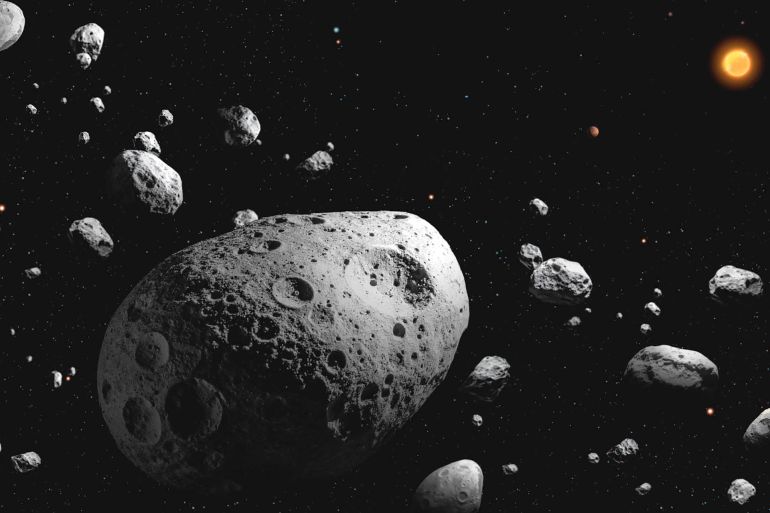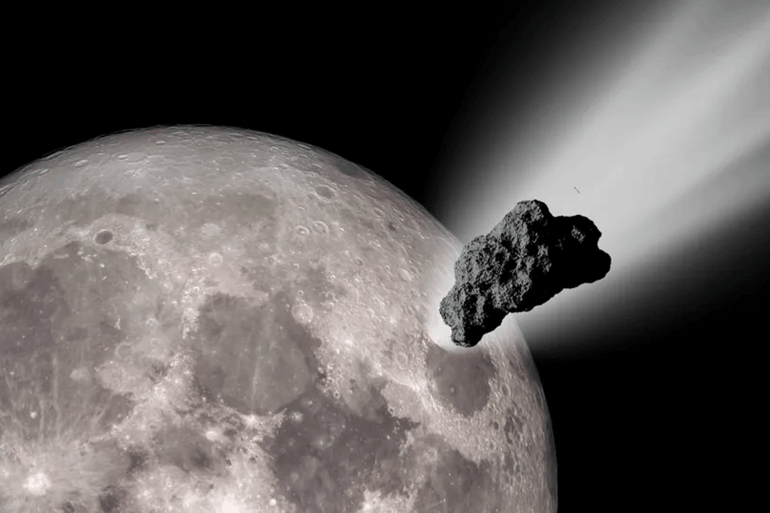
رسم توضيحي يظهر كويكبا متجها للاصطدام بسطح القمر (حساب روبرت ليا على كانفا)
  • February 2, 2026
  • libyawire
  • 0

In a striking scientific discovery, Chinese scientists have revealed that a giant cosmic collision more than 4 billion years ago may be the root cause behind the mysterious difference between the two faces of the Moon: the familiar near side and the largely unknown far side.

This conclusion came after analyzing rare samples returned by the Chang’e-6 mission from one of the Moon’s oldest and largest geological features, the South Pole–Aitken Basin. This basin spans a vast distance of about 2,500 kilometers and covers a large part of the lunar far side.

Also Read

list of 2 itemsend of list
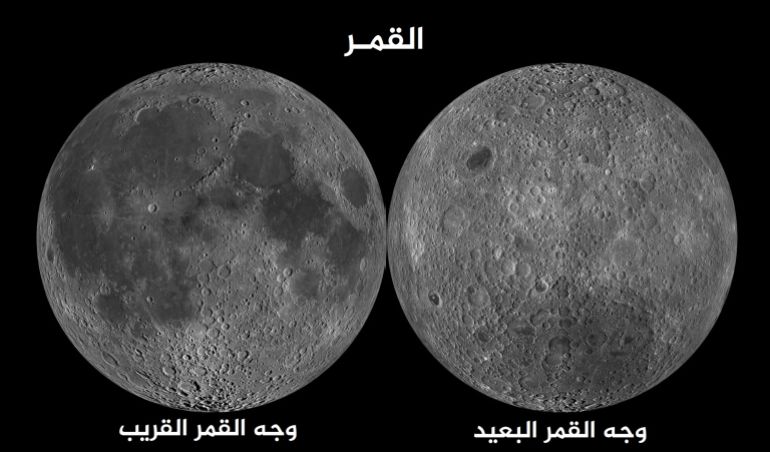
Two Dissimilar Faces of the Moon

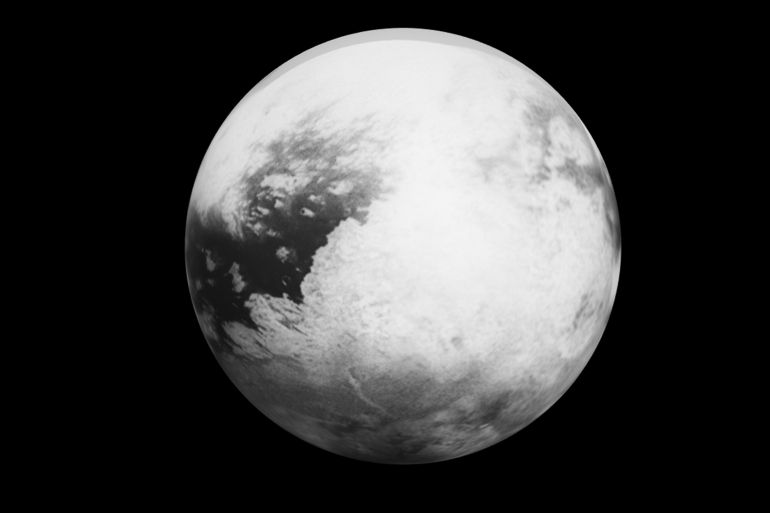
Anyone looking at the Moon can easily notice the wide dark spots on its near side, scientifically known as maria (seas). These are not bodies of water but vast plains of frozen basaltic lava, formed when magma flowed from the Moon’s interior and filled ancient impact basins. Some of the most famous include the Sea of Rains, the Sea of Serenity, the Sea of Tranquility, and the Sea of Fertility.

In contrast, the far side is almost devoid of these maria and is dominated by a bright, heavily cratered surface. This has puzzled scientists for decades: why did volcanic activity occur on one side and not the other?

The answer began to emerge with the Chang’e-6 samples, collected from within the South Pole-Aitken basin. This impact basin is about 2,500 kilometers in diameter and is considered one of the largest and oldest craters in the solar system.

When analyzing the basalt rocks, scientists found an unusual ratio between the isotopes of the element potassium: potassium-41 and potassium-39. This ratio is significantly higher than what was found in near-side samples brought back by the American Apollo missions.

After ruling out the effects of cosmic rays or normal volcanic processes, the researchers concluded that the most likely cause was the massive impact itself.
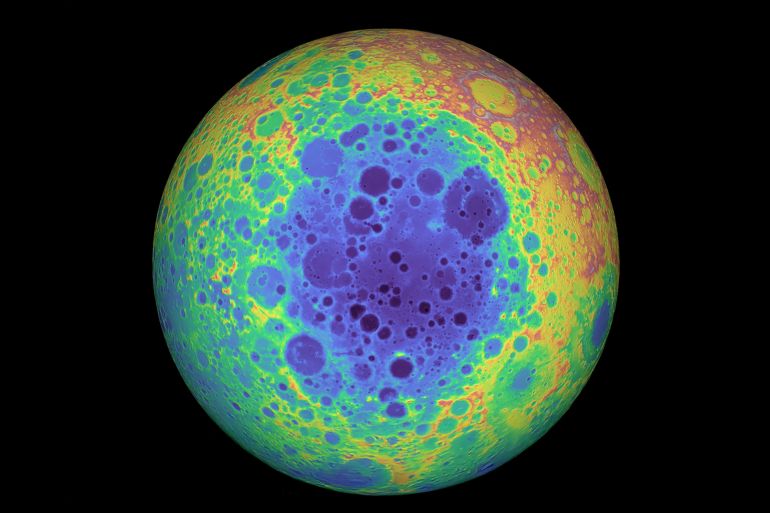
The South Pole-Aitken basin on the lunar far side is one of the largest and oldest impact features in the solar system. It's easily seen in this topographic map. The low center is dark blue and purple. Mountains on its edge, remnants of outer rings, are red and yellow.

What Did the Impact Do to the Moon?

According to the study, the thermal energy and pressure generated by the impact were sufficient to heat the lunar crust and mantle to temperatures that caused volatile elements—such as water and potassium—to evaporate and escape into space, especially on the far side. Because the lighter isotope (potassium-39) evaporates faster, a higher proportion of the heavier isotope (potassium-41) remained.

The result is a mantle depleted in water and volatile elements, meaning less magma, weaker volcanoes, and rare volcanic maria on the far side. This explains the absence of maria there, in contrast to their widespread presence on the near side.

A New Window on the Moon

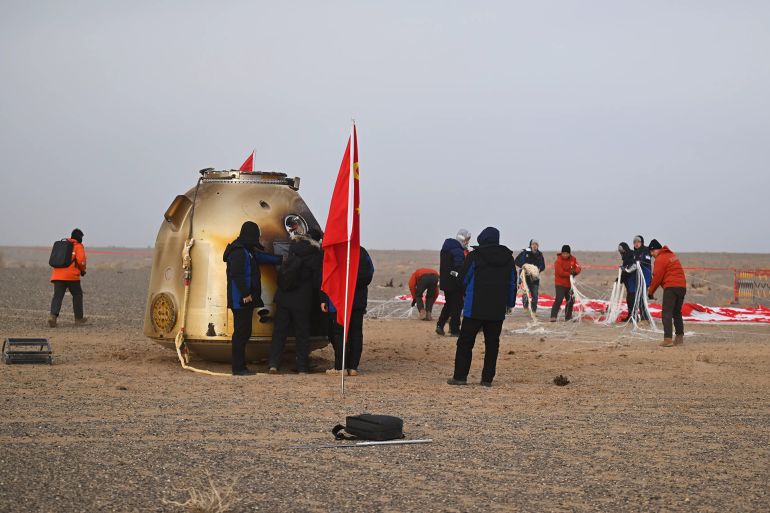
The importance of this discovery lies not only in solving an old mystery but also in the pivotal role played in achieving it. The Chang’e-6 mission is the first in history to bring back samples from the far side of the Moon, a scientific achievement no other nation has accomplished before.

These samples give scientists a direct view into the Moon’s interior and its early history, complementing what was started by the Apollo missions, which were limited to the near side. As China continues its ambitious lunar program, it has become a key player in rewriting the story of the Moon’s formation and evolution.


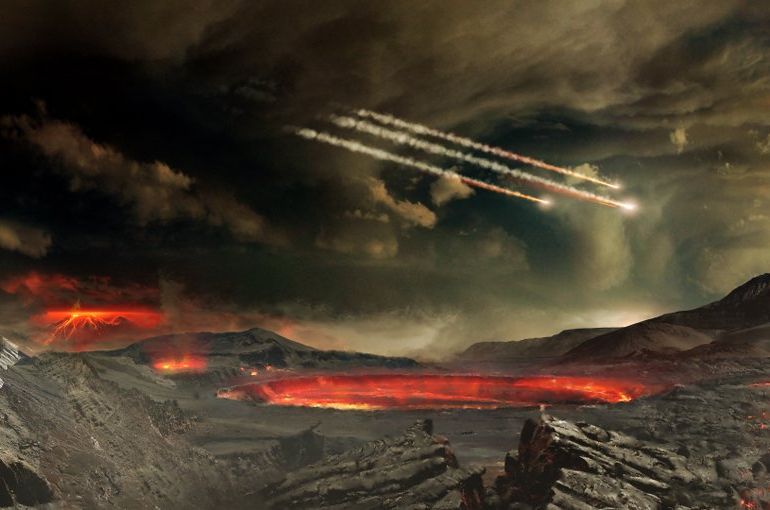
An illustration of a meteorite impact forming the South Pole-Aitken Basin on the moon's far side, causing melting of the crust and mantle and evaporation of volatile elements.

Moon

The Moon is Earth’s only natural satellite, believed to have formed approximately 4.5 billion years ago from debris after a massive collision between Earth and a Mars-sized body. Culturally, it has been a central object in mythology, timekeeping, and artistic inspiration across human civilizations throughout history.

South Pole–Aitken Basin

The South Pole–Aitken Basin is a vast impact crater on the far side of the Moon, approximately 2,500 kilometers in diameter, making it one of the largest known impact structures in the Solar System. It is estimated to have formed roughly 4 billion years ago, providing crucial insights into the early history of lunar bombardment and the Moon’s geological evolution.

Sea of Rains

The Sea of Rains, or *Mare Imbrium*, is a vast, dark lunar plain formed by a massive asteroid impact approximately 3.9 billion years ago. It is one of the largest impact basins on the Moon’s near side and is surrounded by notable mountain ranges, which are the remnants of the basin’s rim.

Sea of Serenity

The Sea of Serenity is a large, dark lunar mare on the Moon, formed by ancient volcanic eruptions that filled a giant impact basin with basalt. It is historically significant as the landing site for the Apollo 17 mission in 1972, the last crewed mission to the lunar surface.

Sea of Tranquility

The Sea of Tranquility is a vast, dark lunar mare formed by ancient volcanic eruptions. It is most historically significant as the landing site of Apollo 11, where astronauts Neil Armstrong and Buzz Aldrin became the first humans to walk on the Moon in 1969.

Sea of Fertility

The “Sea of Fertility” (Mare Fecunditatis) is a large, dark lunar mare, or “sea,” on the near side of the Moon. It was formed by ancient volcanic eruptions that filled a giant impact basin with basalt lava billions of years ago. The Soviet Luna 16 mission successfully returned soil samples from this region in 1970.

South Pole-Aitken basin

The South Pole-Aitken basin is the largest, deepest, and oldest confirmed impact crater on the Moon, spanning roughly 2,500 kilometers in diameter. It is believed to have formed from a colossal collision over 4 billion years ago, offering a unique window into the Moon’s early geological history and interior composition.

Apollo missions

The Apollo missions were a series of NASA spaceflight programs from 1961 to 1972, most famously landing the first humans on the Moon with Apollo 11 in 1969. They were conducted during the Cold War-era Space Race, driven by both scientific exploration and geopolitical competition with the Soviet Union.

Chang’e-6 mission

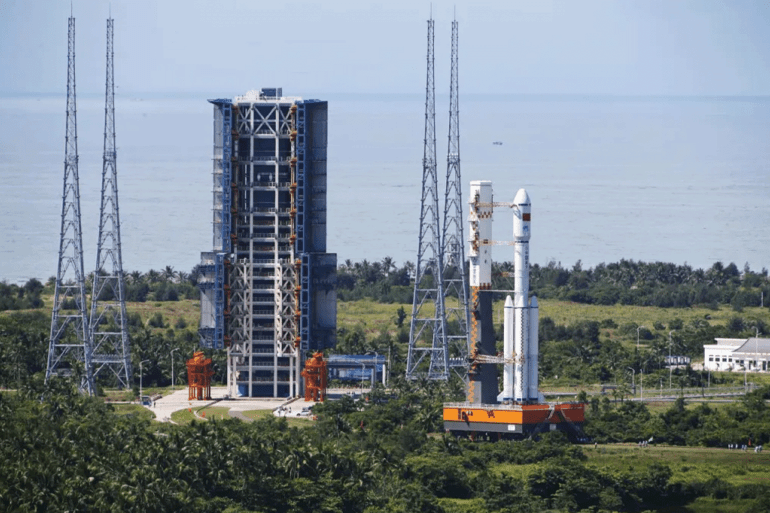
The Chang’e-6 mission is a Chinese lunar exploration spacecraft, launched in May 2024, which successfully collected the first-ever samples from the far side of the Moon. This mission built directly on the history-making success of its predecessor, Chang’e-5, which returned samples from the Moon’s near side in 2020, and is part of China’s broader, multi-decade Chang’e program for lunar exploration.

Leave a Reply

Your email address will not be published. Required fields are marked *