Seventy-three years ago, the term “Unidentified Flying Objects” (UFOs) emerged to describe any object or light seen in the sky or near space that could not be immediately explained by the observer or relevant authorities using the knowledge or data available at the time.
The U.S. Air Force coined this term as a more disciplined alternative to the term “flying saucers,” which became popular after American pilot Kenneth Arnold reported seeing strange objects near Mount Rainier in the northwestern United States.
Since the term was coined in 1952, the only tangible development in this field, aside from the increased frequency of sightings with the advancement of satellites, has been the effort by official bodies like the U.S. Department of Defense and NASA to use a new term since 2017: “Unidentified Aerial Phenomena” (UAP). However, apart from these terminology changes, these objects have remained without a specific scientific explanation, and researchers have approached the topic with great caution.
Nevertheless, attempts to understand them have continued intermittently. A new study has taken a different path by looking to the past, analyzing old photographs and presenting observations that might lead to an explanation for these objects.
The Pre-Satellite Era
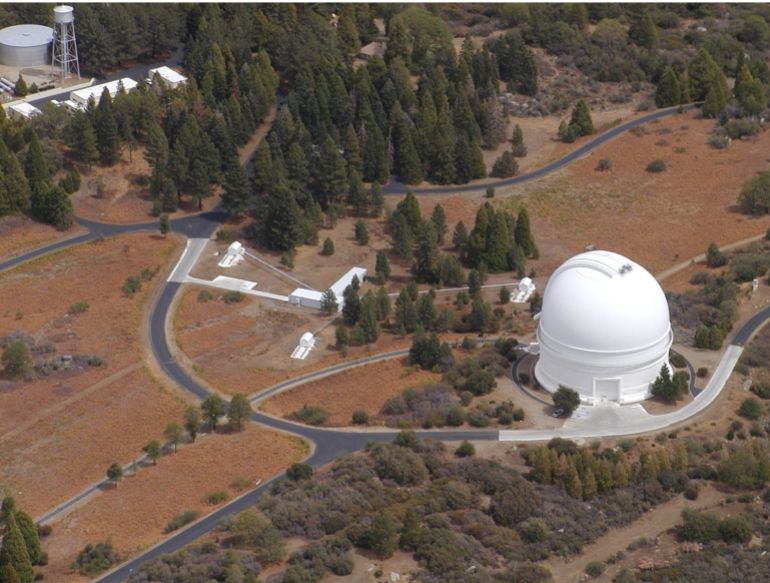
The images analyzed by the study, which has not yet undergone peer review, date back more than 70 years. At that time, astronomers from the Palomar Observatory in California took photographic plates of the sky, showing starlike flashes of light that appeared suddenly, then disappeared in less than an hour and never reappeared. This was before the satellite era, prior to the launch of Sputnik 1 in 1957.
The imaging technology available then was “photographic glass plates.” These were glass plates coated with a light-sensitive material used to record precise images of the sky and stars before the advent of digital cameras. The plates were placed inside telescopes during long exposures, allowing rays from stars and galaxies to leave precise traces on them, creating a fixed image that could be preserved for decades. Despite being heavy and sensitive to scratches and dust, these plates were an essential tool for astronomers to document the sky in a way that was not possible by any other means at the time.
During the study, an international research team re-examined digital copies of thousands of those photographic glass plates used in the first Palomar Observatory Sky Survey (1949-1958). These plates were used to image the sky with long exposures (50 minutes). The result was the discovery of transient light flashes on 310 nights. On some days, thousands of flashes appeared and then vanished completely, never to be observed again in any subsequent astronomical survey.
Palomar Observatory
Where Did the Excitement and Controversy Begin?
When comparing the timing of these flashes with the dates of atmospheric nuclear tests during the Cold War and historically recorded UFO reports, the researchers found that flashes were 45% more frequent near days of nuclear explosions. Every increase in UFO reports on a given day corresponded to an increase in the number of flashes. The researchers described this correlation as “more than just a statistical coincidence.”
What was distinctive about these flashes, as noted by the researchers in their study, was their alignment in straight lines, their complete disappearance without a trace, and their appearance as very sharp points resembling stars. This distinguishes them from other known astronomical flashes, which often originate from stellar explosions, meteors, asteroids, or imaging errors.
The researchers proposed several possible explanations for these unique flashes. They might be rare astronomical mechanisms not well documented in the mid-20th century. Atmospheric explosions could eject metallic materials or radioactive dust into upper layers of the atmosphere, appearing as temporary points of light. Finally, the most controversial explanation was that they are “Unidentified Flying Objects.”</p
night vision goggles
Night vision goggles are a technological device, not a cultural or historical site. They were first developed for military use during World War II, with significant advancements made throughout the Cold War. Their primary function is to amplify low levels of visible light or detect infrared radiation to allow users to see in darkness.
Sedona
Sedona is a city in Arizona, USA, renowned for its striking red sandstone formations and vibrant arts community. The area has a deep history, having been inhabited for thousands of years by Indigenous peoples, including the Sinagua, before becoming a ranching and farming settlement in the late 19th and early 20th centuries. It is now a major spiritual and wellness destination, famous for its alleged energy vortexes.
Arizona
Arizona is a southwestern U.S. state known for its desert landscape and iconic natural wonders like the Grand Canyon, which reveals two billion years of geological history. Historically, it was inhabited by Native American tribes for millennia before becoming part of Mexico and later a U.S. territory, achieving statehood in 1912. The state’s culture is deeply shaped by its Native American, Hispanic, and Old West heritage.
Mount Rainier
Mount Rainier is an active stratovolcano and the highest peak in the Cascade Range of the Pacific Northwest, located in Washington state. It is considered one of the world’s most dangerous volcanoes due to its high probability of eruption and proximity to populated areas, and its history includes numerous eruptions and lava flows over the last half-million years. The mountain and its surrounding ecosystem are protected within Mount Rainier National Park, established in 1899.
United States
The United States is a federal republic founded in 1776 after declaring independence from Great Britain, establishing itself through a revolutionary war and the ratification of its Constitution in 1789. It grew from thirteen original colonies into a global superpower, with a history shaped by westward expansion, industrialization, and significant internal conflicts such as the Civil War. Its diverse culture is a product of immigration and its influential political and economic systems.
U.S. Air Force
The United States Air Force was established as a separate military branch in 1947, evolving from the U.S. Army Air Forces of World War II. It is responsible for aerial and space warfare, providing rapid global mobility, intelligence, and global strike capabilities as a critical component of U.S. national defense.
U.S. Department of Defense
The U.S. Department of Defense is the federal executive department responsible for coordinating and supervising all agencies and functions of the government related directly to national security and the United States Armed Forces. It was established in 1947 through the National Security Act, consolidating the former War Department and Department of the Navy into a unified military command structure.
NASA
NASA, or the National Aeronautics and Space Administration, is the United States government agency responsible for the nation’s civilian space program and aerospace research. It was established in 1958 in response to the Soviet Union’s launch of Sputnik, marking the beginning of the U.S.-Soviet space race. NASA is renowned for landmark achievements like the Apollo moon landings and the operation of the Space Shuttle and International Space Station.
Palomar Observatory
The Palomar Observatory is a world-renowned astronomical research facility located in California, USA, which opened in 1949. It is historically significant for housing the 200-inch Hale Telescope, the largest effective telescope in the world for over 40 years, enabling major discoveries in cosmology and stellar evolution.
California
California is a state on the west coast of the United States, originally inhabited by numerous Native American tribes before becoming a Spanish colony and later part of Mexico. It was annexed by the U.S. in 1848, with the subsequent Gold Rush rapidly accelerating its development and population growth. Today, it is known globally as a center for technology, entertainment, and diverse cultural landscapes.
Sputnik 1
Sputnik 1 was the world’s first artificial satellite, launched by the Soviet Union on October 4, 1957. Its successful orbit marked the beginning of the space age and ignited the space race between the USSR and the United States during the Cold War.