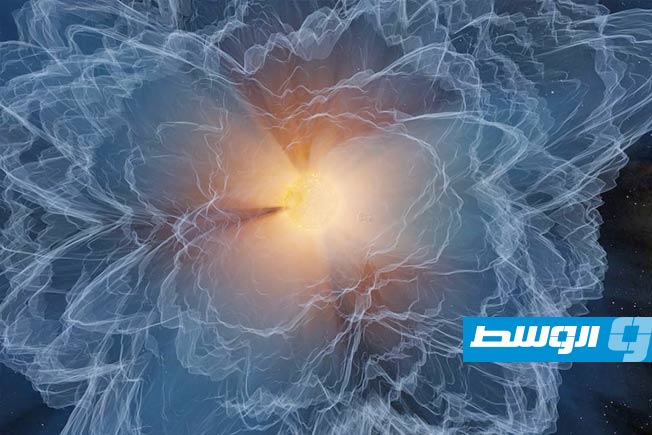
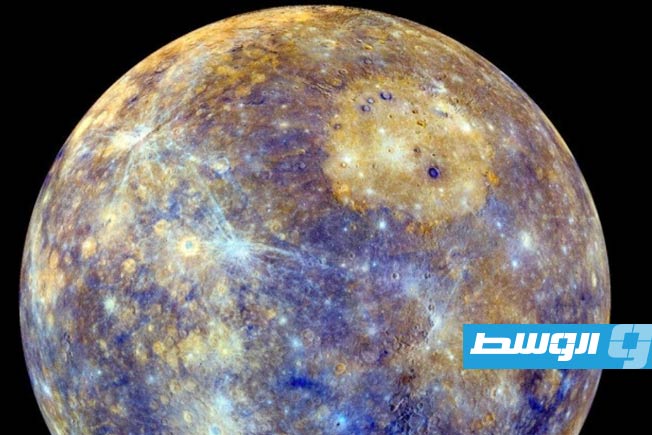
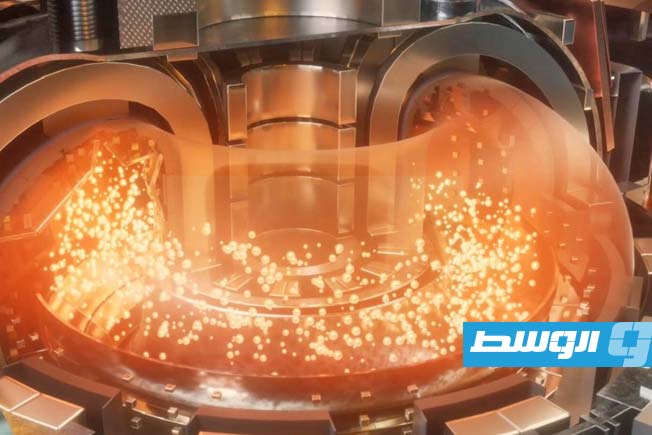
Scientists have successfully constructed the most detailed map to date of the Sun’s magnetic boundary, a region known as the “Alfvén surface,” where the Sun loses its magnetic control over the solar wind, allowing it to begin its free journey into space.
The study precisely tracked how this shape evolved during the first half of the current “Solar Cycle 25.” This is an 11-year cycle during which the Sun experiences peaks of activity, including sunspots, explosions, and flares, before subsiding again.
This achievement is the first of its kind, reconstructing this constantly changing structure using simultaneous measurements from multiple spacecraft. This provides crucial information for understanding the mystery of the immense heat in the Sun’s outer atmosphere.
– Comet ‘Atlas 3’ to reach its closest point to Earth in days, astronomers prepare
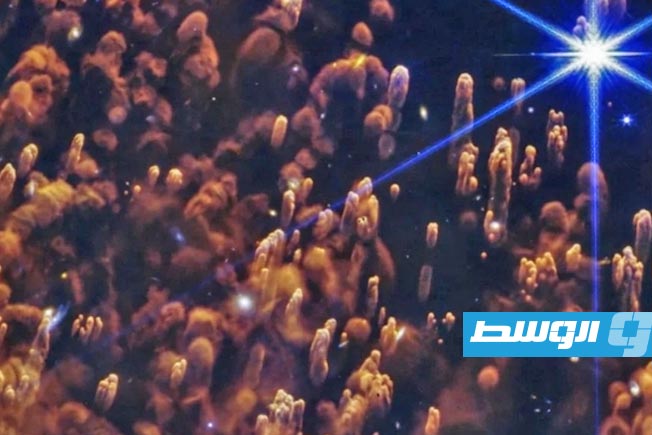
– International research team observes mysterious galaxy formed 11 billion years ago
The lead physicist of the study stated: “Parker Probe data from deep within the Alfvén surface could help answer major questions, such as: Why does the Sun’s corona heat up so tremendously? But to answer that, we first need to know precisely where this boundary is.”
Since 2021, the Parker Solar Probe has performed repeated dives beneath the “Alfvén surface.” An astronomer confirmed that the work proves beyond doubt that the probe is diving into the region where the solar wind is generated.
The researchers compared Parker’s data with observations from the Solar Orbiter probe, as well as three other spacecraft stationed at the Lagrange L1 point between Earth and the Sun, to measure the speed, density, and temperature of the flowing solar wind.
The research’s importance extends to understanding other stars in the universe; stars with strong magnetic fields have much broader Alfvén boundaries, which could affect the habitability of their planets.
The lead researcher concluded: “Previously, we estimated the Sun’s boundaries from afar without a means of verification. Now we have an accurate map we can use to navigate and understand what is truly happening around our parent star.”
Sun
The Sun is the star at the center of our Solar System, a massive sphere of hot plasma that has been the primary source of energy for life on Earth for over 4.6 billion years. Formed from the gravitational collapse of a giant molecular cloud, its nuclear fusion processes generate the light and heat that have fundamentally shaped the development of human cultures, calendars, and mythologies throughout history.
Alfvén surface
The Alfvén surface is a theoretical boundary in space where the solar wind’s speed equals the Alfvén speed, marking the transition from the Sun’s magnetic dominance to the flow-dominated interplanetary medium. It is named after Nobel laureate Hannes Alfvén, who pioneered magnetohydrodynamics, and its exact location around the Sun was first directly measured by NASA’s Parker Solar Probe mission in 2021.
Solar Cycle 25
Solar Cycle 25 is the current, 25th solar cycle of the Sun since detailed record-keeping began in 1755. It began in December 2019 and is expected to reach its peak of heightened solar activity around July 2025. This cycle is notable for a stronger-than-predicted increase in sunspots and solar flares, which can impact satellite operations and power grids on Earth.
Comet ‘Atlas 3’
Comet ATLAS 3, formally known as C/2019 Y4 (ATLAS), is a long-period comet discovered in December 2019 by the ATLAS (Asteroid Terrestrial-impact Last Alert System) survey. It initially showed promise of becoming a bright naked-eye object in 2020, but it disintegrated into multiple fragments as it approached the Sun, a fate common to many comets.
Earth
Earth is the third planet from the Sun and the only known celestial body to harbor life, with a geological history spanning approximately 4.54 billion years. Human cultures and civilizations have developed across its diverse continents and ecosystems over hundreds of thousands of years, fundamentally shaping its modern environment.
Parker Solar Probe
The Parker Solar Probe is a NASA robotic spacecraft launched in 2018, designed to make close observations of the outer corona of the Sun. It is the first spacecraft to be named after a living person, solar physicist Eugene Parker, and its mission is to trace how energy and heat move through the solar corona and to explore what accelerates the solar wind.
Solar Orbiter probe
The Solar Orbiter is a spacecraft developed by the European Space Agency (ESA) with NASA collaboration, launched in 2020 to study the Sun from close range. Its mission is to provide the first-ever images of the Sun’s polar regions and investigate the heliosphere, building on a long history of solar observation to understand solar wind and the 11-year solar cycle.
Lagrange L1 point
The Lagrange L1 point is a position in space between Earth and the Sun where the gravitational pulls of the two bodies balance an object’s orbital motion, allowing it to maintain a relatively stable position. This unique location, predicted by mathematician Joseph-Louis Lagrange in 1772, is now strategically used for solar observation satellites like SOHO, which can monitor the Sun continuously without Earth’s obstruction.