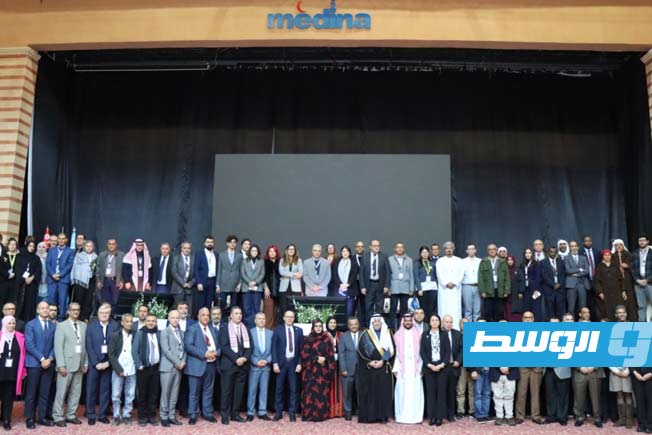
GAZA – Amidst the rubble of destroyed homes and above the sorrow, joy blossoms. Despite the Israeli war of annihilation, the will of more than 200 grooms and brides prevailed as they participated in a mass wedding ceremony titled “We Love Life Despite the Annihilation,” supported by the Turkish “Rabat Foundation.”
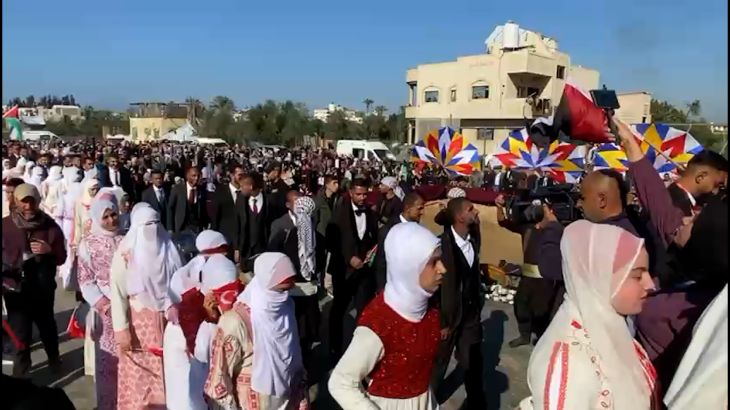
Amid an atmosphere of joy and to the sound of traditional Palestinian ululations and chants, the brides, grooms, and thousands of participants in the mass wedding set their sorrows aside, forgetting the calamities of a war that has ravaged them, their families, and their loved ones for two years—a war that has paused but whose effects of killing and destruction persist.
“No voice rises above joy and the will to live” in the square of the town of Al-Zawaida in the central Gaza Strip, which hosted, on Thursday, the largest mass wedding ceremony in the Strip since the aggression halted last October.
Gaza Rejoices
For three hours, joy was present. The participants in the wedding ceremony reclaimed a part of their lost lives. They are survivors of a war that left deep sorrow in their hearts for the loss of loved ones and places—a war that claimed the lives of more than 70,000 martyrs and nearly 170,000 wounded, and caused massive destruction to homes, facilities, and infrastructure.
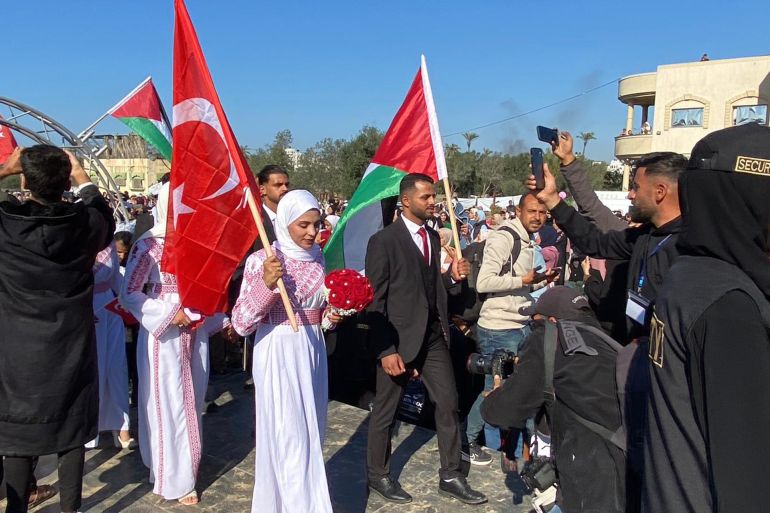
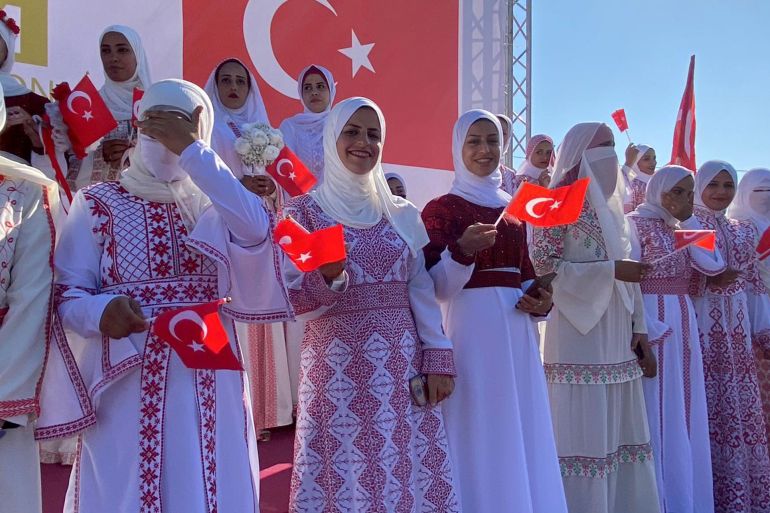
In a passage leading to a large stage adorned with Palestinian and Turkish flags, flanked by children clapping and scattering roses, grooms walked wearing black suits, while brides wore white dresses decorated with traditional Palestinian embroidery.
Overwhelming joy was evident on the faces of thousands of family members and loved ones of the couples, who found in the mass wedding a window of hope and happiness after a bloody and devastating war.
Emotions were mixed and contradictory, as many of the attendees and couples at the wedding are survivors of bloody massacres committed by the Israeli occupation forces, which claimed the lives of their families and relatives.
Brides wearing embroidered Palestinian dresses at the mass wedding ceremony.
A Message of Life
Among these displaced persons is groom Muhammad Al-Shafi’i, who lost his family. He stated that his participation in the mass wedding is a message of life and insistence on survival.
Groom Ahmad Shalayel agrees with him, saying, “Despite the bloodshed and destruction, we insist on seizing every opportunity for joy and happiness.”
With overwhelming happiness, groom Muhammad Abu Tita speaks of his immense joy, describing the wedding as a “special celebration.” He says such charitable initiatives help young people to get married, especially in light of the deteriorating economic conditions resulting from the war.
The people of Gaza are trying to take advantage of the relative calm following the signing of a ceasefire last October 10th to restore life. The trend towards marriage is evident. About two weeks ago, 54 grooms participated in a similar mass wedding in the Al-Mawasi area west of Gaza City, sponsored by a relief operation.
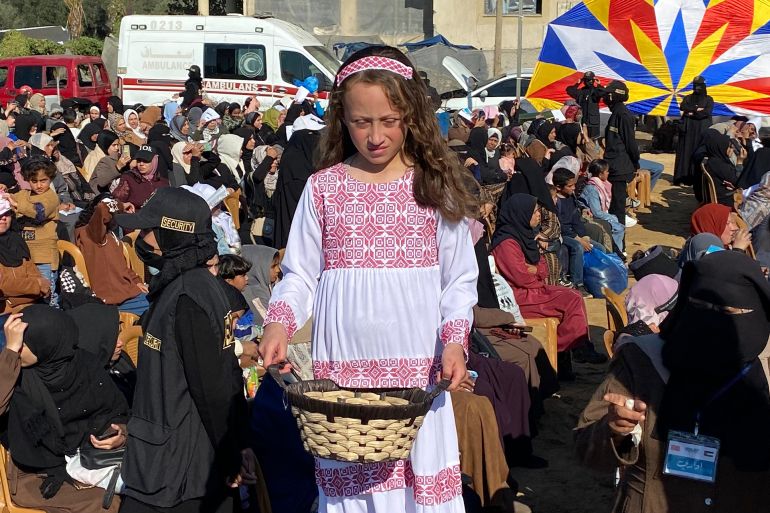
A girl holding a basket of roses at the mass wedding ceremony.
Hope Despite Pain
The media coordinator for the mass wedding, funded by the Turkish Rabat Foundation, stated, “The occupation sought during the war to execute and destroy the features of life in Gaza. Today we have come to revive hope for life and the future.”
Gaza
Gaza is a coastal city in the Palestinian territories with a history dating back over 3,000 years, having been ruled by various empires including the Egyptians, Philistines, Romans, and Ottomans. It is a densely populated urban center and holds significant cultural and religious importance in the region. In recent decades, it has been a focal point of the Israeli-Palestinian conflict and is administered by the Hamas government.
Israeli
Israel is a country in the Middle East, established as a modern state in 1948. It is a historic region with deep religious significance for Judaism, Christianity, and Islam, containing sites like Jerusalem’s Old City and the Western Wall.
Turkish
Turkey is a transcontinental country located mainly on the Anatolian Peninsula in Western Asia, with a smaller portion on the Balkan Peninsula in Southeastern Europe. Its history is profoundly shaped by being the heartland of successive empires, most notably the Byzantine and Ottoman Empires, with the modern Republic of Turkey founded in 1923 following the Turkish War of Independence. The nation’s culture is a rich fusion of these deep historical influences, Central Asian Turkic heritage, and its unique secular, modern identity.
Rabat Foundation
The Rabat Foundation, also known as the Mohammed VI Foundation of African Oulema, was established in 2015 in Rabat, Morocco. It serves as a pan-African institution aimed at promoting moderate Islamic scholarship, cultural exchange, and unity among African Muslim scholars. Its creation reflects Morocco’s historical role as a center for Islamic learning and its contemporary diplomatic efforts to strengthen ties across the African continent.
Palestinian
“Palestinian” refers to the people, culture, and heritage associated with the region of Palestine, a land with a deep and ancient history in the Eastern Mediterranean. The modern Palestinian national identity coalesced in the 20th century, particularly following the 1948 Arab-Israeli war and the displacement known as the Nakba. Key cultural sites include the historic cities of Jerusalem, Bethlehem, and Hebron, which hold significant religious and archaeological importance.
Al-Zawaida
Al-Zawaida is a small village located in the Gaza Strip, historically known for its agricultural lands and citrus groves. It was established in the early 20th century and has been significantly impacted by the broader regional conflicts affecting the area.
Gaza Strip
The Gaza Strip is a small coastal territory on the eastern Mediterranean, historically part of Palestine and administered by Egypt after the 1948 Arab-Israeli war. It came under Israeli occupation following the 1967 Six-Day War and has been governed by the militant group Hamas since 2007, existing under a stringent Israeli-Egyptian blockade.
Al-Mawasi
Al-Mawasi is a narrow coastal strip in the Gaza Strip, historically an agricultural area known for its citrus and olive groves. In recent decades, it has been significantly impacted by regional conflicts, often serving as a refuge for displaced civilians during periods of intense fighting.
Gaza City
Gaza City is a historic coastal city in the Palestinian territories, with a history of settlement dating back over 3,000 years. It has been ruled by numerous empires, including the Egyptians, Philistines, Romans, and Ottomans, serving as a key trade hub. Today, it is the largest city in the Gaza Strip and a major population and administrative center.