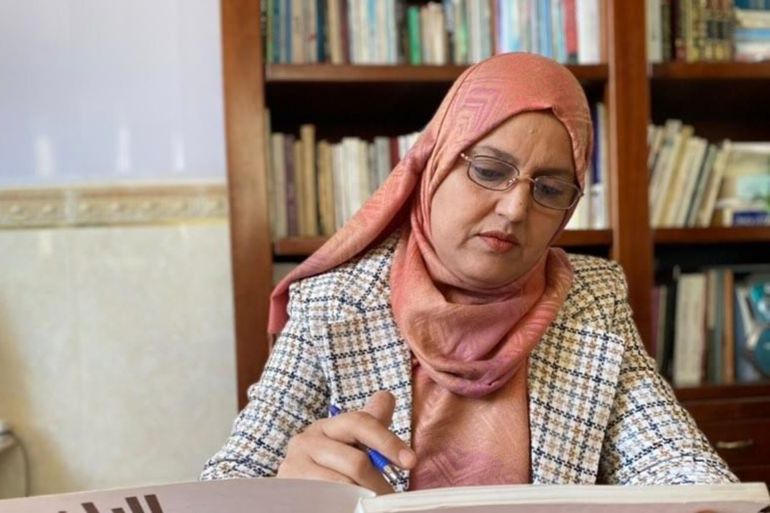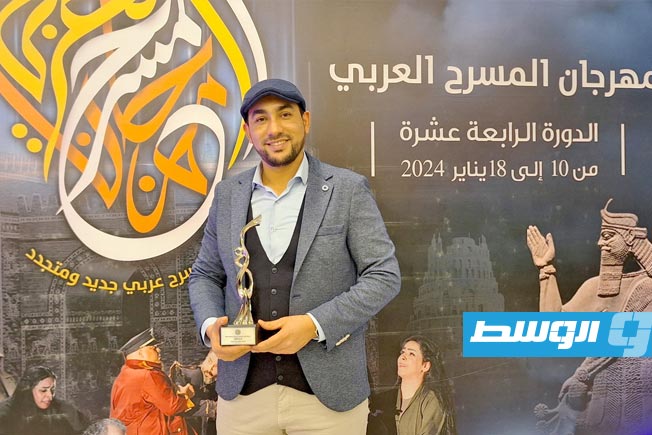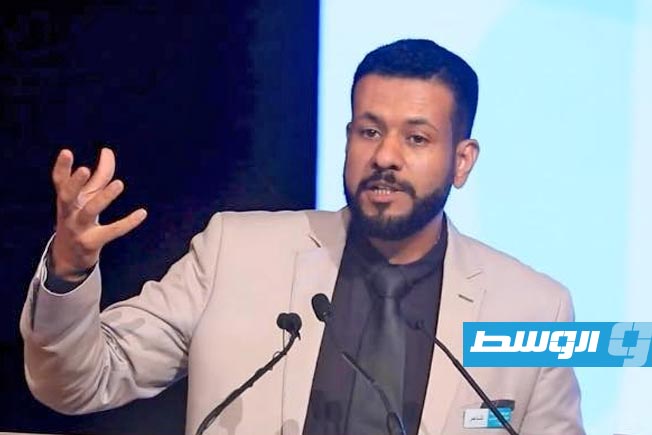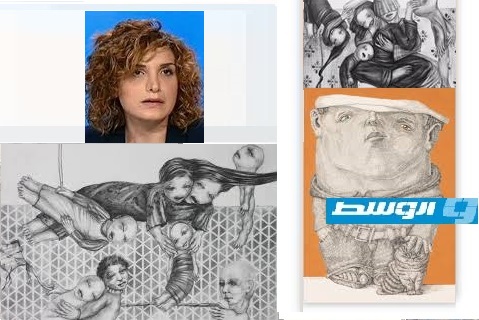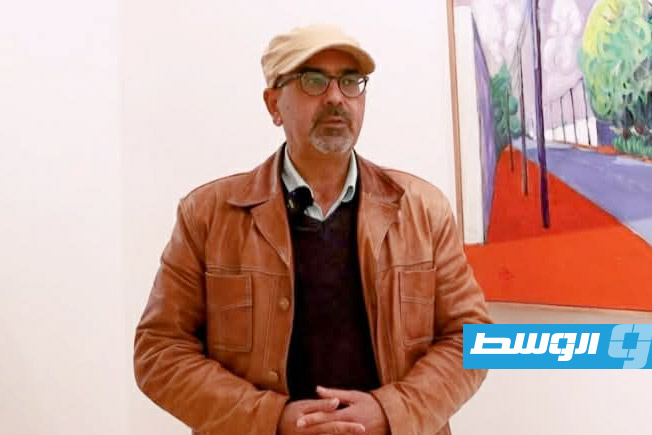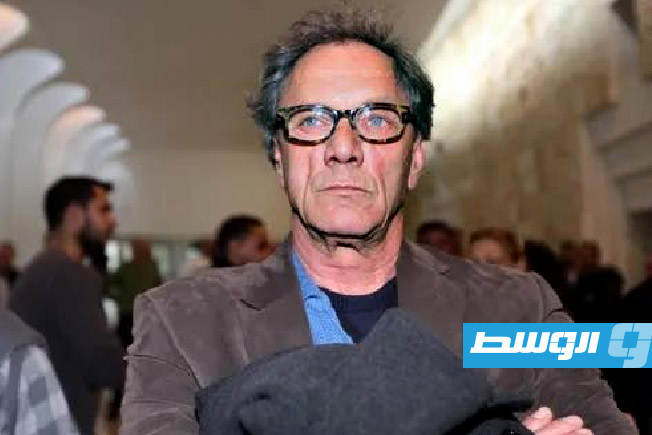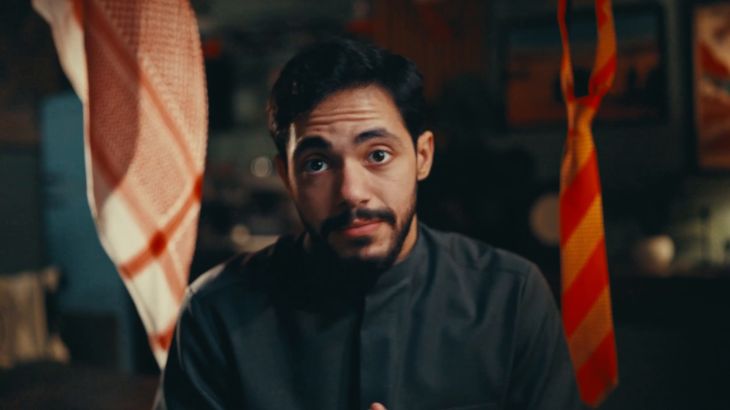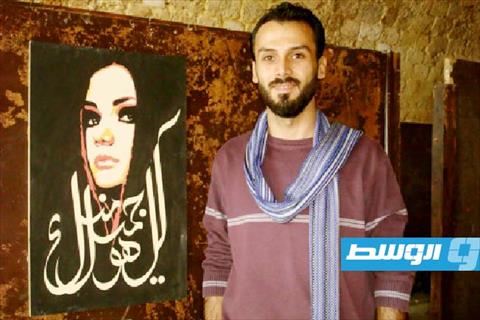
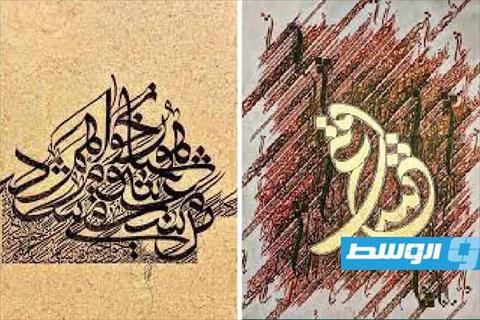
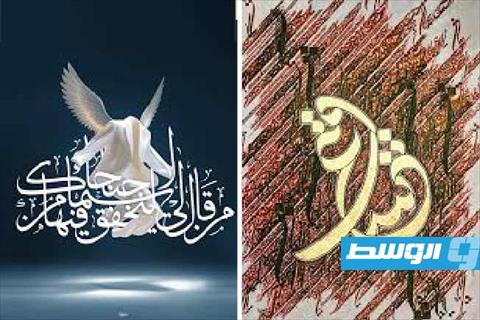
The Syrian calligrapher and visual artist, born in 1986 and a 2009 graduate of the Faculty of Fine Arts with a degree in Sculpture, says: “The idea of holding a solo exhibition never left my mind since graduation until it was realized in 2015 at the (Baal) hall in the city of Tartus.” He adds: “The exhibition lasted for three days, and in his paintings he relied on a style of crafting letters and words alongside drawing (a portrait with a phrase), moving away from calligraphic abstraction. He used images of faces with specific expressions, adding a phrase that serves the intended meaning; this gives the painting a compositional completeness. He relied on the Diwani script as the foundation for his works because he is captivated by it and prefers it over other scripts.”
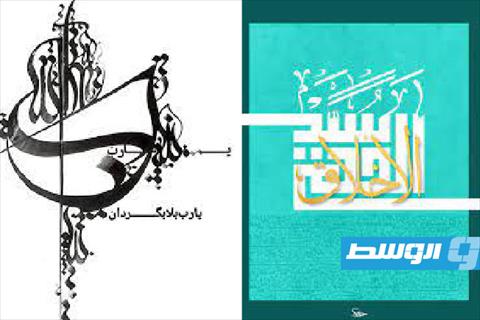
He reworked some outstanding works by a number of calligraphers.
Among what he executed was the reworking of some accomplished and distinguished works by a number of calligraphers. His relationship with Arabic calligraphy began alongside his love for sculpture a long time ago, and he says: “Alongside my great love for sculpture, I simultaneously showed a great interest in Arabic calligraphy, which was not taught at the college as a separate major among the other specializations. Its modest presence in the university was limited to ‘Arabic Calligraphy’ as a quasi-secondary subject, and unfortunately, it was not given proper attention like other subjects despite the presence of professors of great standing in this field. So, through personal effort, I began closely following most calligraphers, from amateurs to the master giants of Arabic calligraphy, to owners of advertising centers; learning about how script is used in advertisements, newspaper headlines, and shop names.”
Merging the art of sculpture with the art of calligraphy
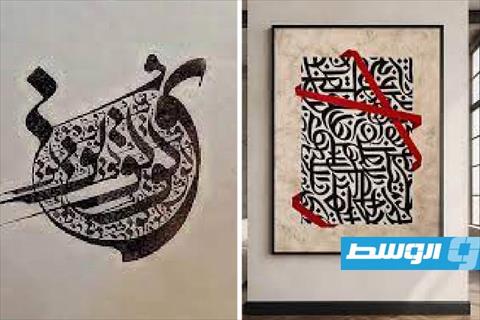
He researched the most famous paintings worked in Arabic calligraphy, and also became acquainted with a certain professor and studied his art and how he developed some scripts; this had the greatest impact on his drive to focus and persevere in practicing Arabic calligraphy. He was always questioning during his participation in exhibitions about the possibility of merging the art of sculpture with the art of calligraphy, and attempting to draw scripts as decorative engraving on the sculptural mass, and as an abstract form of letters chosen by the sculptor and carefully studied to be crafted with that mass. Therefore, he learned calligraphic abstraction and abstract calligraphy. Sometimes he practiced through imitation, and sometimes he innovated in shaping words and phrases, and the exhibition’s paintings were the best witness to the results of those efforts in merging these two arts.
The artist has created a new artistic style in composition.
Perhaps with this selected glimpse, we have highlighted that the artist has created a new artistic style in composition by linking the beauty of Arabic calligraphy with visual paintings, and sometimes (portraits) of beautiful faces that harmonized with the arrangement of the script used, achieving a distinct uniqueness. This led another artist to say about him: “The stylistic approach adopted in his creative output is seen through simplicity and lack of affectation; his lines are flowing, taking a curved movement to emphasize strength and increase rhythm, thus managing to balance their sharpness with the calm colors brushed in the background of the work. We notice that the letter in his works takes two dimensions without any presence of the third dimension – the illusory dimension – thus affirming the truth of the word through the truth of the line. Indeed, he has proven to be the owner of a serious project, and I wish him success and brilliance.”
 </
</