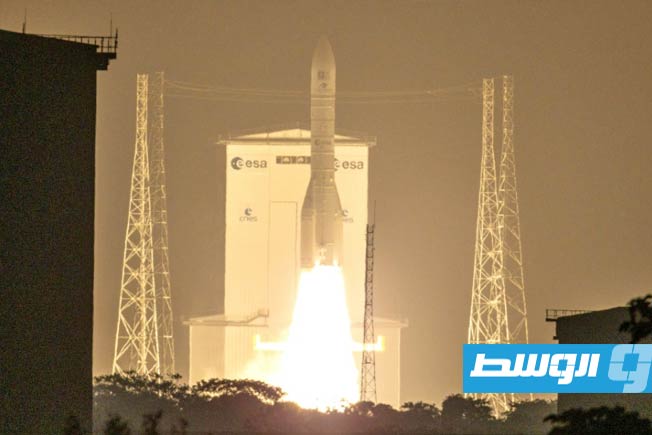
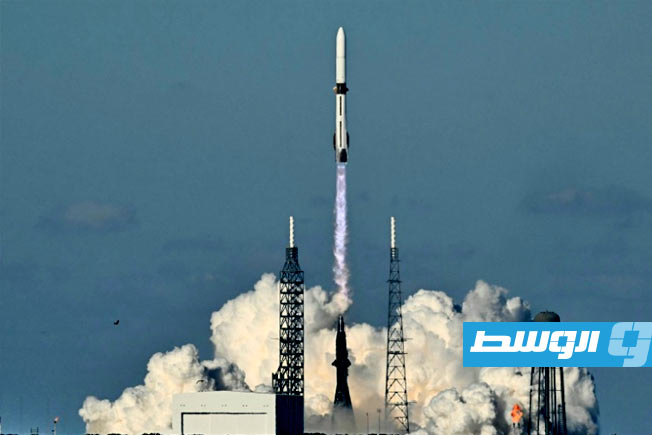
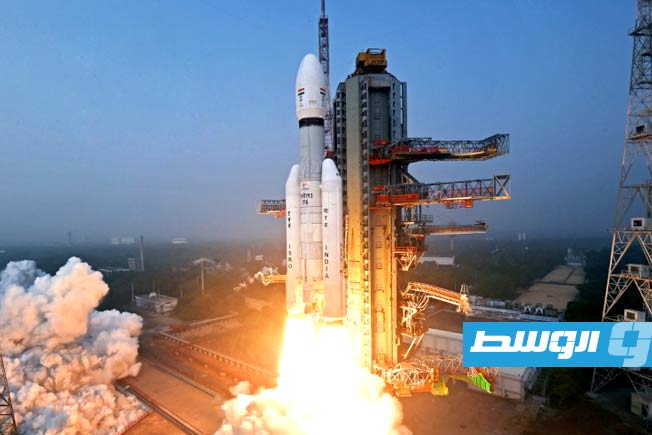
The Ariane 6 rocket launched today, Wednesday, from the Guiana Space Centre in French Guiana, carrying two satellites for the European Galileo program. This marks the fourth commercial flight for this heavy-lift rocket, which symbolizes Europe’s regained autonomous capabilities for space access.
The rocket lifted off into the tropical night sky as planned at 2:00 AM, taking advantage of favorable weather conditions despite the rainy season in this French region located in South America near the equator.
– South Korea intends to compete with ‘SpaceX’ in the space transportation sector
Arianespace, the company responsible for marketing and operating Ariane 6, is scheduled to place the two satellites belonging to the European Commission’s Galileo program into a medium Earth orbit at an altitude of approximately 22,900 kilometers, three hours and 55 minutes after launch.
34 satellites in the Galileo constellation
The launch of the two new-generation satellites, named ‘SAT 33’ and ‘SAT 34’, will increase the number of satellites in the Galileo constellation to 34.
Galileo is the European satellite navigation system, equivalent to and a competitor of the American Global Positioning System (GPS), designed to provide precise and independent geographical positioning.
According to Arianespace, these two satellites will join the first-generation Galileo constellation to improve the accuracy, availability, and reliability of the European Union’s global satellite navigation system.
Thanks to the use of dual-frequency technology, Galileo provides real-time positioning accuracy of up to one meter for billions of users worldwide. This is the European Union’s largest infrastructure initiative, designed to ensure strategic autonomy and sovereignty.
Ariane 6
Ariane 6 is a European heavy-lift launch vehicle developed by the European Space Agency (ESA) to succeed the Ariane 5, with its maiden flight scheduled for 2024. Its development, initiated in 2014, was driven by the need for a more modular and cost-competitive rocket to secure Europe’s independent access to space for institutional and commercial missions.
Guiana Space Centre
The Guiana Space Centre is Europe’s primary spaceport, located in French Guiana. It was established in 1964 by the French government, chosen for its advantageous location near the equator, which provides a significant boost to rocket payload capacity. Today, it is used by the European Space Agency (ESA) for launching missions with vehicles like the Ariane and Vega rockets.
French Guiana
French Guiana is an overseas department and region of France located on the northeastern coast of South America. Its history is marked by indigenous settlement, European colonization beginning in the 17th century, and its infamous use as a penal colony, most notably the Devil’s Island complex. Today, it is best known for hosting the Guiana Space Centre, Europe’s primary spaceport.
South America
South America is a continent known for its diverse landscapes, ranging from the Amazon rainforest to the Andes mountains. Its history is marked by ancient civilizations like the Inca, followed by European colonization primarily by Spain and Portugal, which led to a complex cultural heritage blending indigenous, European, and African influences.
South Korea
South Korea, officially the Republic of Korea, is a country in East Asia located on the southern portion of the Korean Peninsula. Its modern history began with its liberation from Japanese colonial rule in 1945, followed by the establishment of a separate government in 1948 and the devastating Korean War (1950-1953). Since the late 20th century, it has undergone rapid industrialization and democratization, becoming a global leader in technology and popular culture.
SpaceX
SpaceX, founded by Elon Musk in 2002, is a private American aerospace manufacturer and space transportation company. Its history is defined by pioneering reusable rocket technology, significantly reducing the cost of space access, and achieving milestones like being the first private company to send astronauts to the International Space Station.
Arianespace
Arianespace is a European commercial launch service provider founded in 1980, which became the world’s first commercial company dedicated to launching satellites. It was established to manage the production and operation of the Ariane series of rockets, originally developed by the European Space Agency to provide Europe with independent access to space.
European Commission
The European Commission is the executive branch of the European Union, responsible for proposing legislation, implementing decisions, and managing EU policies. It was established in 1958 as part of the then-European Economic Community to act as a politically independent guardian of the EU treaties and promote the general interest of the Union.
Galileo
Galileo refers to the Italian astronomer and physicist Galileo Galilei, a key figure in the scientific revolution of the 16th and 17th centuries. His pioneering use of the telescope led to groundbreaking astronomical discoveries, such as the moons of Jupiter, which challenged the prevailing geocentric view of the universe. His advocacy for heliocentrism brought him into conflict with the Catholic Church, resulting in his famous trial and condemnation for heresy in 1633.
SAT 33
“SAT 33” is a reference to the 33rd Street Armory in Philadelphia, Pennsylvania, a historic military building constructed in 1900. It served as a training and mobilization site for the Pennsylvania National Guard and is notable for its distinctive castle-like architecture.
SAT 34
“SAT 34” is not a recognized or widely known place or cultural site. Without additional context or clarification, it is not possible to provide a meaningful historical summary.
Global Positioning System
The Global Positioning System (GPS) is a satellite-based navigation system developed and operated by the United States Department of Defense, with its first satellite launched in 1978. Originally created for military use, it was made fully available for civilian applications in the 1990s, revolutionizing global navigation, timing, and mapping.
GPS
GPS, or the Global Positioning System, is a satellite-based navigation system developed and operated by the United States Department of Defense. It was initially created for military use in the 1970s, with its full constellation of satellites becoming operational in 1995, before being made freely available for civilian and commercial applications worldwide.
European Union
The European Union (EU) is a political and economic union of 27 European countries, founded after World War II to foster economic cooperation and prevent future conflict. It has evolved from the European Coal and Steel Community in 1951 into a major supranational entity with its own currency (the euro, used by 20 members) and institutions that govern common policies on trade, agriculture, and regional development.