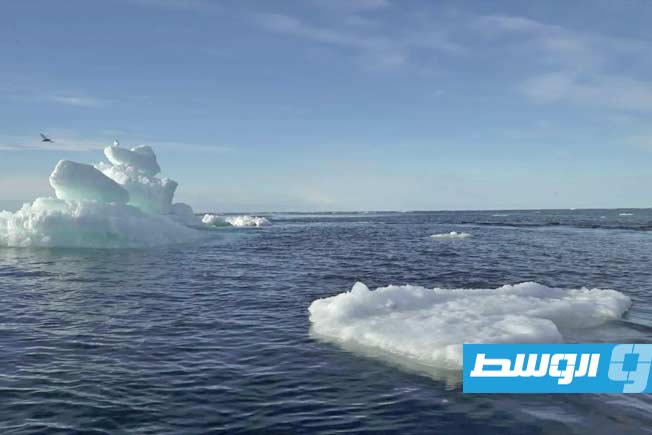
Last year was the warmest year on record in the Arctic region, according to a report from a leading American agency that paints a grim picture for the future of the North Pole, which is particularly vulnerable to the consequences of climate change.
According to this annual report, temperatures in the Arctic region between October 2024 and September 2025 exceeded the average recorded between 1991 and 2020 by 1.60 degrees Celsius.
The report warns that the region experienced its warmest autumn on record, its second warmest winter, and its third warmest summer since data recording began. Temperatures in the Arctic are rising at a rate two to four times faster than the global average, a phenomenon known as “Arctic amplification.”
The region recorded its highest precipitation rate on record, while the maximum extent of winter sea ice in March 2025 reached its lowest level in the 47-year satellite record.
The report also documented the phenomenon of “rusting rivers” in Alaska, where thawing permafrost releases minerals like iron that turn the water orange and increase its acidity.
Arctic region
The Arctic region is the northernmost area of Earth, encompassing the Arctic Ocean and parts of several countries, and has been home to Indigenous peoples like the Inuit for thousands of years. Its history is marked by exploration and scientific study, particularly during the 19th and 20th centuries, as nations sought to map its territory and understand its climate. Today, it is a focal point for climate change research and geopolitical interest due to its melting sea ice and natural resources.
North Pole
The North Pole is the northernmost point on Earth, located in the middle of the Arctic Ocean and covered by shifting sea ice. Unlike the South Pole, it has no landmass beneath it and no permanent human settlement or indigenous history, though it has been a target for exploration since the 19th century, with Robert Peary’s disputed 1909 expedition being a notable claim.
Alaska
Alaska is the largest state in the United States, located in the northwest extremity of North America. It was purchased from the Russian Empire by the United States in 1867 and became the 49th state in 1959.