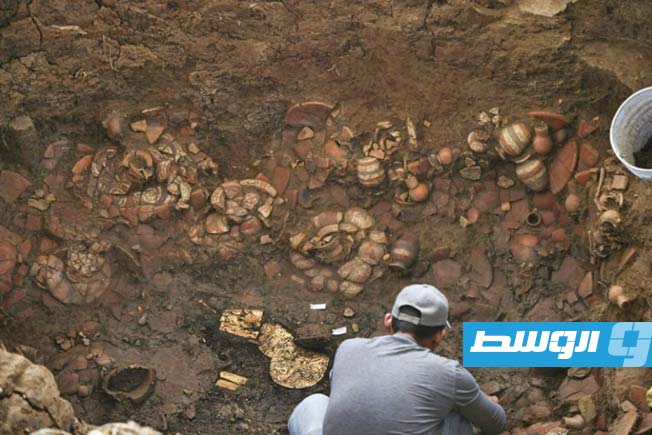
A team of archaeologists in Panama announced the discovery of an ancient tomb dating back approximately a thousand years. Inside, human remains were found surrounded by gold treasures and decorated pottery at the “El Caño” site in the Nata region, located 200 kilometers southwest of the capital, Panama City.
The nature of the valuable artifacts indicates that the buried individuals belonged to the social elite in the pre-European colonial era.
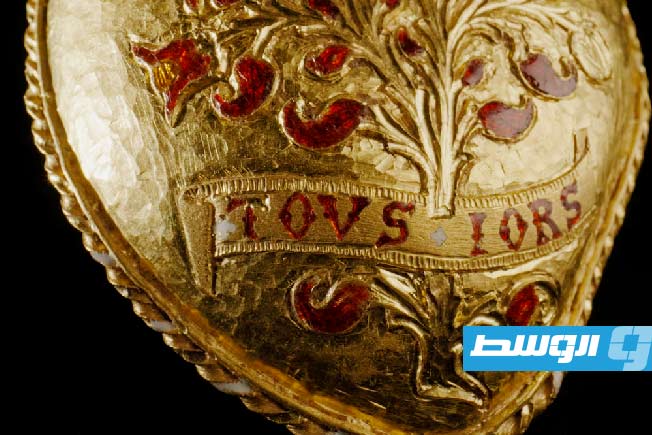
The tomb, estimated to be between 800 and 1000 years old, belonged to a high-ranking individual. The remains were adorned with two bracelets, two earrings, and a pectoral necklace decorated with engravings of bats and crocodiles.
Used as a burial site for two hundred years
This archaeological site is linked to communities that inhabited the central provinces of Panama between the 8th and 11th centuries, where it was used as a burial ground for nearly two hundred years.
The Panamanian Ministry of Culture confirmed that this discovery is of great importance for the study of pre-Spanish societies in Central America, noting that these excavations reflect the beliefs of those peoples who did not see death as an end, but rather as a transition to another stage where the individual maintains their social status and valuable possessions.
Panama
Panama is a Central American nation most famous for the Panama Canal, a critical man-made waterway completed in 1914 that connects the Atlantic and Pacific Oceans. Its history is deeply tied to trade and colonialism, having been a part of both the Spanish Empire and later Colombia before gaining independence in 1903. The country’s culture is a vibrant blend of indigenous, African, Spanish, and North American influences.
El Caño
El Caño is an archaeological site in Panama, known for its pre-Columbian necropolis dating from approximately 700–1000 AD. It is famous for its stone monoliths and rich burial tombs of high-status individuals, which provide significant insight into the social hierarchy and funerary practices of the region’s ancient cultures.
Nata region
The Nata region in northeastern Botswana is known for the Nata Bird Sanctuary, a vital wetland area at the confluence of the Nata and Sua Rivers. Historically, this region has been inhabited by the Basarwa (San) people and later became a significant area for salt harvesting. It serves as a crucial habitat for migratory birds and wildlife within the Makgadikgadi Pans system.
Panama City
Panama City is the capital and largest city of Panama, originally founded in 1519 by Spanish conquistador Pedro Arias Dávila, making it the oldest continuously inhabited European settlement on the Pacific coast of the Americas. The modern city, known for its iconic skyline and the Panama Canal, was rebuilt in 1673 a few miles west of the original settlement after the historic Panamá Viejo was destroyed by the pirate Henry Morgan.
China
China is one of the world’s oldest continuous civilizations, with a recorded history spanning over four millennia. It is home to numerous UNESCO World Heritage sites, such as the Great Wall and the Forbidden City, which reflect its long imperial past and profound cultural achievements.
Greek
Greece is a southeastern European country widely regarded as the cradle of Western civilization, with a history spanning over 3,000 years. It is renowned for its foundational contributions to democracy, philosophy, and the arts, and is home to iconic cultural sites like the Acropolis in Athens and the ancient sanctuary of Delphi.
Central America
Central America is a cultural and geographic region connecting North and South America, historically home to advanced pre-Columbian civilizations like the Maya. It was colonized by Spain in the 16th century and gained independence as the Federal Republic of Central America in the 1820s before later splitting into the seven modern nations found there today.