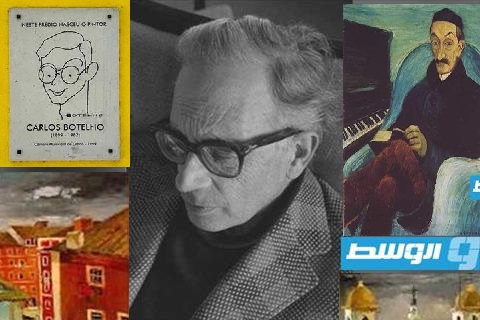
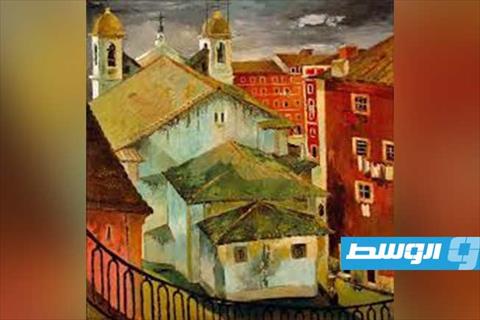
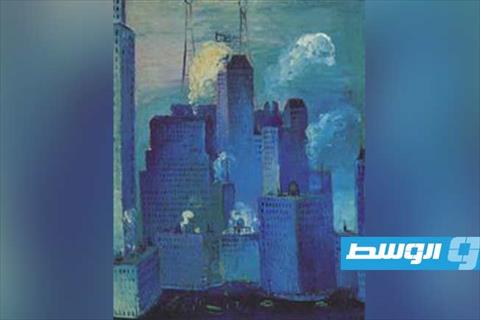
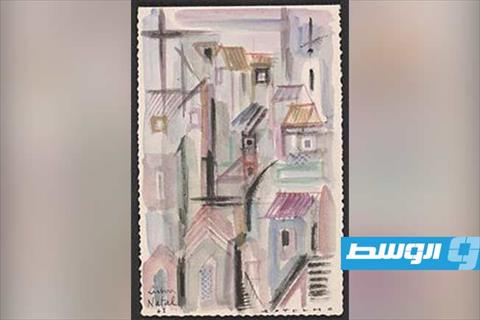
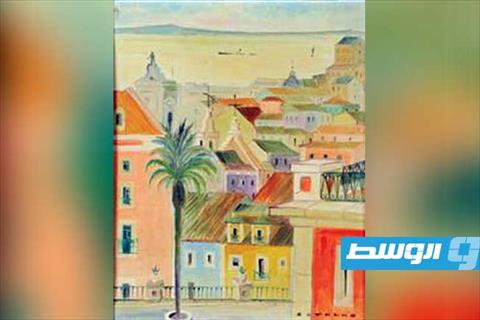
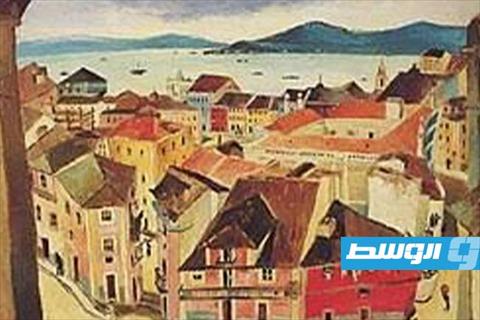
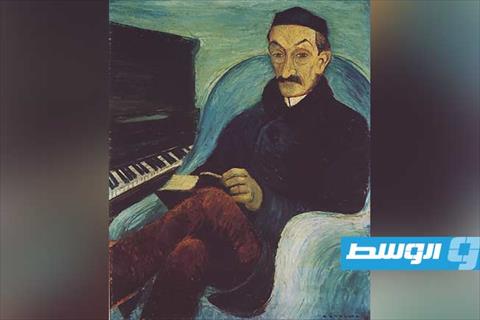
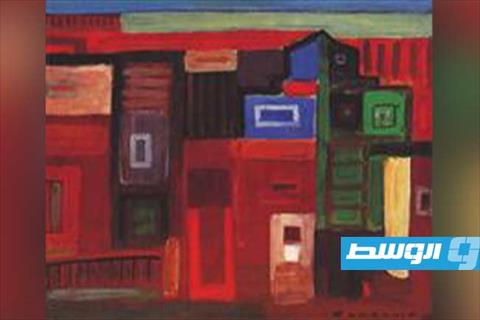
The Portuguese artist Carlos Botelho, born in Lisbon on 18/9/1899 and died there on 18/8/1982, was a self-taught artist. He was the only child of musician parents, which is why music dominated his childhood. However, he became a painter, set designer, and author of humorous comic stories. He also drew political cartoons and, moreover, was a satirical writer! He is considered one of the most important references in his field in Portugal. He worked in his studio in Costa do Castelo, and his works are exhibited in public museums, most notably the Chiado Museum, the Modern Art Center (José de Azeredo Perdigão), and the Calouste Gulbenkian Foundation in Lisbon. He was known for focusing on drawing original scenes and paintings of the city of Lisbon in his aforementioned studio, and his works are often considered expressionist.
He emerged as a self-taught artist around 1922.
It is said that his career began after he attended secondary school at the Pedro Nunes School in Lisbon, where he held his first solo exhibitions. He then enrolled at the Lisbon School of Fine Arts but left after completing traditional training. He emerged as a self-taught artist, married in 1922, and had two children. Between 1926 and 1929, he regularly drew comic strips for a weekly children’s magazine, consistently producing the first and last two colored pages of each issue.
His comic strips served as a sharp platform for over 22 years.
Starting in 1929, he began producing two pages of comic strips for a weekly magazine, continuing for over 22 years as an influential and sharp critical platform on a wide range of issues, from the simple details of daily life in Lisbon to some of the most important events in international affairs. He continued his work with “a style blending historical narrative, autobiography, journalism, and satire,” producing sharp and satirical drawings of Mussolini and Hitler.
One of the leading designers tasked with designing Portuguese pavilions.
During the 1930s, he oversaw the Portuguese pavilion at the Paris Exhibition “1930-1931” and then at the Lyon International Exhibition in 1935. From 1937, he joined the design team of the National Propaganda Secretariat, tasked with designing the Portuguese pavilions at the Paris, New York, and San Francisco exhibitions: the International Exhibition of Art and Technology – Paris – 1937, the New York World’s Fair – 1939, and the Golden Gate International Exposition – San Francisco – California – 1939.
Lisbon
Lisbon is the capital and largest city of Portugal, with a history dating back over 3,000 years to Phoenician settlers. It became a major hub during the Age of Discovery in the 15th and 16th centuries, though much of its historic architecture was rebuilt following a devastating earthquake in 1755. Today, it is known for its iconic yellow trams, historic neighborhoods like Alfama, and monuments such as the Belém Tower.
Costa do Castelo
Costa do Castelo is a historic hillside neighborhood in Lisbon, Portugal, wrapping around the slopes of São Jorge Castle. Its history is deeply tied to the Moorish and medieval fortifications above, with its narrow streets and traditional houses developing over centuries as a residential area for artisans and workers. Today, it offers panoramic views of the city and retains a characteristic old Lisbon atmosphere.
Chiado Museum
The Chiado Museum, located in Lisbon, Portugal, is the country’s national museum of contemporary art. It was established in 1911 and is housed in the former Convent of São Francisco, which was significantly rebuilt after a devastating fire in the Chiado district in 1988. The museum’s collection primarily focuses on Portuguese art from the 1850s to the 1950s.
Modern Art Center
The Modern Art Center (Centro de Arte Moderna) is a prominent museum in Lisbon, Portugal, founded in 1983. It is part of the Calouste Gulbenkian Foundation and houses a significant collection of Portuguese modern and contemporary art from the early 20th century to the present day.
José de Azeredo Perdigão
José de Azeredo Perdigão was a prominent Portuguese lawyer and the first president of the Calouste Gulbenkian Foundation, serving from 1956 to 1993. He played a pivotal role in establishing and shaping the Foundation, one of the world’s largest private foundations, which is dedicated to the arts, charity, education, and science. His leadership was instrumental in creating its renowned museum and cultural programs in Lisbon.
Calouste Gulbenkian Foundation
The Calouste Gulbenkian Foundation is a major Portuguese cultural institution established in 1956 according to the will of the Armenian oil magnate and philanthropist Calouste Sarkis Gulbenkian. It is headquartered in Lisbon and promotes activities across the arts, education, science, and charity, primarily through its museum, orchestra, and extensive grant programs.
Pedro Nunes School
The Pedro Nunes School is a prestigious public secondary school in Coimbra, Portugal, founded in 1911. It is named after the renowned 16th-century Portuguese mathematician and cosmographer, Pedro Nunes, reflecting its strong academic tradition in sciences and humanities.
Lisbon School of Fine Arts
The Lisbon School of Fine Arts, originally established as the *Aula Pública de Desenho* in 1836, is a historic Portuguese institution dedicated to artistic education. It was later integrated into the University of Lisbon and is now known as the Faculty of Fine Arts, having played a central role in shaping Portugal’s modern art movements throughout the 19th and 20th centuries.
Paris
Paris is the capital of France, historically founded as the Roman town of Lutetia in the 3rd century BC. It is globally renowned as a center for art, fashion, and culture, home to iconic landmarks like the Eiffel Tower, the Louvre Museum, and Notre-Dame Cathedral.
Lyon
Lyon is a historic city in east-central France, founded as a Roman colony in 43 BC. It is renowned for its well-preserved Renaissance architecture in the Vieux Lyon district and its significant role in the European silk trade during the 15th to 17th centuries.
New York
New York City, originally founded as New Amsterdam by Dutch colonists in 1624, became a major British colonial port before emerging as a global economic and cultural capital following American independence. It is renowned for iconic landmarks like the Statue of Liberty, Central Park, and its towering skyline anchored by the Empire State Building. The city’s diverse neighborhoods and institutions, such as Broadway and numerous museums, reflect its long history as a gateway for immigration and a center of innovation.
San Francisco
San Francisco is a major coastal city in California, founded in 1776 as a Spanish mission and presidio. It grew rapidly during the 1849 Gold Rush and is known for landmarks like the Golden Gate Bridge, its historic cable cars, and its role as a center for counterculture movements.
California
California is a state on the west coast of the United States, originally inhabited by numerous Native American tribes before becoming a Spanish colony and later part of Mexico. It was annexed by the U.S. in 1848 after the Mexican-American War, with the subsequent Gold Rush rapidly accelerating its population growth and economic development. Today, it is known globally for its diverse culture, technological innovation centered in Silicon Valley, and major entertainment industry in Hollywood.
Paris Exhibition
The Paris Exhibition, also known as the Exposition Universelle, was a recurring world’s fair held in Paris, France, most famously in 1889 and 1900. The 1889 edition, for which the Eiffel Tower was built as its entrance arch, celebrated the centennial of the French Revolution and showcased industrial and technological progress. These grand events were designed to display French cultural and imperial prestige on the global stage.
Lyon International Exhibition
The Lyon International Exhibition was a major world’s fair held in 1872 in Lyon, France, designed to showcase the city’s industrial and economic prowess, particularly in the silk industry. It was part of a series of 19th-century exhibitions that highlighted technological progress and international trade.
International Exhibition of Art and Technology
The International Exhibition of Art and Technology in Modern Life was the official name of the 1937 World’s Fair held in Paris. It is historically notable for the iconic, opposing pavilions of Nazi Germany and the Soviet Union facing each other near the Eiffel Tower, reflecting the political tensions of the pre-war era. The fair’s theme celebrated the union of art and technological innovation, though it is often remembered for its stark political symbolism.
New York World’s Fair
The New York World’s Fair was a major international exhibition held in Flushing Meadows–Corona Park, Queens, in 1939–40 and again in 1964–65. The 1939 fair, themed “The World of Tomorrow,” showcased technological optimism on the eve of World War II, while the 1964 fair famously introduced visions of a futuristic 21st century. Both events left a lasting architectural and cultural legacy on New York City.
Golden Gate International Exposition
The Golden Gate International Exposition was a world’s fair held in 1939 and 1940 on Treasure Island in San Francisco Bay. It was built to celebrate the city’s newly constructed bridges and promote Pacific unity, featuring grand art, architecture, and technological displays. The site was later converted into a U.S. naval station during World War II.