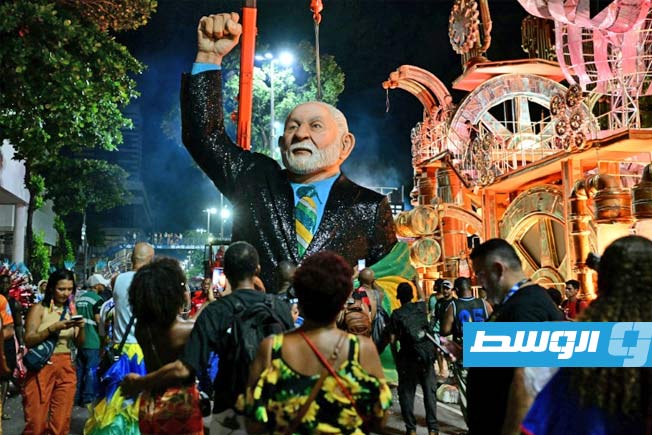
A dance parade honoring leftist Brazilian President Luiz Inácio Lula da Silva during the Rio de Janeiro Carnival sparked widespread controversy and lowered the ranking of the prestigious samba school responsible for the performance in the heated competition.
The “Acadêmicos de Niterói” school, competing alongside 11 other samba schools, intended to dedicate its dance performance to the Brazilian President.
However, this choice ignited fierce debate even before the performance on Sunday night into Monday, with right-wing groups denouncing it as a disguised campaign for the 80-year-old president, who returned to power in 2023 and intends to run in the upcoming elections.
The performance also did not please the judging panel, whose decisions are based on technical and aesthetic criteria. Consequently, on Wednesday, they gave the Niterói school its worst score, causing its ranking to fall.
First tribute to a sitting president during Carnival events
Lula attended the performance from the Sambadrome box, in what was considered the first tribute to a sitting president during Carnival festivities. The performance retraced Lula’s career, mocked his rival Jair Bolsonaro—who is serving a prison sentence—by depicting him as a clown in jail, and also criticized traditional family values.
– Carnival parades in Germany mock Putin, Trump, and Merz
– São Paulo Carnival rivals Rio de Janeiro Carnival in joy and dance
Last week, the Supreme Electoral Court rejected petitions from two opposition parties to cancel the performance, though the judges indicated they might review the case at a later time.
Brazilian President
The Brazilian President is the head of state and government of Brazil, leading the executive branch of the federal government. The position was established with the country’s independence in 1822, evolving from a constitutional monarchy to the current presidential republic defined by the 1988 Constitution.
Luiz Inácio Lula da Silva
Luiz Inácio Lula da Silva is not a place or cultural site, but a prominent Brazilian political figure. He served as the 35th and 39th President of Brazil, first from 2003 to 2010, and again beginning in 2023, rising from a trade union leader to found the Workers’ Party. His presidency is historically noted for significant social programs that reduced poverty in Brazil.
Rio de Janeiro
Rio de Janeiro is a major coastal city in Brazil, famously founded by Portuguese explorers in 1565. It served as the capital of Brazil for nearly two centuries, from 1763 to 1960, and is globally renowned for its iconic landmarks like Christ the Redeemer, the annual Carnival festival, and its dramatic natural setting between mountains and the sea.
Carnival
Carnival is a festive season celebrated in many countries, most famously in Brazil and Venice, with roots in pre-Christian pagan traditions and later adapted into a period of feasting before the Christian observance of Lent. It is characterized by vibrant parades, elaborate costumes, music, and dancing. The modern celebrations, particularly in places like Rio de Janeiro, evolved significantly in the 20th century, incorporating samba schools and large-scale competitive performances.
Acadêmicos de Niterói
Acadêmicos de Niterói is a prominent samba school from the city of Niterói, Brazil, known for its vibrant participation in the Rio de Janeiro Carnival parade. Founded on March 31, 1974, it was established by members of the local community with the goal of creating a competitive and culturally significant carnival bloc.
Niterói
Niterói is a city in southeastern Brazil, located across Guanabara Bay from Rio de Janeiro. It is historically known as a stronghold of the Portuguese court during the colonial period and is famous for its striking modern architecture, most notably the Niterói Contemporary Art Museum designed by Oscar Niemeyer.
Sambadrome
The Sambadrome is a purpose-built parade stadium in Rio de Janeiro, Brazil, designed by architect Oscar Niemeyer and inaugurated in 1984. It is the permanent home for the city’s famous Carnival parades, where samba schools compete in elaborate processions along its 700-meter-long runway.
Jair Bolsonaro
Jair Bolsonaro is a former Brazilian army captain who served as the 38th President of Brazil from 2019 to 2023. His political career, which began in the 1980s, has been defined by his conservative, right-wing populist platform and his tenure was marked by significant political polarization, particularly regarding environmental policies in the Amazon and his administration’s handling of the COVID-19 pandemic.
Germany
Germany is a country in Central Europe with a complex history, having been a collection of states for centuries before unifying in 1871. It was a central power in both World Wars, and its post-World War II division into East and West Germany symbolized the Cold War, before reunifying in 1990. Today, it is a leading economic and political force in the European Union, known for its rich cultural heritage in philosophy, music, and science.
Putin
Vladimir Putin is a Russian politician who has served as president or prime minister of Russia since 1999, establishing a system of centralized political control. His tenure has been marked by the consolidation of power, economic changes, and a significant increase in Russia’s assertiveness on the global stage.
Trump
Donald Trump is a former U.S. president and businessman who served as the 45th president from 2017 to 2021. His presidency was marked by significant tax reforms, a focus on immigration restrictions, and a distinctive, often controversial, communication style. Prior to politics, he was a prominent real estate developer and television personality.
Merkel
Angela Merkel is not a place or cultural site, but a person—specifically, the former Chancellor of Germany who served from 2005 to 2021. Her political career is historically significant as she was the first woman to hold the office and a central figure in European politics during crises such as the Eurozone debt crisis and the 2015 refugee influx.
São Paulo
São Paulo is Brazil’s largest city and a major economic hub, founded in 1554 by Jesuit missionaries as a small mission village. Its history is marked by waves of immigration and rapid industrialization, transforming it from a colonial outpost into a sprawling, diverse metropolis known for its cultural institutions, vibrant arts scene, and significant financial influence.
Supreme Electoral Court
The Supreme Electoral Court is the highest electoral authority in Costa Rica, established in 1949 following the country’s civil war to guarantee impartial and transparent elections. It is a constitutionally independent branch of government responsible for organizing all national elections and ensuring the integrity of the democratic process.